On this page
If you have ever reached into a mango or guava tree and pulled your hand back burning, you have probably met the red weaver ant. The pain feels far too big for such a small insect. The reason is a piece of Class 10 chemistry: the ant adds an acid to the wound.
Why do red ant bites sting so much?
The red ant you meet in Indian fruit trees is usually the weaver ant, *Oecophylla smaragdina*. A Pacific Pests, Pathogens and Weeds fact sheet says that Oecophylla ants do not sting, but can bite, and often spray formic acid on the wound. So you get two injuries at once: jaws break the skin, and then acid reaches the cut.
The same ant is also food: red weaver ants go into Odisha's Similipal kai chutney, which received a geographical indication tag on 2 January 2024.
Weaver ants belong to the subfamily Formicinae. A 2025 review of their venoms, summarised by Myrmecological News, says these ants rely on a nozzle called an acidopore instead of stinging, and that formic acid can make up half or more of the venom's volume.
What is formic acid, and how strong is it?
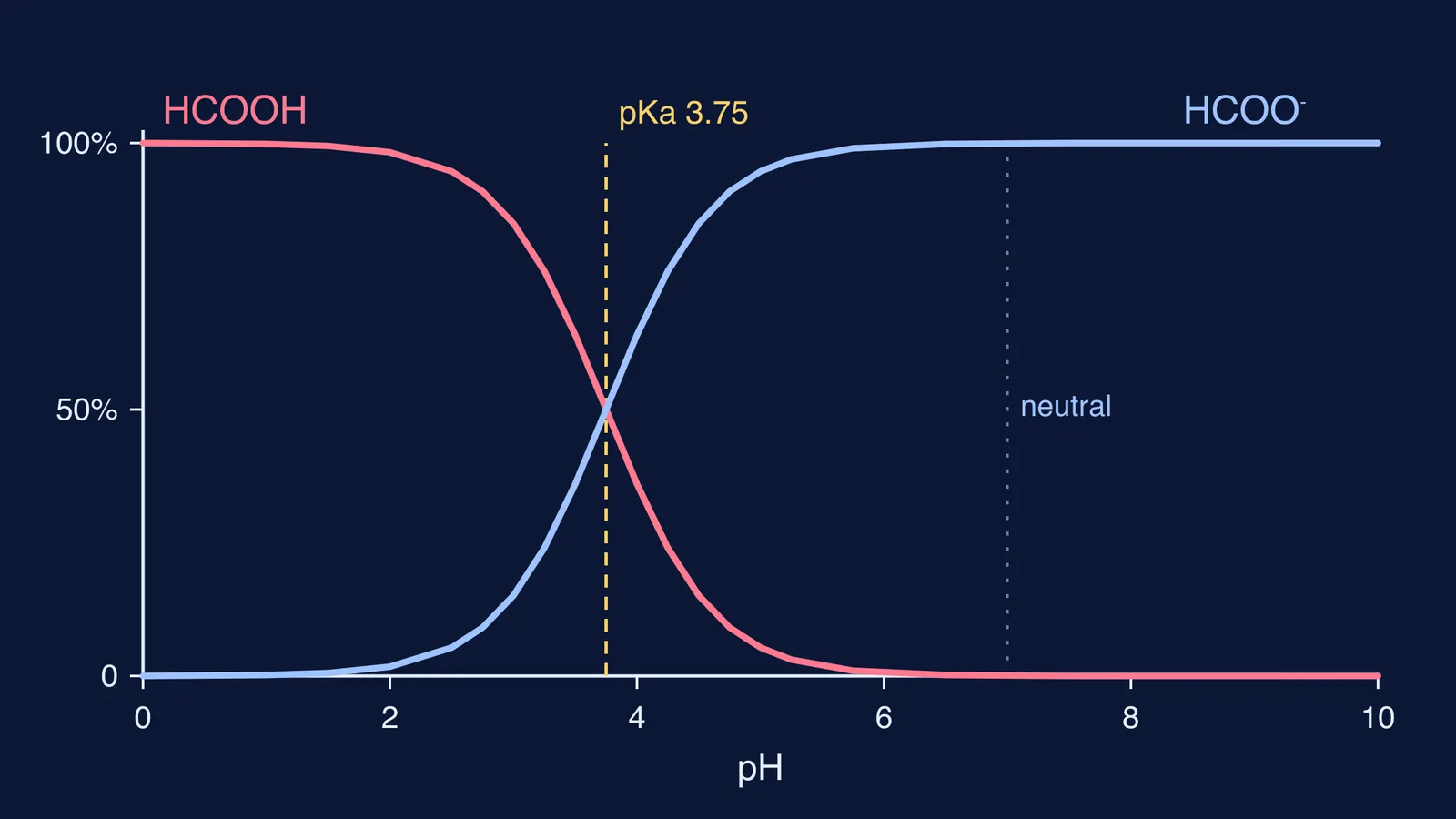
Formic acid, HCOOH, is the simplest carboxylic acid. It is a weak acid with a pKa of 3.75 at 25 °C, according to PubChem, so it only partly gives up its H+ ions in water. Our post on why formic acid is stronger than acetic and benzoic acid explains where it sits.
A weak acid can still hurt when there is a lot of it. In a 2023 study of another formicine ant, *Camponotus japonicus*, formic acid made up more than 90% of the identified venom gland compounds. That is a lot of acid to put into broken skin.
A 2018 paper on tropical fire ant venom notes that fire ant venom is 90 to 95% basic piperidine alkaloids, which cause a pustule and a burning feeling.
Does baking soda help an ant bite?
On paper, yes. Baking soda is sodium hydrogencarbonate, a mild base, and it neutralises formic acid:
HCOOH + NaHCO3 → HCOONa + H2O + CO2
The products are a salt (sodium formate), water and carbon dioxide gas. It is the same reaction family as the fizz in our post on how an antacid tablet neutralises stomach acid.
Your skin is not a test tube, though: by the time it hurts, the acid is already in the wound. The NHS is clear on insect bites and stings: do not use home remedies such as bicarbonate of soda. So treat the baking-soda answer as a chemistry question, not first aid.
Worked example: how much base for how much acid?
PubChem gives the molar masses as 46.025 g/mol for formic acid and 84.007 g/mol for sodium bicarbonate.
Write the balanced equation. The ratio of HCOOH to NaHCO3 is 1 : 1.
Take 0.46 g of formic acid. Moles = 0.46 / 46.025 ≈ 0.0100 mol.
You need the same number of moles of base: 0.0100 mol of NaHCO3.
Mass of base = 0.0100 × 84.007 ≈ 0.84 g.
Check the gas: one mole of CO2 forms for each mole of acid, so you also get 0.0100 mol of CO2.
The pattern to remember: balance first, convert grams to moles, use the ratio, convert back to grams.
What should you do after a red ant bite?
The NHS insect bites guidance says most bites are not serious and get better in a few days. Its simple steps:
Wash the area with soap and water.
Hold an ice pack wrapped in a cloth on the bite for at least 20 minutes.
Do not scratch, as this raises the risk of infection.
See a pharmacist if the area shows signs of infection, such as pus, redness, warmth or swelling.
Get urgent medical advice if symptoms get worse or are not getting better.
In India, call 112, the single national emergency number being set up across the country, or 108 for ambulance services.
How do you use this in your chemistry exam?
The ant bite is a stock example in the Class 10 acids chapter, and our Class 10 acids, bases and salts guide covers the rest. Answer in three steps: name the acid (formic acid), name the base (sodium hydrogencarbonate), and write the balanced equation with its products.
Weak acids and pKa make more sense when you can watch them change. The Fermi Simulation Lab has interactive simulations for ideas that are easier to see than to read, and the Fermi Concept Library gives each chemistry concept its own lesson.
Next time a weaver ant gets you, wash the bite, cool it, and think about the equation.