

On this page
If a question asks who coined the term tissue in biology, the answer is the French anatomist Xavier Bichat. The English word comes from the French tissu, meaning "fabric", from tisser, "to weave" (Tissue (biology), Wikipedia)). Bichat brought the word into anatomy by 1801. He was the first to propose that tissue is a central element of human anatomy, and that organs are collections of tissues rather than separate, independent things.
The surprising part is how he got there. He did it without a microscope.
Who was Xavier Bichat?
Bichat was born on 14 November 1771 in Thoirette, France, and died in Paris on 22 July 1802, aged 30 (Xavier Bichat, Wikipedia). In that short life he published *Traité des membranes* (1800) and the four-volume *Anatomie générale* (1801), the book in which his tissue doctrine is fully laid out.
He learned by cutting. A 2022 article in the Journal of Medical Biography says he performed as many as 600 autopsies in a single year, without using a microscope (Perdicoyianni-Paleologou, Journal of Medical Biography). The same article describes his view that organs are "formed through the specialization of simple, functional units (tissues)".
How did Bichat find tissues without a microscope?
He tested them. In the preface to *Anatomie générale*, Bichat writes that he put each simple tissue through drying, rotting, soaking, boiling, cooking, and the action of acids and alkalis (Anatomie générale, vol. 1, Internet Archive scan of the 1812 printing). The point, he explains, was not chemistry: he wanted to show that each tissue reacts in its own way, so his sorting rested on real differences in structure. In his words, the chemical tests were "a supplement to the insufficiency of the scalpel" (our translation of "un supplément à l'insuffisance du scalpel").
Why no microscope? His biography says the microscope of his day was not advanced enough for medical use, so he relied on what he could see, feel and handle (Xavier Bichat, Wikipedia).
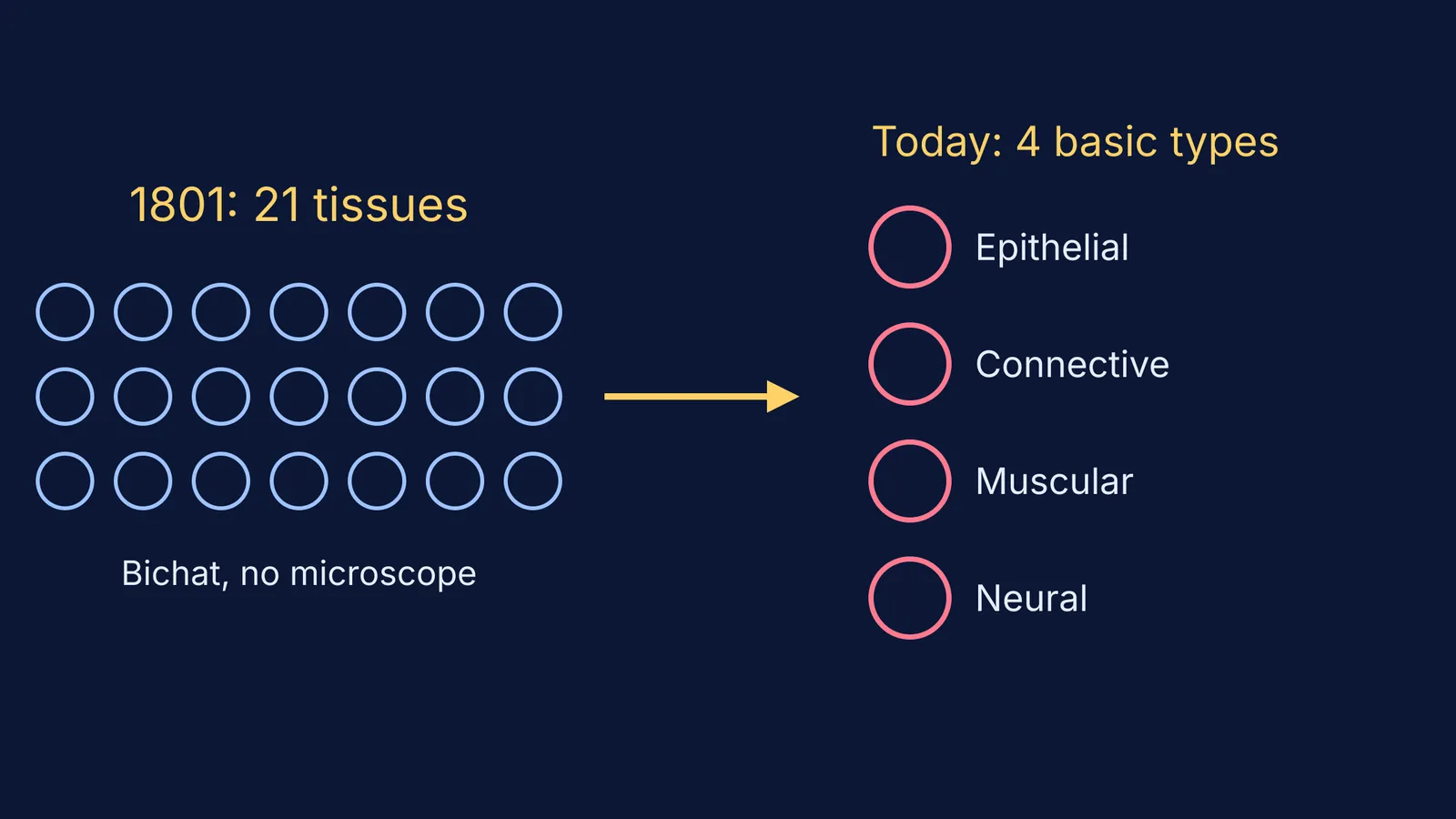
His key idea was an analogy with chemistry. In the same book he says chemistry has its simple bodies, such as hydrogen, oxygen and carbon, which combine to make compounds; in the same way, anatomy has its simple tissues, which combine "four by four, six by six, eight by eight" to form organs (Anatomie générale, vol. 1). He then lists exactly 21:
Cellular
Nervous, of animal life
Nervous, of organic life
Arterial
Venous
Exhalant
Absorbent, with their glands
Bone
Marrow (medullary)
Cartilage
Fibrous
Fibro-cartilage
Muscle, of animal life
Muscle, of organic life
Mucous
Serous
Synovial
Glandular
Dermal (skin)
Epidermal
Hair
How did histology grow from Bichat's work?
The name for the new subject came 18 years after *Anatomie générale*. The German anatomist Karl Mayer coined the term Histologie in 1819, in a work titled *Ueber Histologie und eine neue Eintheilung der Gewebe des menschlichen Körpers* (August Franz Josef Karl Mayer, Wikipedia). Histology joins the Greek-derived histo-, "tissue", with -logy, "study of" (Histology, Wikipedia).
After that, tissues moved under the microscope, and the work of Theodor Schwann and the cell theory showed that tissues themselves are built from cells.
Today your textbook defines tissue as a group of similar cells, along with intercellular substances, that perform a specific function (NCERT Class 11 Biology, Chapter 7). The same chapter says all complex animals consist of only four basic types of tissues, and that the heart contains all four: epithelial, connective, muscular and neural. If you want the four types in detail, our Class 9 guide to tissues walks through them.
What is the two-line answer for exams?
Multiple-choice questions like to swap names. Keep these apart:
Bichat: tissue, 21 tissues, no microscope, 1801.
Karl Mayer: the word histology, 1819 (Mayer, Wikipedia).
Robert Hooke: the word cell, in *Micrographia*, 1665 (Robert Hooke, Wikipedia); see our post on how Hooke first saw cells.
Marcello Malpighi: a 17th-century microscopist whom some call the founder of histology (Histology, Wikipedia). If a question says "father of histology", check whether its options include Bichat, Malpighi or both.
How can you make this stick in 10 minutes?
Cover this page and write the two-line answer from memory.
Say Bichat's chemistry analogy out loud: simple tissues combine to form organs, as simple substances combine to form compounds.
Name any five of his 21 tissues, then check the list.
Name the four modern animal tissue types and one organ that has all four (the heart, per NCERT).
Tomorrow, repeat step 1 without looking, then sort the five names (Bichat, Mayer, Hooke, Malpighi, Schwann) by what each one gave biology.
If the jump from cells to tissues to organs still feels blurry, the Fermi Concept Library has a lesson for every concept in biology, each with its place in the map. Fermi's AI tutor can also check your understanding as it goes, so step 5 does not rest on memory alone.
Write the two lines once now, and save yourself relearning them before the exam.


