On this page
The word "cell" in your biology textbook comes from a 1665 book about what things look like under a microscope. Robert Hooke used it to describe the tiny boxes he saw in cork. He did not know he was looking at the basic unit of life, and what he saw was not alive. This post covers what Hooke actually did, what the word meant to him, and a worked example using his own measurements.
Who was Robert Hooke?
The University of California Museum of Paleontology biography describes him as one of the most wide-ranging experimental scientists of the seventeenth century. Born on 18 July 1635 at Freshwater on the Isle of Wight, he went to Westminster School and then Oxford, where he became assistant to the chemist Robert Boyle. In 1662 he was named Curator of Experiments of the new Royal Society of London, responsible for demonstrating experiments at its weekly meetings.
His interests ran from clocks and gases to fossils and architecture. Physics students know him for Hooke's law of elasticity, which our guide to elasticity and Young's modulus works through. He died in London in 1703.
What was Micrographia?
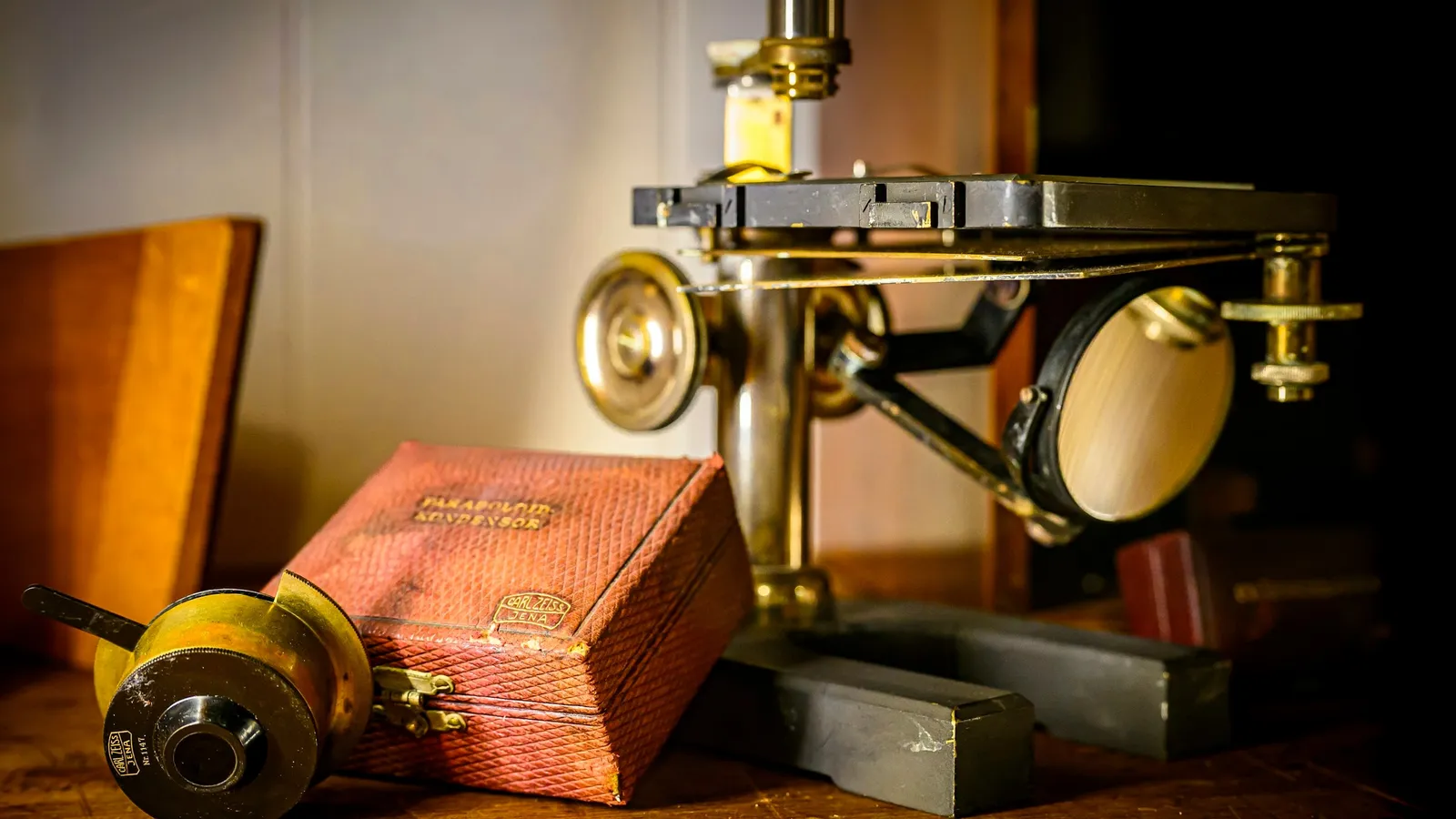
Micrographia, published in 1665 and printed for the Royal Society, was a record of what Hooke saw through his compound microscope, with large engraved drawings. It opens with the point of a needle and the edge of a razor, and the UCMP biography notes it also showed insects such as a flea, and bird feathers. The same biography says it was a very popular book in its day.
What did Hooke actually see in cork?
Observation XVIII is titled "Of the Schematisme or Texture of Cork, and of the Cells and Pores of some other such frothy Bodies". Hooke describes his method in detail. He cut cork with a penknife "sharpen'd as keen as a Razor", sliced off "an exceeding thin piece", placed it on a black plate because cork is white, and lit it with a lens. Then he could see it was "all perforated and porous, much like a Honey-comb".
The sentence that gives us the word follows soon after: "these pores, or cells, were not very deep, but consisted of a great many little Boxes". He added that they were "indeed the first microscopical pores I ever saw, and perhaps, that were ever seen".
He used the structure to explain cork's everyday properties: it is light because it is mostly air, and it floats and seals bottles because the air is trapped in closed boxes.
Worked example: Hooke's own cell count
Hooke did not just look; he counted. He wrote that there were "usually about threescore of these small Cells placed end-ways in the eighteenth part of an Inch in length". Redo his arithmetic:
Cells per inch: 60 × 18 = 1,080. Hooke: "neer eleven hundred".
Cells in a square inch: 1,080² = 1,166,400. Hooke wrote exactly 1166400.
Cells in a cubic inch: 1,080³ = 1,259,712,000. Hooke wrote 1259712000, "above twelve hundred Millions".
Size of one cell: 1 inch = 25.4 mm, so 25.4 mm / 1,080 ≈ 0.0235 mm, or about 24 µm across.
Common mistakes in this kind of scaling:
Multiplying by 18 once for area or volume. Length scales once, area with the square and volume with the cube.
Mixing units. Convert to micrometres at the end: 1 mm = 1,000 µm.
Confusing magnification with size. The cell's real size does not change with the lens; only its image does.
Did Hooke discover the cell?
Partly. The UCMP biography notes that what Hooke saw were the cell walls in cork tissue. NCERT Class 11 Biology credits Antonie van Leeuwenhoek as the first to see and describe a live cell, and dates the cell theory much later: Schleiden and Schwann formulated it, and in 1855 Rudolf Virchow explained that new cells form from pre-existing cells. NCERT also lists "Robert Brown discovered the cell" as an incorrect statement in its exercises, a common trap.
Hooke's influence ran through Leeuwenhoek too. In a 2015 review in Philosophical Transactions B, Nick Lane argues that Micrographia most likely inspired Leeuwenhoek to start his own microscopy, and that in 1677 it was Hooke who reproduced Leeuwenhoek's sightings of microbes for the Royal Society. Read more in our post on Antonie van Leeuwenhoek.
What can a student take from Hooke's way of working?
Describe your method so others can repeat it. His knife, slice, black plate and lighting are all written down.
Measure, then calculate. A count over one-eighteenth of an inch became an estimate for a cubic inch.
Explain everyday facts with what you see. He used cork's structure to explain why it floats and seals.
If cell structure is a chapter you keep revising without it sticking, the Fermi Concept Library covers every concept in physics, chemistry, biology, mathematics and computing, each with its own lesson. Our guide to the cell cycle, mitosis and meiosis is a good next chapter.
Try this now: if a plant cell is 40 µm across, how many would fit end to end along 1 cm? Then check your answer by working back to the cell size.