

On this page
A whirly tube is a ribbed plastic pipe, open at both ends, sold as a toy. Hold one end and swing it round your head and it sings a clear note. Swing it faster and the note does not slide upwards like a siren. It jumps to a new, higher note, and then to another. Those notes are the harmonics of an open pipe, and the jumps happen because the air flowing through the tube taps the ribs at a rate that must match one of them. This post works through the physics with numbers measured by the physicist Frank Crawford, who studied the toy in the 1970s.
Why does a whirly tube only make certain notes?
The tube is an open pipe, so it can hold standing waves only at its natural frequencies:
fₙ = n × v ÷ 2L, with n = 1, 2, 3, …
Because both ends are open, every whole-number harmonic is allowed, not only the odd ones you get in a pipe closed at one end. If you want a refresher on why, see open and closed organ pipe harmonics.
The tube does not choose a frequency on its own. Something has to drive it. The driver is air flowing through the tube past the ribs. Crawford's picture was simple: air moving at speed u along a tube with ribs a distance d apart "bumps" into the ribs at a rate
f = u ÷ d
When that bump frequency is close to one of the tube's harmonics, the tube resonates and sings that harmonic. Because the harmonics are spaced out, the note jumps from one to the next as the flow speeds up. In his paper, Crawford reports that the tube is always singing some harmonic once the flow is fast enough, and that each note sings over a range of flow speeds (Crawford, "Singing corrugated pipes", American Journal of Physics 42, 278, 1974; Berkeley Lab preprint).
Why does air flow through a whirled tube at all?
Crawford checked first that flow is essential. With one end closed, a whirled tube does not sing. Held at its centre and whirled, so there is no net flow, it does not sing either.
The whirled tube is a centrifugal pump. Air near the outer end is moving in a circle and needs a centripetal force, which comes from a pressure that rises outwards along the tube. That is the same physics that curves the surface of water in a spinning bucket, worked out in the shape of a liquid surface in a rotating container. Adding up dp = ρω²r dr from the hand to the tip gives a pressure difference:
Δp = ½ρω²L²
If there were no friction, that pressure would fling the air out of the far end at a speed equal to the tip speed, u = ωL, and draw fresh air in at your hand. Crawford found the same result by treating the air as frictionless marbles sliding along the tube. Either way, u is proportional to ω, so the bump frequency u/d is proportional to how fast you whirl. That predicts what he measured: the harmonic number rises in step with the whirling rate.
Worked example: Crawford's tube
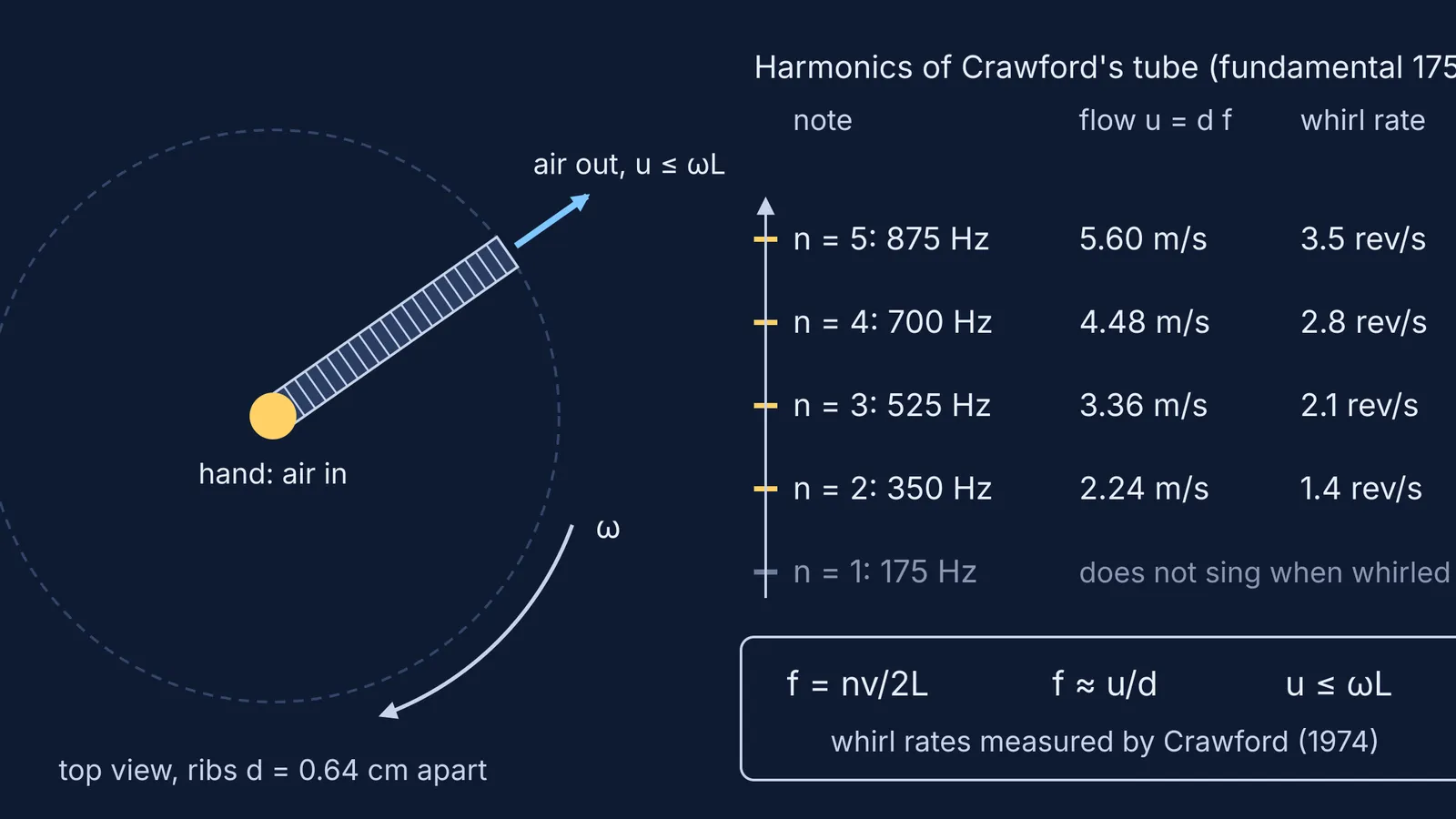
Crawford's tube was about 3 ft (0.914 m) long and 1 inch across, with ribs 0.64 cm apart. He measured its fundamental as about 175 Hz.
Smooth-pipe estimate. v ÷ 2L = 343 ÷ (2 × 0.914) = 188 Hz at 20 °C. The measured 175 Hz is about 7% lower. End corrections lower it a little, and Crawford notes the ribs lower it further, roughly as if sound travelled more slowly in the ribbed tube.
The harmonics. fₙ = n × 175 Hz: 350, 525, 700 and 875 Hz for n = 2 to 5.
Flow speed needed. u = d × f. For n = 2, u = 0.0064 × 350 = 2.24 m/s. For n = 5, u = 0.0064 × 875 = 5.6 m/s. Crawford measured the flow through the tube directly and confirmed u = d f to within about 10%.
Frictionless whirling rate. If u = ωL, then for n = 5, ω = 5.6 ÷ 0.914 = 6.1 rad/s, or 0.97 revolutions per second.
What he actually needed. To hold each note, Crawford counted whirls against his watch and needed about 0.7n revolutions per second: 1.4 rev/s for n = 2 and 3.5 rev/s for n = 5. That is about 3.6 times the frictionless rate.
So friction in the ribbed tube cuts the flow to roughly 28% of the frictionless value. The ratio is the same for every harmonic, which is why the simple "harmonic number proportional to whirl rate" rule still holds. Crawford also noticed that friction was obvious if you breathe in and out through a full-length tube.
Units check for step 4: (m/s) ÷ m = s⁻¹, an angular speed, as it should be.
Is the "bump frequency" the whole story?
Crawford's rule u = d f is a good first estimate, and it fits his measurements, but it is not the full mechanism. Later research treats each gap between ribs as a small cavity. The air flowing across a cavity forms a shear layer that rolls up into vortices, and the sound field in the pipe times that roll-up. This is the same family of effects as the vortex shedding behind a cylinder that makes wires hum, covered in what a Kármán vortex street is.
In that picture the flow speed needed for a note is set by a Strouhal number based on the cavity width and the shape of the rib edge. Experiments on corrugated pipes show that number does not depend on the pipe length but does change with the ratio of pipe diameter to cavity width (Nakiboğlu, Belfroid, Golliard and Hirschberg, Journal of Fluid Mechanics, 2011). For a Class 11 estimate, u ≈ d f gives the right size; just do not treat the constant as exactly 1.
To see how harmonics and standing waves in pipes change with length, the Simulation Lab has interactive simulations for ideas that are easier to see than read. For practice numericals on pipes and harmonics, try the Fermi Problem Library, a step-by-step solver that explains the reasoning.
A safety note if you try this: swing the tube well clear of other people and anything breakable.
Quick checklist
A whirly tube is an open pipe: fₙ = nv/2L, all harmonics allowed.
Whirling pumps air through it; frictionless flow would leave at u = ωL.
Ribs spaced d apart are tapped at about f = u/d; the tube sings the harmonic that matches.
Faster whirling means faster flow, so the note jumps up the harmonic ladder.
The fundamental does not sing when whirled; the lowest note is usually n = 2.
Friction cuts the real flow well below ωL, to about 28% in Crawford's tube.


