

On this page
If you are revising digestion for a Class 11 test or a NEET-UG-style MCQ, the textbook answer is short. The harder part is explaining why, and keeping the stomach and both intestines apart when options mix them up.
Which substances does the stomach absorb?
The NCERT Class 11 Biology chapter "Digestion and Absorption" sums up absorption in Table 16.1. For the stomach it says: "Absorption of water, simple sugars, and alcohol etc. takes place." NCERT Class 11 Biology, Chapter 16, 2020-21 edition (archived)
The NCERT Exemplar for this chapter asks exactly this as a one-line question.
What about medicines? Table 16.1 lists drugs under the mouth and large intestine, not the stomach. But the same chapter's summary says: "Absorption of simple sugars, alcohol and medicines also takes place in the stomach." The MSD Manual on drug absorption says weakly acidic drugs such as aspirin are, in theory, more readily absorbed from the acid of the stomach, but most drugs are absorbed mainly in the small intestine, which has a larger surface area and more permeable membranes. So if an option adds medicines to the stomach, it is not wrong by NCERT.
A note on editions: in the current rationalised NCERT Class 11 Biology reprint, Chapter 16 is about excretion, while the Exemplar chapter is still online. Check your exam's current official syllabus.
Why are proteins and fats not absorbed in the stomach?
The simple answer: the stomach never finishes breaking them down. The same NCERT chapter shows what happens at each step.
Proteins. The stomach holds food for 4 to 5 hours. Hydrochloric acid gives a pH of 1.8, which suits pepsin. But pepsin only converts proteins into proteoses and peptones, which are still chains. Amino acids, the form your body can absorb, appear only when enzymes in the small intestine's juice (succus entericus) act on dipeptides.
Fats. Gastric glands secrete only small amounts of lipase. Most fat digestion happens in the small intestine, where bile emulsifies fat into very small micelles and lipases split it, step by step, into fatty acids and glycerol. These are insoluble, so they cannot pass straight into blood. They move into the intestinal lining inside micelles, are re-formed into protein-coated droplets called chylomicrons, and enter the lymph vessels (lacteals) of the villi. The full route is in our post on how fats are absorbed through chylomicrons and lacteals.
Surface. The inner lining of the stomach forms irregular folds called rugae. The small intestine instead has finger-like villi, and the cells covering each villus carry microvilli, which NCERT says "increase the surface area enormously". See how villi increase absorption in the small intestine for the structure.
Where is each substance absorbed along the gut?
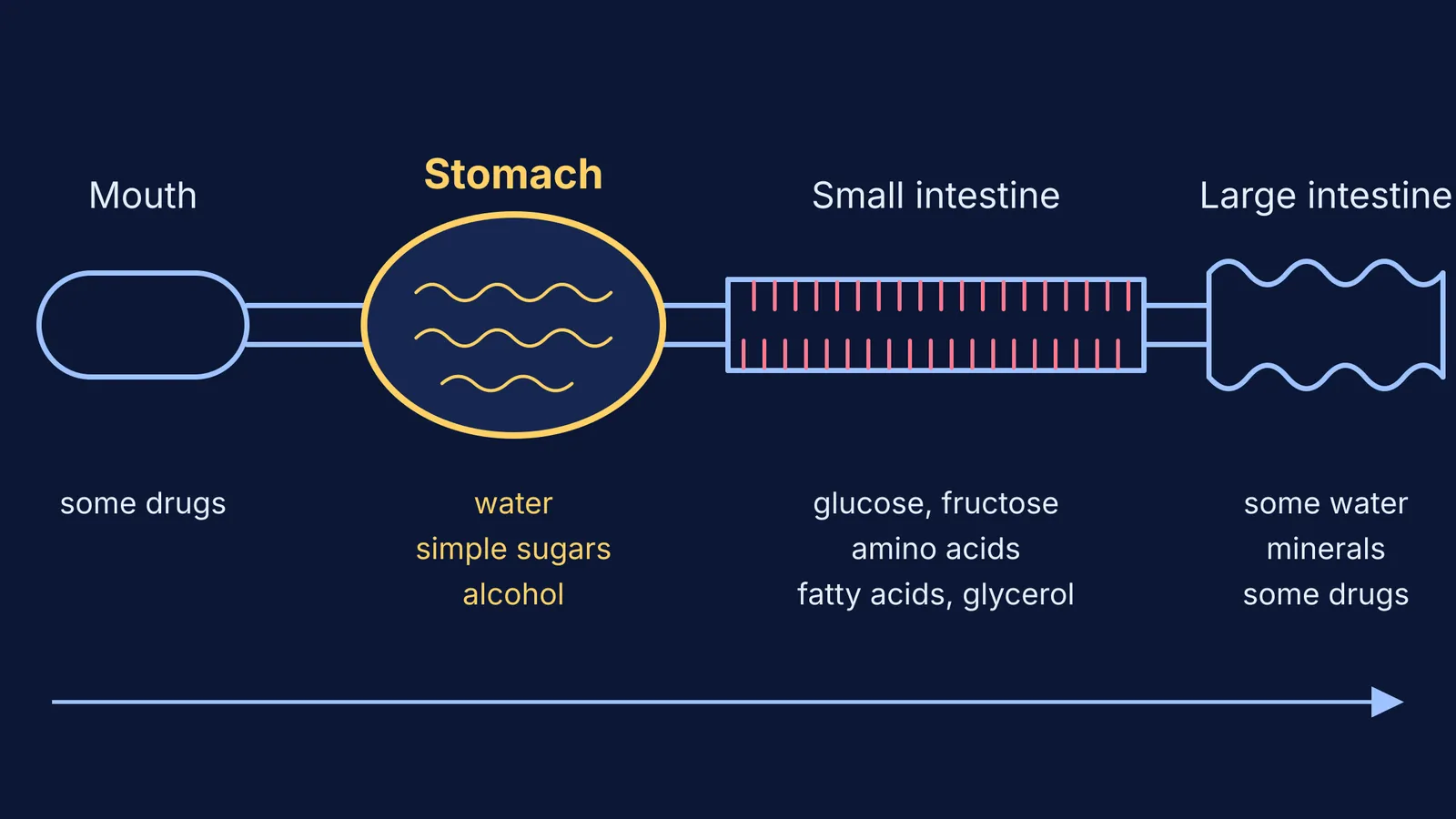
Here is Table 16.1 from the NCERT chapter, site by site:
Mouth: certain drugs that touch the lining of the mouth and the underside of the tongue pass into the blood capillaries there.
Stomach: water, simple sugars and alcohol.
Small intestine: the principal organ for absorbing nutrients. Glucose, fructose, fatty acids, glycerol and amino acids cross the lining into blood and lymph. Breakdown happens in the duodenum, and absorption in the jejunum and ileum.
Large intestine: some water, minerals and certain drugs. No significant digestion happens here. Our post on water absorption in the large intestine explains this step.
The chapter also names the methods: simple diffusion for small amounts of glucose, amino acids and chloride ions; carrier proteins (facilitated transport) for glucose and amino acids; energy-using active transport for amino acids, glucose and sodium ions; and the osmotic gradient for water.
How do you answer an exam question on stomach absorption?
Use three checks, in order:
Is the substance already small enough to absorb, like water, a simple sugar or alcohol? Then the stomach can take some of it.
Does it still need bile or a small-intestine enzyme? Then it is absorbed in the small intestine.
Is it water or minerals left over after digestion? Then think large intestine.
Worked example 1. Which pair is absorbed in the stomach? (a) glucose and amino acids (b) water and alcohol (c) fatty acids and glycerol (d) water and minerals. Check 1 picks (b). Option (d) is the trap: per Table 16.1, the large intestine absorbs water and some minerals.
Worked example 2. Assertion: amino acids are absorbed in the stomach. Reason: pepsin digests proteins in the stomach. The reason is true, because pepsin does act there. The assertion is false, because pepsin stops at proteoses and peptones, and check 2 sends amino acids to the small intestine.
If a missing link in the chain trips you up, such as why fats need micelles, the Fermi Concept Library gives every concept in biology its own lesson and its place in the map. For practice, the Fermi Problem Library has worked problems with a step-by-step solver that explains the reasoning rather than printing an answer.
Next step: cover the list above, write the four sites from memory, then check yourself against Table 16.1.


