On this page
Every day, liquid waste (chyme) enters your large intestine from the small intestine. Its primary job is to recover that water. According to StatPearls, a healthy colon absorbs most of this fluid daily, leaving only a small amount to be excreted in stool.
What is the anatomy of the large intestine?
The large intestine is a critical part of the human digestive tract, measuring approximately five feet in length according to StatPearls. It makes up about one-fifth of the entire gastrointestinal system. Anatomically, it is divided into four main segments: the cecum (which leads into the ascending colon), the transverse colon, the descending colon, and the sigmoid colon.
The wall of the large intestine has four distinct layers from the inside out: the mucosa, submucosa, muscular layer, and serosa. The muscular layer features an inner circular layer and an outer longitudinal layer of smooth muscle. This specialized structure allows the colon to perform its unique mixing and moving actions.
How does the large intestine absorb water and salt?
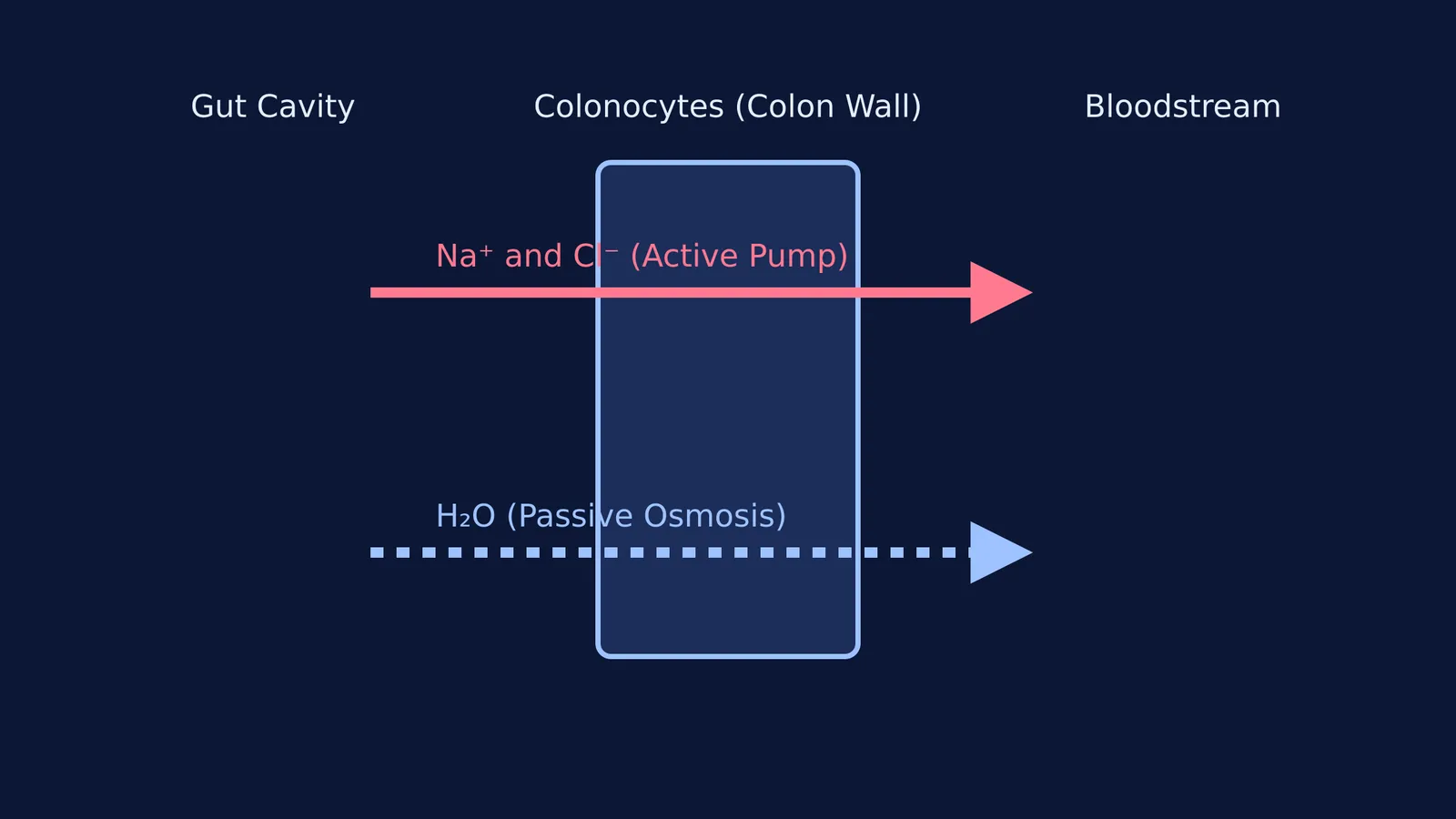
Water absorption in the gut is a passive process driven by osmosis. The cells lining your colon actively pump sodium (Na⁺) and chloride (Cl⁻) ions out of the intestinal cavity and into your bloodstream. As these salts move, they create an electrochemical and osmotic gradient. Water simply diffuses across the cell membranes to follow the salt.
This is the same principle behind why we feel thirsty when our blood salt concentration rises. It relies on osmosis, similar to how an RO water purifier works, but in reverse. If you are preparing for exams, you can study osmosis and its place in the map in the Fermi Concept Library, where every concept has its own lesson.
What happens to undigested food?
As water is absorbed, the remaining undigested food—mostly dietary fibre—is compacted into solid stool. However, the colon does much more than just store waste.
Bacterial fermentation: The large intestine houses a large microbiota, known as the normal flora. These microbes break down the remaining fibre, producing short-chain fatty acids that provide energy to your colon cells.
Vitamin synthesis: The bacteria also produce essential vitamins as metabolic byproducts, including Vitamin K and several B vitamins like biotin, which are then absorbed into your blood.
Storage and elimination: The waste is mixed by slow haustral contractions and then pushed into the rectum by powerful mass movements. It is stored there until it can be safely eliminated.
What is the function of the appendix?
The appendix is a small, finger-like pouch attached to the start of the large intestine. For over a century, biology textbooks described it as a vestigial organ—a useless evolutionary leftover from our herbivorous ancestors.
However, modern research shows the appendix has a crucial job. A 2007 study from Duke University revealed that the appendix acts as a "safe house" for beneficial gut bacteria. Because it is a narrow, dead-end tube, it protects these microbes during severe illnesses like diarrhoea or cholera that flush out the rest of the colon. Once the infection clears, the surviving bacteria emerge from the appendix to repopulate your gut.
How do antibiotics affect the colon?
Maintaining a healthy balance of colonic flora is essential for proper digestion and overall health. When a person takes antibiotics, the drugs can destroy the normal, protective bacteria in the large intestine. This disruption allows opportunistic organisms to overgrow, which can lead to complications like infectious colitis. A high-fibre diet and adequate hydration are important to support the recovery of these beneficial microbes and ensure the smooth movement of waste.