

On this page
When you catch a cold, many kinds of immune cells have to act together, and they talk to each other using small proteins called cytokines. A cytokine storm is what happens when that conversation turns into shouting: so many signals, so fast, that the defence starts damaging the body it is meant to protect. Here is how it works, and how it links to the cytokine barrier and interferons in your NCERT Class 12 Biology chapter.
What do cytokines normally do?
Cytokines are the immune system's messengers. In a 2020 review in the New England Journal of Medicine, David Fajgenbaum and Carl June write that cytokines "play a key role in coordinating antimicrobial effector cells and providing regulatory signals that direct, amplify, and resolve the immune response" (Fajgenbaum and June, NEJM 2020).
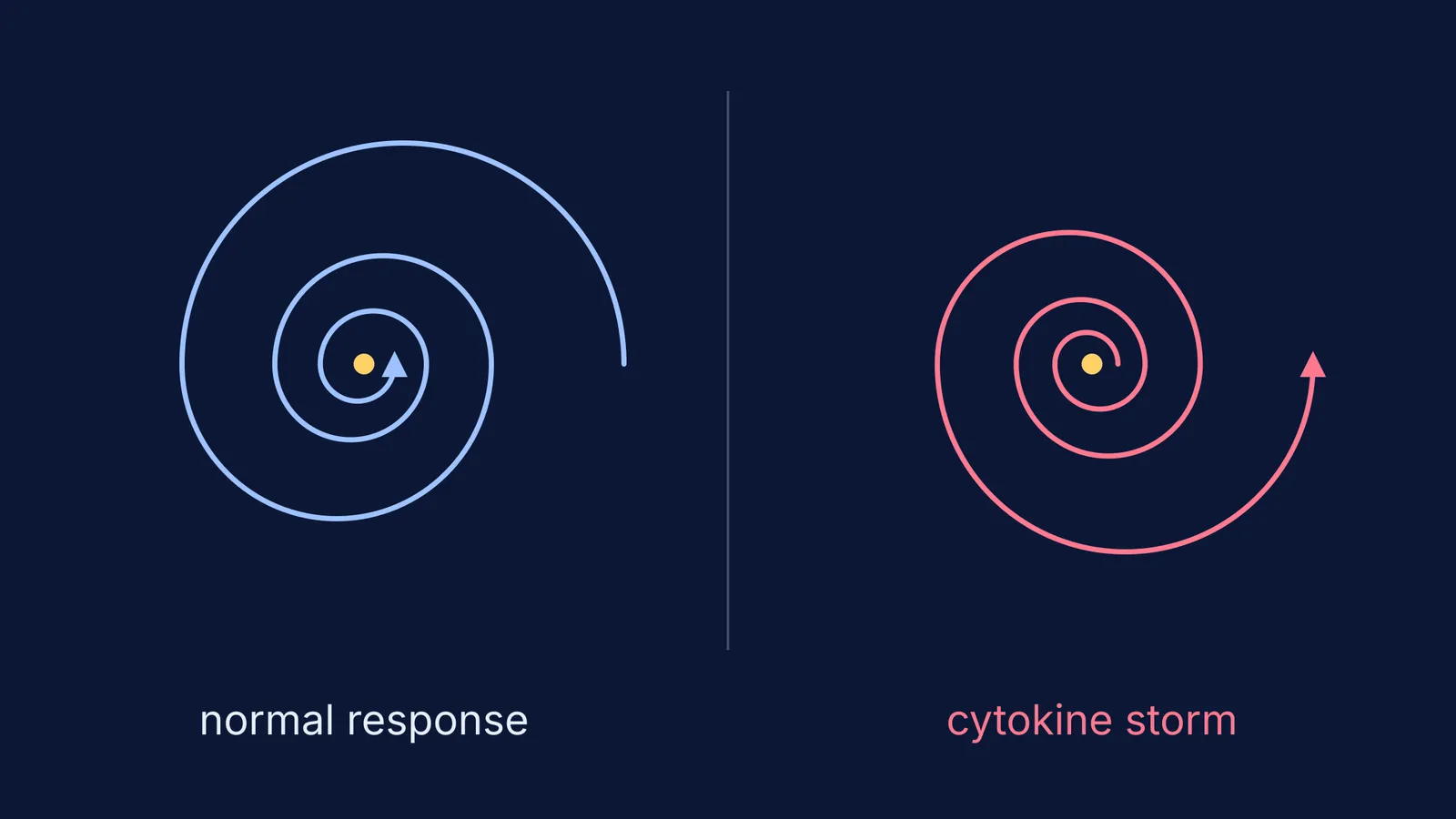
Notice the three verbs: direct, amplify, resolve. A healthy response turns up, does its job and then turns down. The same review says the immune system is expected to "respond proportionally to the pathogen burden, and then return to homeostasis."
Cytokines have short half-lives, which normally stops them acting outside lymphoid tissue and sites of inflammation, according to the same NEJM review. A signal that fades quickly cannot spread trouble around the whole body.
What is a cytokine storm in simple words?
A cytokine storm is an immune overreaction in which cytokines pour into the blood, inflammation spreads through the whole body, and organs start to fail.
The NEJM review notes that "no single definition of cytokine storm or the cytokine release syndrome is widely accepted" and proposes three features: elevated cytokine levels in the blood, acute whole-body inflammatory symptoms, and organ dysfunction (often of the kidneys, liver or lungs) caused by inflammation beyond what a normal response to the infection would explain, or, when no pathogen is present, any organ dysfunction driven by cytokines (NEJM review).
How does too much defence damage the body?
The review describes a trade-off between making enough cytokines to clear the pathogen and avoiding "a hyperinflammatory response in which an overabundance of cytokines causes clinically significant collateral damage." Here is the chain, step by step:
Infected cells and immune cells release cytokines.
Cytokines call in and switch on more immune cells. Interferon-gamma, for example, is released by activated T cells and NK cells and is "a potent activator of macrophages", in the review's words.
The newly activated cells release still more cytokines. If nothing brakes this, it becomes a positive feedback loop; the review uses that phrase when describing studies of the storm that can follow CAR T-cell therapy, a cancer treatment.
Signals spill out of the infected tissue into the blood. Nearly all patients with a cytokine storm have a fever, and in severe cases it can be high.
The lining of blood vessels is harmed. Together with other changes, this can make capillaries leak fluid into tissues, and organs such as the kidneys, liver and lungs begin to struggle.
An ordinary fever, by contrast, is part of a working defence: see why fever helps the body fight infection.
How does this connect to NCERT's cytokine barrier and interferons?
NCERT Class 12 Biology, Chapter 7 (Human Health and Disease), lists four barriers of innate immunity: physical, physiological, cellular and cytokine (NCERT chapter PDF). Under cytokine barriers, it says virus-infected cells secrete interferons, proteins that protect non-infected cells from further viral infection.
That one line is the healthy version of everything above: a cell in trouble sends a warning that helps its neighbours. Interferons are themselves cytokines, and the NEJM review discusses interferon-gamma among the cytokines involved when the response runs too hot. A storm is the system NCERT describes, with its off switch failing.
For a refresher, see our explainers on the four barriers of innate immunity and how interferons defend cells against viruses.
How do you explain a cytokine storm in an exam answer?
The NCERT chapter does not discuss cytokine storms, so keep the term out of answers that only ask you to list the barriers. It helps in reasoning questions, such as whether the immune response can harm the body. Use this three-line template:
Define: Cytokines are signalling proteins that coordinate immune cells; interferons, NCERT's cytokine barrier, are one example.
Normal: The response is proportional and switches off, because cytokines are short-lived and act locally.
Storm: When release is excessive and feeds on itself, cytokines reach the blood, inflammation spreads through the body and organs are damaged.
Before you move on, check yourself:
Can you name the four innate barriers in NCERT's order?
Can you say in one sentence what interferons do for non-infected cells?
Can you draw the feedback loop from memory: cytokines, more immune cells, more cytokines?
If one of these feels shaky, the Fermi Concept Library covers every concept in physics, chemistry, biology, mathematics and computing, each with its own lesson and its place in the map, so you can see where innate immunity fits.
Next time you revise Human Health and Disease, say the three-line template aloud. If you can, you understand both the barrier and the storm.


