

On this page
Whales breathe air, feed their young on milk and have a mammal's skeleton, yet they never leave the water. Their history is well documented: the fossils appear in the order the idea predicts, and living whales still carry a leftover from their walking past. Here is the series, and how to turn it into an exam answer.
Which land mammals did whales evolve from?
Whales belong with the artiodactyls, the even-toed hoofed mammals such as cows, deer and hippos. DNA studies identified the hippo as the closest living relative of whales, though palaeontologist Philip Gingerich calls that result somewhat controversial in his 2004 review of whale evolution. Fossil ankles settle the wider link: early whales from Pakistan have a 'double-pulley' astragalus, an ankle bone found only in artiodactyls (Gingerich and colleagues, Science, 2001). And in 2007 a team that included Indian palaeontologists Sunil Bajpai and B. N. Tiwari showed that Indohyus, an Eocene artiodactyl from south Asia, is the closest known relative of whales: it shares whale-like ears and dense limb bones and was probably an aquatic wader (Thewissen et al., Nature, 2007).
What does the fossil series from Pakicetus to modern whales show?
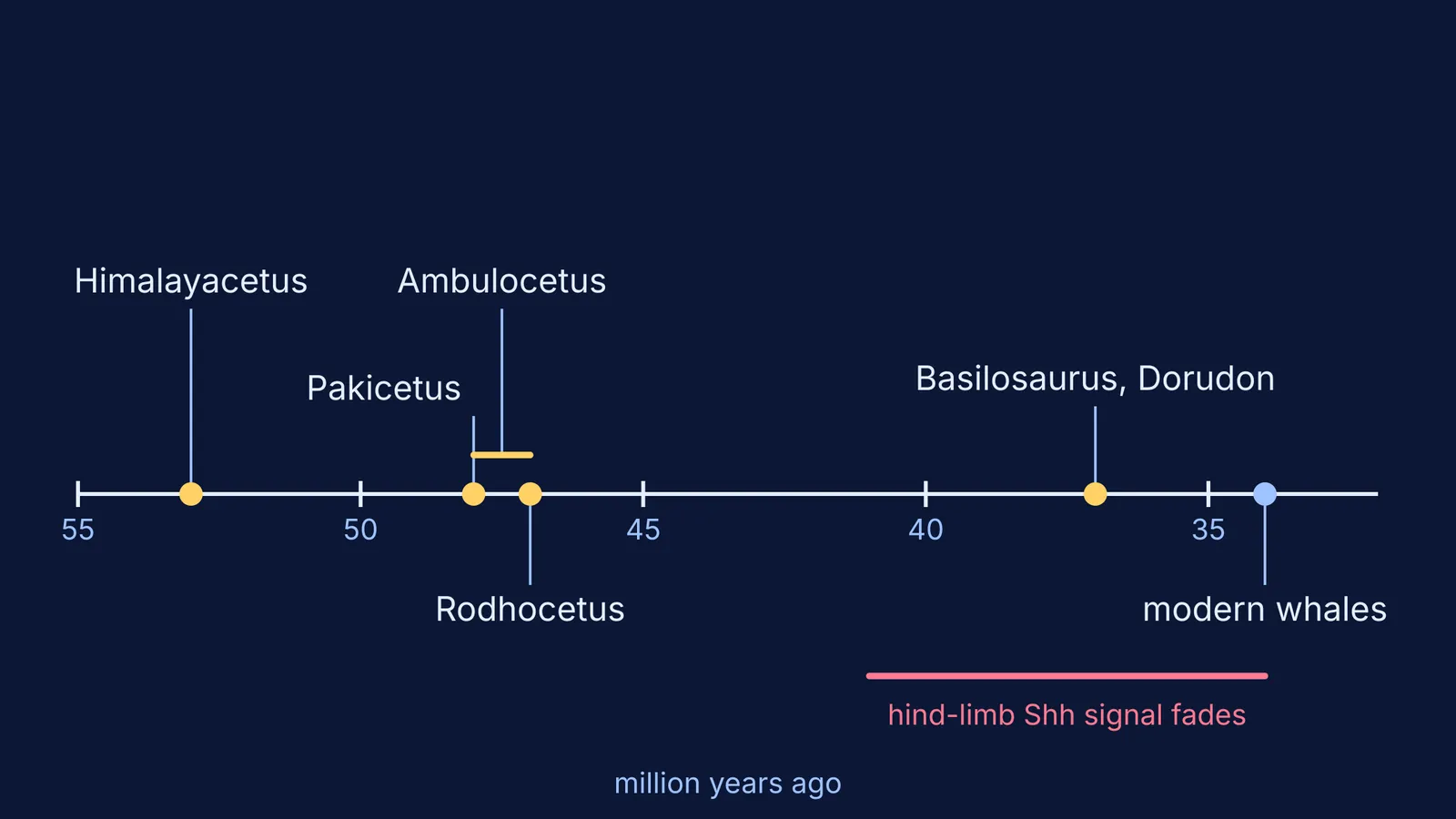
Gingerich's 2012 overview in the Proceedings of the American Philosophical Society dates each step. Read it as snapshots, not one family line: some are side branches.
Himalayacetus, about 53 million years ago, Himachal Pradesh. The oldest known whale, found in marine rocks of the Subathu Formation; its tooth chemistry sits between freshwater and marine values (Bajpai and Gingerich, PNAS, 1998).
Pakicetus, about 48 million years ago, Pakistan. A wolf-sized animal with four legs (Thewissen et al., Nature, 2001). It was first recognised as a whale from an ear feature, the 'sigmoid process' on the bone around the middle ear.
Ambulocetus, 48 to 47 million years ago, Pakistan. It swam by bending its backbone up and down, which drove its feet like an otter's, and probably moved on land a little like a sea lion (Thewissen et al., Science, 1994).
Protocetids such as Rodhocetus and Maiacetus, about 47 million years ago, Pakistan. Webbed hind feet and no tail fluke: foot-powered swimmers. Rodhocetus still had a large pelvis attached to the backbone, and Maiacetus was about 2.6 metres long.
Basilosaurus and Dorudon, about 37 million years ago, Egypt. Dorudon was a fully aquatic, tail-powered swimmer. A 15-metre Basilosaurus had a 15-centimetre foot, and its pelvis no longer connected to the backbone (Gingerich et al., Science, 1990).
Modern baleen and toothed whales, from about 34 million years ago. No hind legs visible at all.
Why do whales still have hip bones?
Across the fossils, hind limbs shrink. Embryos agree: dolphin embryos start to grow hind-limb buds, which stop and break down around the fifth week of pregnancy (Thewissen et al., PNAS, 2006). That study links the loss to a gene called Sonic hedgehog and suggests its activity in the limbs was reduced about 41 million years ago and lost altogether around 34 million years ago.
What is left is a pair of small pelvic bones, not attached to the spine. A study of 130 individuals from 29 species found that the bones anchor muscles controlling the penis, and that males in species with stronger competition for mates have larger pelvic bones for their body length (Dines et al., Evolution, 2014). Vestigial means reduced from an original job, not necessarily useless. Our explainer on vestigial organs in humans uses the same idea.
How do fossils and anatomy work together as evidence?
Use this four-check framework whenever a question asks for evidence of evolution:
Order: are the fossils dated, and do they appear in the predicted order? Himalayacetus at 53, Pakicetus at 48 and Dorudon at 37 million years ago, per Gingerich's dated list.
Shared marker: is there a feature only that group has? The whale ear; the artiodactyl double-pulley ankle.
Trend: does a structure change gradually? Hind limbs shrink while the tail takes over swimming.
Leftover: does the living animal still carry a trace? Pelvic bones, and limb buds in embryos.
Worked example: a five-mark answer
Question: give evidence that whales evolved from land mammals.
A strong answer: 'Fossils show four-legged early whales such as Pakicetus about 48 million years ago, then foot-paddling Ambulocetus, then fully aquatic Dorudon about 37 million years ago, with hind limbs shrinking over time. Early whales share a double-pulley ankle bone with even-toed hoofed mammals. Modern whales keep small pelvic bones, and dolphin embryos briefly form hind-limb buds. These leftovers are explained by descent from four-legged ancestors.'
Each sentence hits one check. The same logic works for the horse series from Eohippus to Equus, and if a classmate still files whales with fish, our post on why a whale is a mammal, not a fish covers the anatomy.
If terms like vestigial and transitional fossil start to blur, the Fermi Concept Library gives each biology concept its own lesson. Not sure where to begin revising evolution? Fermi's AI tutor can work out what you already know and build a plan for the session.


