

On this page
Most people picture horse evolution as a parade: a small forest animal at one end, a tall one-toed horse at the other. Horses have a fossil record running back about 55 million years, mostly in North America. It has been cited as classic evidence for evolution since the late 19th century, and it branches rather than running in a straight line (MacFadden, Science, 2005).
How did horses change from Eohippus to Equus?
Size. Early Eocene horses, once grouped together as eohippus or *Hyracotherium*, are classically compared to a small dog of about 10 to 20 kg, and some species were only the size of a house cat (MacFadden 2005). Wild modern *Equus* reaches about 500 kg, according to the same paper.
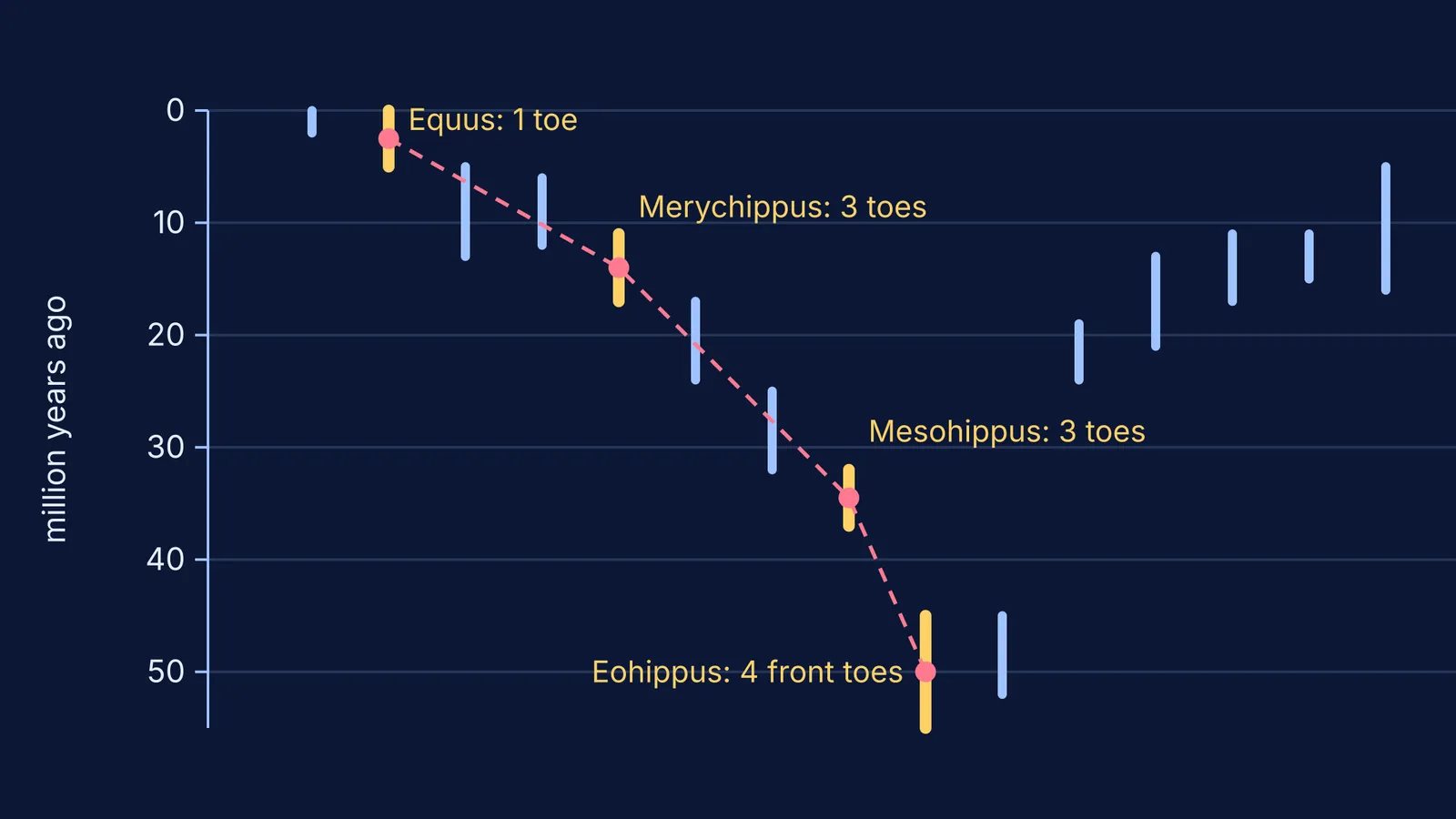
Toes. *Hyracotherium* had 4 toes on each front foot and 3 on each hind foot (Florida Museum of Natural History). *Mesohippus*, which lived about 37 to 32 million years ago, had lost that fourth front toe (Florida Museum). Later horses kept 3 toes on the ground, but the middle toe did most of the work while the side toes dangled, and modern horses have only one (Florida Museum, Amazing Feets). It stayed untidy: at Nebraska's Ashfall Beds, some *Dinohippus* individuals had three toes and others only one (Florida Museum).
Teeth. Horses from 55 to about 20 million years ago had short-crowned teeth for browsing soft leaves, and high-crowned teeth for grazing spread as grasslands opened up during the Miocene (MacFadden 2005). *Merychippus*, which lived 17 to 11 million years ago, had high-crowned cheek teeth and is the first known grazing horse (Florida Museum). A study of the teeth of 6,500 fossil horses from more than 70 extinct species found that changes in tooth anatomy lagged behind changes in diet by a million years or more (Mihlbachler and colleagues, Science, 2011; summary).
Why is horse evolution a bush and not a straight line?
In O. C. Marsh's time (Thomas Huxley studied his fossil horses at Yale in 1876), horse evolution was thought to run in a straight line toward the modern horse (MacFadden 2005). Since the early 20th century, paleontologists have drawn it as a tree with many side branches, some ending in extinction.
Only one horse genus, *Equus*, is alive today, but the family produced some three dozen extinct genera and a few hundred extinct species over 55 million years (MacFadden 2005).
Size did not march one way either. From 55 to 20 million years ago horses stayed between about 10 and 50 kg; after that, some lines grew larger, some stayed the same size and some got smaller (MacFadden 2005). MacFadden writes that using the fossil horse sequence as a classic example of ever-larger body size "is now known to be incorrect". *Archaeohippus* (21 to 13 million years ago) was a tiny browsing horse about the size of a collie (Florida Museum).
This is what Darwin meant by branching descent: lineages split, and many branches end. You can run the same check on our guide to human evolution from Australopithecus to Homo sapiens.
Worked example: which horses were alive 14 million years ago?
Test the ladder yourself with the Florida Museum's date ranges, plotted in the diagram above.
List the ranges: *Archaeohippus* 21 to 13, *Merychippus* 17 to 11, *Hypohippus* 17 to 11, *Neohipparion* 16 to 5, *Megahippus* 15 to 11 million years ago.
Draw a horizontal line at 14 million years.
Count the ranges that cross it. All five do.
Compare them. *Merychippus* was a grazer. *Hypohippus* was a pony-sized browser (Florida Museum). *Megahippus* weighed about 585 pounds and ate leaves at a time when most horses were beginning to eat only grass (Florida Museum). *Archaeohippus* was a small browser, and *Neohipparion* was a three-toed hipparion (Florida Museum).
A ladder gives one rung at a time. The fossils give five horses of different sizes and diets at once: a bush.
How should you write horse evolution in an exam answer?
A five-step plan for a long answer:
Timespan: about 55 million years, mostly in North America.
Three trends, one example each: size (small-dog-sized to about 500 kg), toes (4 front toes to 1), teeth (short crowns for leaves to high crowns for grass).
Cause: grasslands spread, and natural selection favoured teeth that coped with tougher food. No horse was "trying" to become *Equus*.
Correction: the record is a branching bush with many extinct side branches.
Evidence: name one side branch, such as *Megahippus* or *Archaeohippus*.
For quick recall practice, see our Evolution NCERT numbers for NEET. If the links between fossils, natural selection and speciation still feel loose, the Fermi Concept Library gives every biology concept its own lesson and its place in the map. And if you are not sure where to start revising, Fermi's AI tutor can work out what you already know and build a plan for the session.
Next time you see the horse parade in a textbook, look for the missing branches.


