

On this page
Wave optics questions in NEET are short, but each one turns on a single condition: bright or dark, coherent or not, polarised or not. These 8 original questions test those conditions, from easy to hard.
How should you use this wave optics question set?
The NEET (UG)-2026 syllabus from the National Medical Commission lists wavefronts and Huygens' principle, Young's double-slit experiment, coherent sources, single-slit diffraction and polarisation under Unit 16, Optics. Every question here stays inside that list and inside NCERT Class 12 Physics Chapter 10, Wave Optics (Reprint 2026-27). As in NEET-UG 2026, each question is multiple choice with four options and a single correct answer, per the NTA information bulletin.
Cover the solutions and give yourself about a minute per question.
Before you calculate, write the condition you are using, such as "dark: path difference (2n − 1)λ/2".
Read every trap line, even when you got the answer right.
For the full chapter plan, start with how to prepare optics for NEET.
Easy: can you read wavefronts, fringe orders and Polaroids?
Q1 (easy). A plane wavefront meets a flat boundary at an angle. Using Huygens' construction, in the time one end of the wavefront travels 7.5 mm in air to reach the boundary, the secondary wavelet from the other end grows to a radius of 5.0 mm inside the second medium. The refractive index of the second medium is:
(A) 0.67 (B) 1.00 (C) 1.50 (D) 2.25
Answer: (C). Both distances are covered in the same time, so their ratio is the ratio of speeds: n = v(air)/v(medium) = 7.5/5.0 = 1.50. Trap: (A) divides the other way, which would make light faster in the medium.
Q2 (easy). In a Young's double-slit experiment with light of wavelength 500 nm, the path difference at a point P on the screen is 1.75 μm. What is at P?
(A) The third bright fringe (B) The third dark fringe (C) The fourth dark fringe (D) The fourth bright fringe
Answer: (C). 1.75 μm ÷ 0.5 μm = 3.5, so the path difference is 3.5λ = 7λ/2. Dark fringes sit at (2n − 1)λ/2, and 2n − 1 = 7 gives n = 4. Trap: (B), which reads 3.5λ as "the third dark fringe" because 3 is the whole-number part.
Q3 (easy). Plane-polarised light of intensity 40 W/m² falls on a single Polaroid. The light that emerges has intensity 10 W/m². The angle between the plane of polarisation and the pass axis of the Polaroid is:
(A) 30° (B) 45° (C) 60° (D) 75°
Answer: (C). The light is already polarised, so there is no halving. Malus's law gives 40 cos²θ = 10, so cos²θ = 1/4, cos θ = 1/2 and θ = 60°. Trap: (B), which halves the beam first as if it were unpolarised and solves 20 cos²θ = 10.
Medium: what changes with coherence, slit width and two colours?
Q4 (medium). In a double-slit set-up, each slit alone gives intensity I₀ at the centre of the screen. With both slits lit by the same source, the intensity there is X. If the slits are replaced by two separate, identical lamps, the intensity there becomes Y. Then X and Y are:
(A) 2I₀ and 2I₀ (B) 4I₀ and 2I₀ (C) 4I₀ and 0 (D) 2I₀ and 4I₀
Answer: (B). Coherent waves add amplitudes: zero path difference doubles the amplitude, so the intensity is 4I₀. Independent lamps have a rapidly changing phase difference, so only intensities add: 2I₀, the same at every point. Trap: (A), which adds intensities even when the sources are coherent.
Q5 (medium). For light of 600 nm, the central maximum of a single-slit pattern has an angular width of 0.30°. The slit is made 1.5 times wider and the light is changed to 450 nm. The new angular width is:
(A) 0.15° (B) 0.20° (C) 0.225° (D) 0.60°
Answer: (A). The angular width is 2λ/a. The new width is 0.30° × (450/600) ÷ 1.5 = 0.15°. Trap: (C), which updates the wavelength but forgets the wider slit; (B) does the reverse.
Q6 (medium). A double-slit set-up is lit by two wavelengths together, 480 nm and 560 nm. The 7th bright fringe of the 480 nm light falls exactly on a bright fringe of the 560 nm light. Which order is that 560 nm fringe?
(A) 5th (B) 6th (C) 7th (D) 8th
Answer: (B). Bright fringes sit at y = nλD/d, so coinciding fringes need n₁λ₁ = n₂λ₂: 7 × 480 = n × 560, giving n = 6. Trap: (D), which flips the ratio (7 × 560/480 ≈ 8.2) and rounds.
Hard: can you work out intensity between the fringes?
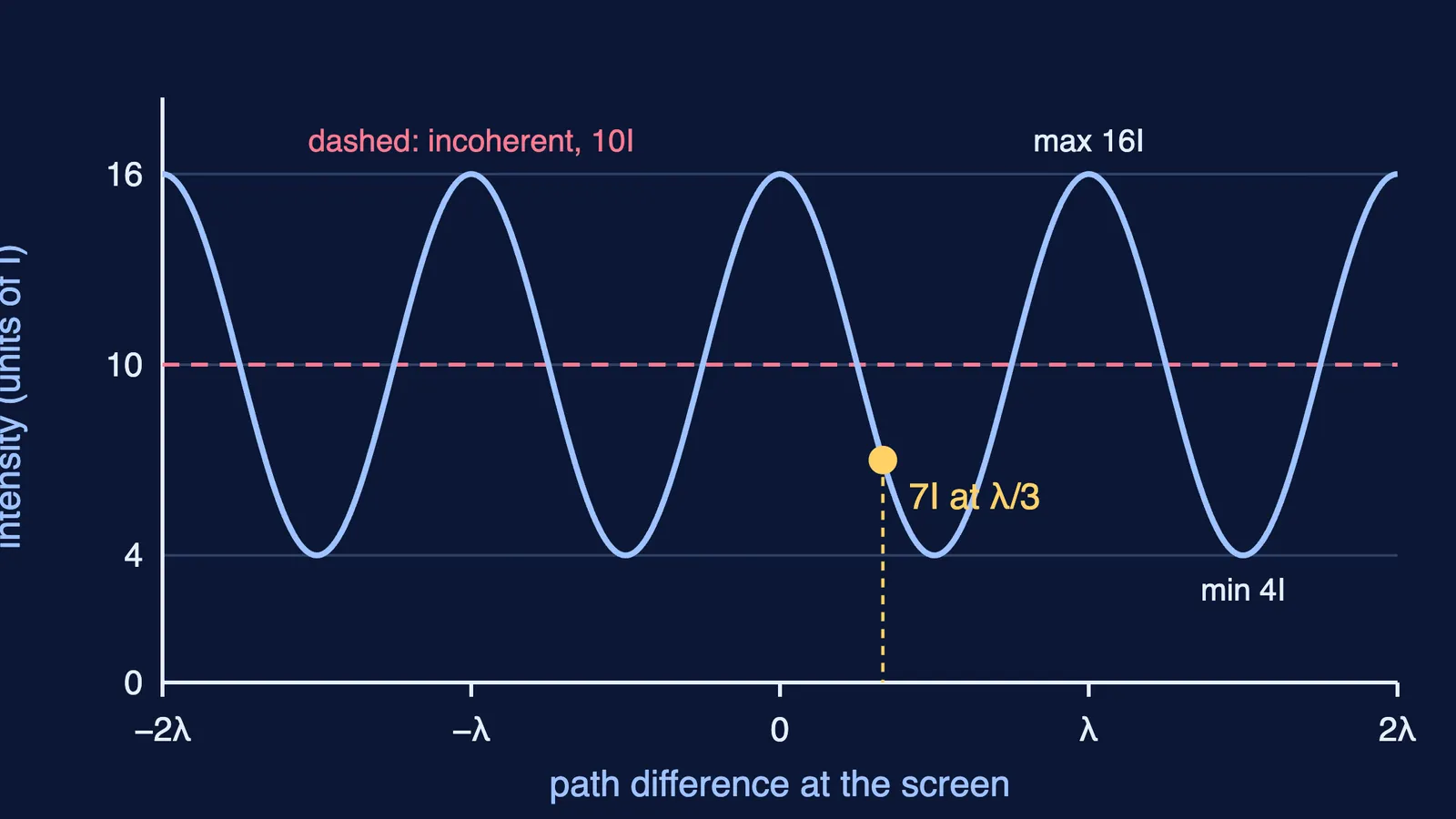
Q7 (hard). In a double-slit experiment, light from the two slits reaches the screen with intensities I and 9I. At a point where the path difference is λ/3, the intensity is:
(A) 4I (B) 7I (C) 10I (D) 13I
Answer: (B). A path difference of λ/3 is a phase difference of 2π/3. Then I(P) = I + 9I + 2√(I × 9I) cos(2π/3) = 10I − 3I = 7I. Trap: (D), which uses cos 60° (+1/2) instead of cos 120° (−1/2).
Q8 (hard). Two identical slits 0.30 mm apart are lit by 600 nm light, and the screen is 1.5 m away. How far from the central bright fringe is the nearest point where the intensity is three quarters of the maximum?
(A) 0.25 mm (B) 0.50 mm (C) 0.75 mm (D) 1.00 mm
Answer: (B). The fringe width is β = λD/d = 3.0 mm. For equal slits, I = I(max) cos²(φ/2), so cos(φ/2) = √3/2 and φ = π/3. That is a path difference of λ/6, so y = β/6 = 0.50 mm. Trap: (A), which sets cos²φ = 3/4 and loses the half-angle.
What should you do after checking your answers?
Sort each miss into one bin: wrong condition (Q2, Q6), wrong way of adding light (Q4, Q7, Q8) or a step added or skipped (Q3, Q5). Redo the misses two days later without the solutions.
If you cannot see where your working broke, the Fermi Problem Library has worked problems with a step-by-step solver that explains the reasoning rather than printing an answer.
Keep the wave optics formulas for Class 12 beside you while you revise, and for the other half of the unit, try the ray optics NEET practice questions.


