

On this page
Bacteria in your large intestine make vitamin K and several B vitamins. What most notes skip is how much of it your body actually gets to use. For some vitamins the honest answer is "a useful extra"; for vitamin B12 made in the colon, it is close to nothing.
Which vitamins are made by gut bacteria?
Vitamin K2. Bacteria that normally live in the large intestine (colon) can make menaquinones, the vitamin K2 family, according to the Linus Pauling Institute's vitamin K review.
B vitamins. A 2015 study in Frontiers in Genetics by Magnúsdóttir and colleagues checked the genomes of 256 common human gut bacteria for the pathways that build eight B vitamins: biotin (B7), cobalamin (B12), folate (B9), niacin (B3), pantothenate (B5), pyridoxine (B6), riboflavin (B2) and thiamin (B1). It predicted that each vitamin is made by 40–65% of those bacteria, and 88% of its predictions matched published lab data for 16 organisms.
For more on who lives in your gut, see our beginner's guide to probiotics and gut bacteria.
How much of your daily need do gut bacteria cover?
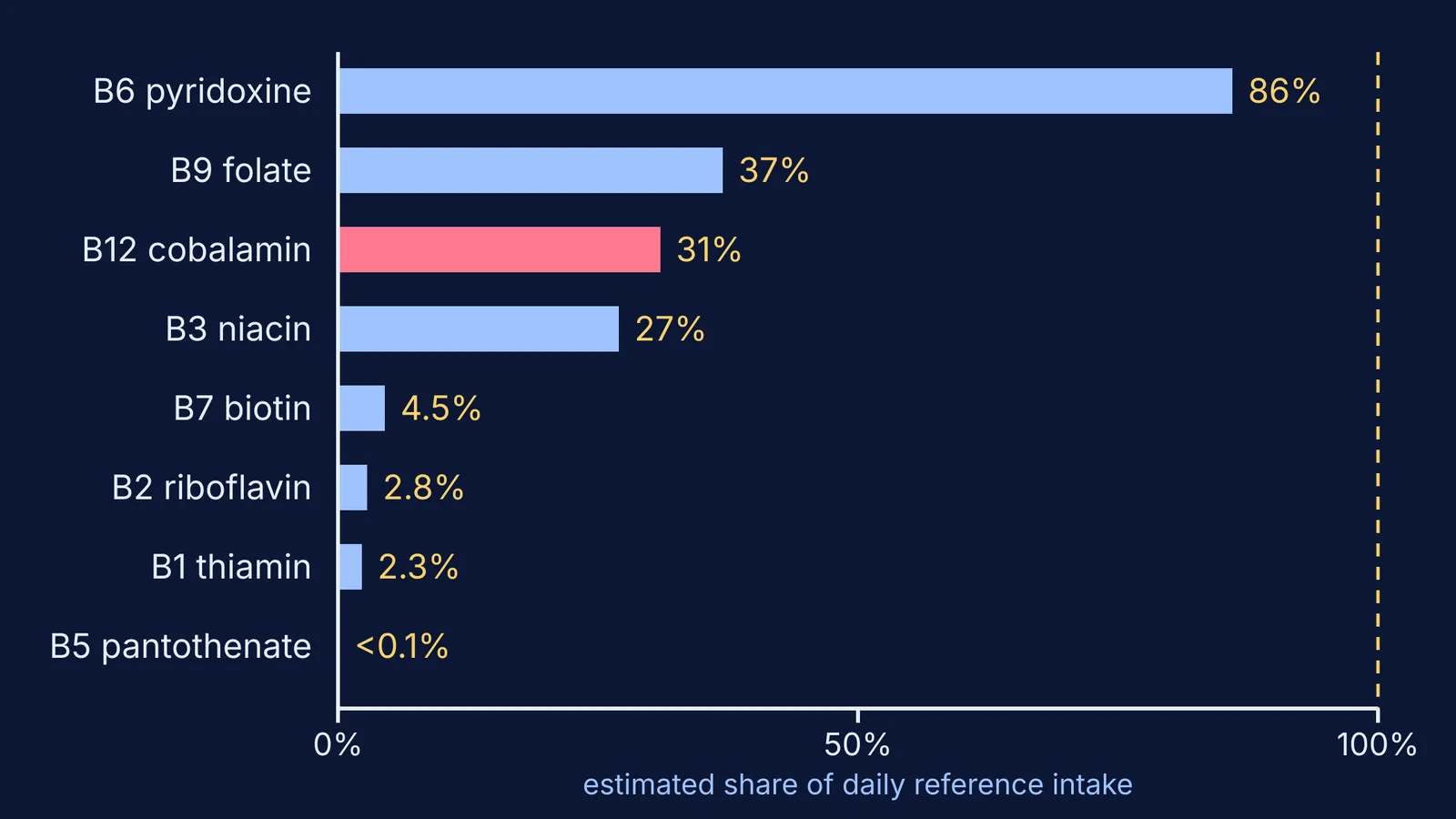
The same 2015 genome study estimated the share of the daily reference intake that gut bacteria could theoretically supply:
Pyridoxine (B6): about 86%
Folate (B9): about 37%
Cobalamin (B12): about 31%
Niacin (B3): about 27%
Biotin (B7): about 4.5%
Riboflavin (B2): about 2.8%
Thiamin (B1): about 2.3%
Pantothenate (B5): under 0.1%
Read these as upper-bound guesses, not measurements. The estimate assumes vitamins inside bacteria become available when the cells die and break open, and the authors write that "the calculated values are speculative and do not represent the true amount of B-vitamins provided by the human gut microbiota."
Vitamin K is similar. The Linus Pauling Institute says the bacterial contribution "is much less than previously thought, although the exact contribution remains unclear," because vitamin K is absorbed in the small intestine with the help of bile salts, while most menaquinone is made in the colon, where bile salts are lacking. It gives the adult adequate intake as 90 micrograms a day for women and 120 micrograms for men.
Why doesn't the B12 made in your colon count?
A 1980 paper in Nature by Albert, Mathan and Baker states that the body absorbs normal amounts of B12 only in the ileum, the last part of the small intestine, with help from intrinsic factor. Human faeces contain appreciable amounts of B12 or B12-like material, probably made by colon bacteria, but the paper says it "is unavailable to the non-coprophagic individual" (anyone who doesn't eat faeces).
The colon comes after the ileum, so B12 made there has already passed the only place that can absorb it. The same paper reports something more hopeful: the small intestine often holds many bacteria too, especially in apparently healthy people in southern India, and at least two groups there, *Pseudomonas* and *Klebsiella*, may make significant amounts of B12. Our explainer on what the large intestine absorbs covers the rest of the colon's job.
How should you answer this in NCERT-style exam questions?
For a one-mark MCQ, "vitamin K and B-complex vitamins" is the usual short answer. One caution: in the 2026–27 reprint of NCERT Class 11 Biology, Chapter 16 is "Excretory Products and their Elimination", so ask your teacher whether digestion is in your syllabus this year.
For a longer answer, run this three-question check on any vitamin:
Made? Do gut bacteria make it, and in which part of the gut?
Absorbed where? Which part of the gut takes it in, and what does it need (bile salts, intrinsic factor)?
Do the two meet? If it is made after the place it is absorbed, it mostly leaves in faeces.
Worked example, B12: made by colon bacteria; absorbed in the ileum with intrinsic factor; the colon comes after the ileum, so colon-made B12 is lost. Worked example, vitamin K2: made in the colon; absorbed in the small intestine with bile salts; the colon lacks bile salts, so the gain is small and uncertain.
Gut bacteria matter for babies too. The Linus Pauling Institute lists limited transfer across the placenta, low vitamin K in breast milk and immature gut bacteria among the reasons newborns tend to have low vitamin K. For the history, read our profile of Henrik Dam and the discovery of vitamin K.
If the "absorbed where?" step trips you up, the Fermi Concept Library gives every biology concept its own lesson and its place in the map. Stuck on a full question? Fermi's AI tutor works out what you already know and builds a plan for the session.
What does this mean for what you eat?
Treat gut bacteria as a bonus, not a supply line. Your vitamin K and B vitamins still need to come mainly from a varied diet. If you eat little or no animal food, ask a doctor or dietitian about B12.
Next time you meet the line "gut bacteria make vitamins", ask the follow-up: does the body actually get them?


