

On this page
Your gut is not only yours. A 2016 estimate put the number of bacteria in a reference 70 kg adult at about 38 trillion, the same order as the roughly 30 trillion human cells, with a total mass of about 0.2 kg (Sender, Fuchs and Milo, PLoS Biology). Some products promise to add more.
What are probiotics, exactly?
A probiotic is a live microorganism that, when taken in adequate amounts, gives a health benefit to the person taking it. This is the FAO/WHO definition, which an expert panel of the International Scientific Association for Probiotics and Prebiotics (ISAPP) reaffirmed in a 2014 consensus statement (Hill et al., Nature Reviews Gastroenterology & Hepatology).
Three words do the work: live, adequate, benefit. A microbe that is dead, scarce or never tested does not qualify, however healthy the packet looks.
Probiotics are not the same as prebiotics. Prebiotics are food components you cannot digest that selectively feed helpful microorganisms (NCCIH, US National Institutes of Health). Fibre is the familiar example; see what roughage does in your body.
What do gut bacteria actually do?
Gut microbes carry out chemistry that complements your own enzymes, including functions essential for digestion. A 2018 review describes how they break down dietary carbohydrates into short-chain fatty acids and gases, and also process proteins, plant polyphenols, bile acids and vitamins (Rowland et al., European Journal of Nutrition).
The NCERT Class 12 biology chapter on microbes notes that lactic acid bacteria in our stomach play a very beneficial role in checking disease-causing microbes (NCERT, Microbes in Human Welfare).
Antibiotics alter this microbial balance, and diarrhoea is a common result (Guo et al., Cochrane). To see why, read how antibiotics attack a bacterial cell.
Is curd a probiotic?
Curd is made by bacteria. NCERT explains that Lactobacillus and other lactic acid bacteria (LAB) grow in milk, produce acids that coagulate and partially digest the milk proteins, and raise its vitamin B12 content (NCERT, Microbes in Human Welfare). The spoonful of old curd you stir into warm milk is the starter: it carries millions of LAB that multiply. That is also why curd sets late when milk has baking soda in it.
But curd is not automatically a probiotic. An ISAPP panel on fermented foods separates a food made by fermentation, a food that "contains live and active cultures", and a "probiotic fermented food", which needs a strain-specific benefit shown in a well-controlled study and enough of that strain in the final product (Marco et al., Nature Reviews Gastroenterology & Hepatology). The panel expects most fermented foods sold today do not belong in that last group.
So fresh home curd is a fermented food with live bacteria. Its microbes are an undefined, variable mix, and nobody has tested your pot as a probiotic.
What do probiotic trials show?
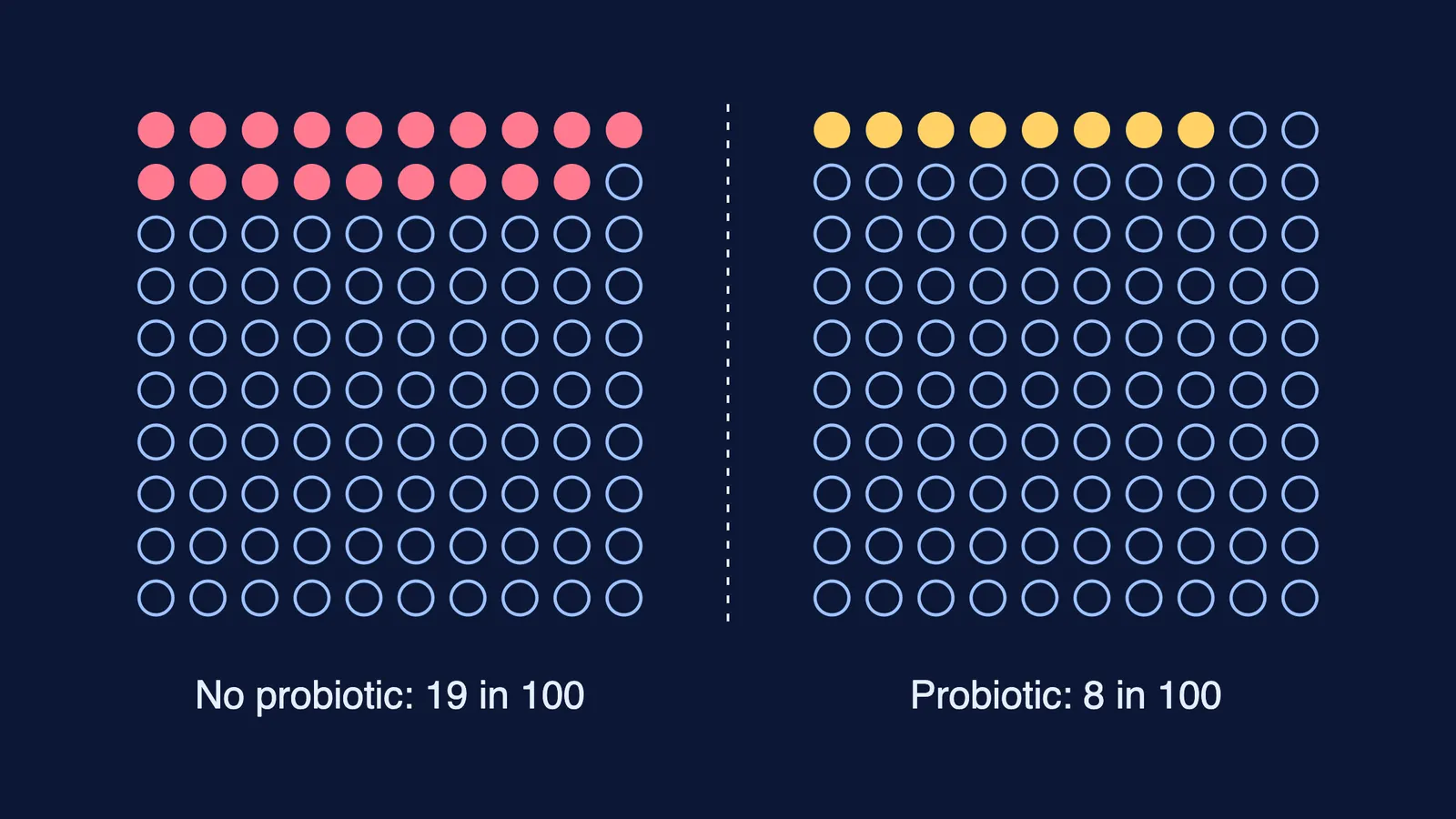
One well-studied use is preventing diarrhoea caused by antibiotics. A 2019 Cochrane review pooled 33 randomised trials with 6,352 children taking antibiotics (Guo et al., Cochrane Database of Systematic Reviews). Diarrhoea occurred in 8% of children given probiotics and 19% of those who were not, and the reviewers rated this moderate-certainty evidence.
To read that result yourself:
Without probiotics: 19 children in 100 got diarrhoea.
With probiotics: 8 in 100 did.
Difference: 11 fewer cases per 100 children.
100 divided by 11 is about 9, which matches the review's "number needed to treat" of 9: roughly nine children take a probiotic for one to avoid diarrhoea.
The same review found a larger benefit at high doses (at least 5 billion colony-forming units a day), and none of the 24 trials that reported side effects found a serious one caused by probiotics.
The picture is weaker elsewhere. The American Gastroenterological Association's 2020 guideline recommends probiotics only inside clinical trials for Crohn's disease, ulcerative colitis and irritable bowel syndrome, and suggests against them for children with acute infectious gastroenteritis (AGA guideline). Where it does suggest them, it names specific strains. NCCIH adds that the risk of harm is greater in people with severe illness or weak immune systems, and that some products have contained microbes not listed on the label (NCCIH).
How should a family use this?
Eat curd and other fermented foods as food, not as medicine.
On a supplement, look for the genus, species and strain code, and a count of live microbes; without them, the claim cannot be checked.
If a doctor prescribes antibiotics and you want a probiotic too, ask the doctor which strain and dose suit you.
Do not use a probiotic as a reason to delay seeing a doctor, as NCCIH advises.
Talk to a paediatrician before giving a probiotic to a newborn, especially a premature baby; NCCIH notes severe infections reported in premature infants given probiotics.
If you are revising microbes for Class 12, the Fermi Concept Library gives every biology concept its own lesson and its place in the map.
Next time a packet says "probiotic", ask: live, enough, tested?


