

On this page
A milkman stirs a pinch of baking soda into fresh milk. Why? This is a question from the NCERT Class 10 Science chapter Acids, Bases and Salts, and it asks two things: why he shifts the pH of fresh milk from 6 to slightly alkaline, and why that milk takes a long time to set as curd (question text). Both answers come from one idea: an acid and a base cancel each other out.
Why does a milkman add baking soda to milk?
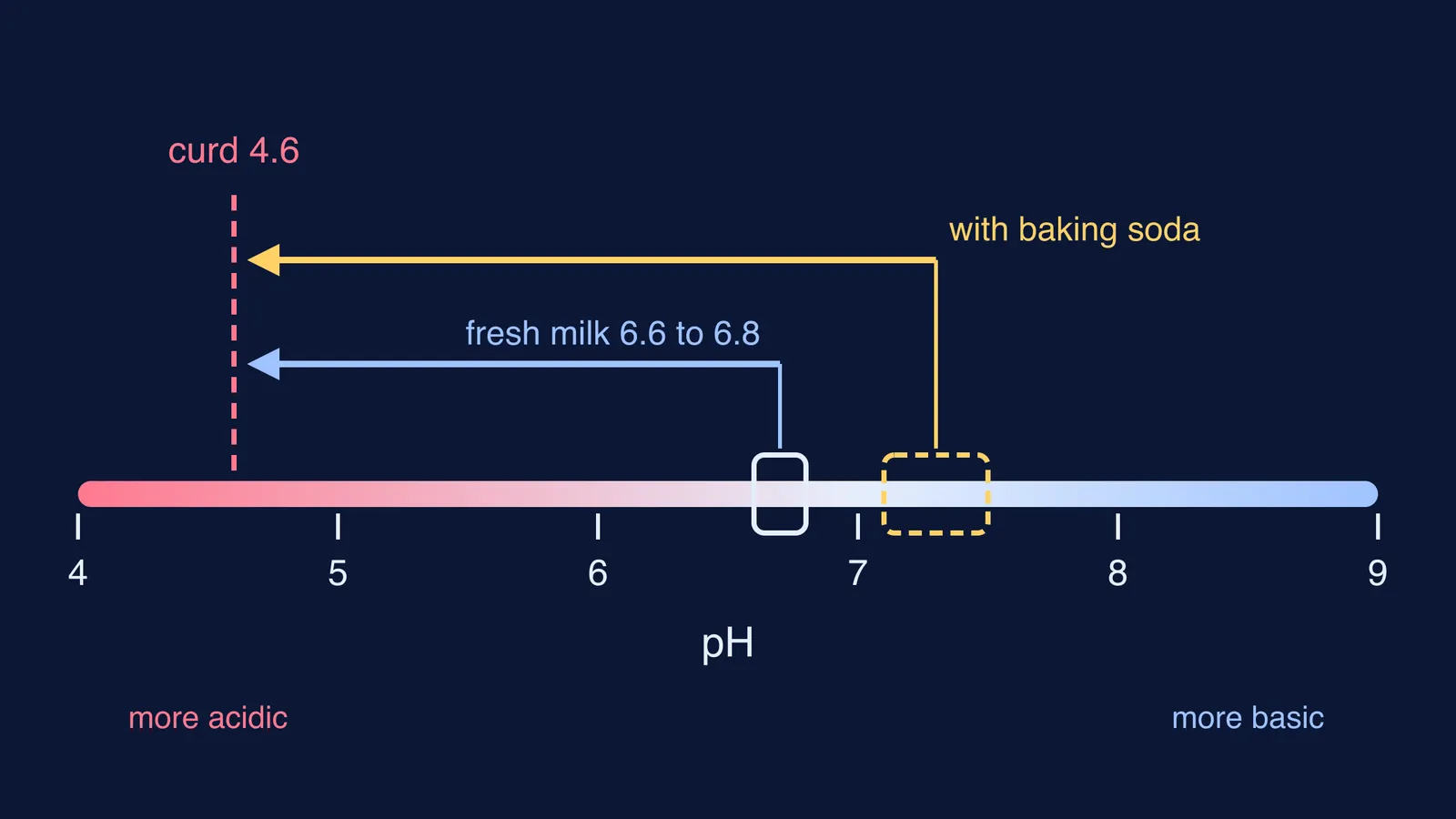
Fresh milk is very slightly acidic. The Tetra Pak Dairy Processing Handbook gives the pH of normal milk as 6.6 to 6.8, with 6.7 the most common value. The NCERT question uses a round figure of 6.
Milk sours because bacteria feed on lactose, the sugar in milk. The same handbook explains that bacterial enzymes split lactose into glucose and galactose, which are then converted mainly into lactic acid. As lactic acid builds up, the pH falls.
Baking soda is sodium hydrogencarbonate, NaHCO3, a mild base. When it meets lactic acid, it neutralises it:
CH3CH(OH)COOH + NaHCO3 → CH3CH(OH)COONa + H2O + CO2
The products are sodium lactate (a salt), water and carbon dioxide. So for a while, any acid the bacteria make is used up before it can lower the pH. To a buyer, the milk tastes fresh for longer. That is the milkman's reason.
Why does milk with baking soda take longer to set into curd?
Curd forms when casein, the main milk protein, clumps together. The Dairy Processing Handbook gives pH 4.6 as the practical value at which casein precipitates, because at that pH the casein molecules lose their net charge and stop repelling each other.
So when you add a spoon of old curd (the starter) to warm milk, the bacteria have a job: make enough lactic acid to take the pH from about 6.7 down to 4.6. In milk with baking soda, the job is longer. The first lactic acid they make goes into neutralising the soda, and only after that can the pH start to fall.
Worked example: how much acid does a pinch of soda cancel?
Suppose the milkman adds 0.5 g of baking soda to 1 litre of milk. (This amount is ours, chosen to show the method.)
Molar mass of NaHCO3 = 23 + 1 + 12 + 48 = 84 g/mol.
Moles of soda = 0.5 ÷ 84 ≈ 0.006 mol.
The equation above is 1 : 1, so it neutralises about 0.006 mol of lactic acid.
Molar mass of lactic acid, C3H6O3 = 36 + 6 + 48 = 90 g/mol.
Mass of lactic acid cancelled ≈ 0.006 × 90 ≈ 0.54 g.
So the bacteria must make roughly an extra half gram of lactic acid in every litre before the pH can start to fall towards curd. Real milk is more complicated, because milk proteins and salts also resist pH change, but the direction of the effect is what the NCERT answer says.
If you get stuck on mole steps like these, the Fermi Problem Library has worked problems with a step-by-step solver that explains the reasoning rather than printing an answer.
Is adding baking soda to milk allowed?
In the dairy trade, baking soda and similar substances are called acid neutralisers. A 2021 study in Química Nova by Gondim and colleagues describes neutralisation with alkaline compounds as one of the most common adulterations of milk. It validated the rosolic acid test, a classical method for detecting sodium bicarbonate, sodium carbonate, sodium hydroxide and sodium citrate in what the title calls fraudulent milk (abstract). Because a neutraliser cancels acid as it forms, it can make milk that has started to sour seem fresher than it is.
The chemistry in your textbook is real, but it describes a trick, not good practice. Milk stays fresh longer when it is kept cold or heat-treated; see how tetra pack milk lasts months without a fridge for the safe way to slow bacteria down.
How do you write this answer in a board exam?
Cover these four ideas:
Fresh milk is slightly acidic (pH about 6); souring means lactic acid lowers the pH further.
Baking soda (NaHCO3) is a base, so it raises the pH to slightly alkaline and neutralises lactic acid as it forms.
This slows souring, so the milk stays fresh for longer.
Curd sets only when the pH falls enough; the lactic acid must first neutralise the baking soda, so setting takes longer.
Write the neutralisation equation if you have space; it shows you know the products are a salt, water and carbon dioxide. The same fizz of NaHCO3 meeting an acid is behind the baking soda volcano experiment, and curd's acidity is also why curd should not be kept in brass or copper vessels.
If the idea of pH itself still feels shaky, start with acids, bases and pH in the Fermi Concept Library, then come back to the milkman.


