

On this page
The baking soda volcano is over in ten seconds. The useful part is the two minutes after it, when your child asks what just happened and you have a true, simple answer.
What do you need for a baking soda volcano?
1 tablespoon of baking soda (sodium bicarbonate)
About 100 mL of white vinegar (a little under half a cup)
A few drops of dish soap and food colouring (optional, for thicker, coloured foam)
A small bottle or glass, a baking tray, and some clay or a paper cone to build the "mountain"
Stand the bottle on the tray and build the volcano around it, mouth open.
Put the baking soda, soap and colour in the bottle.
Ask your child to predict what will happen, and write it down.
Pour in the vinegar in one go and step back.
When it stops, add a little more vinegar. If it fizzes again, ask why.
Keep faces away from the bottle mouth and an adult beside younger children.
What gas does a baking soda volcano make?
The gas is carbon dioxide. Vinegar is a dilute acid: most vinegars contain around 4 to 10% acetic acid, according to chemist Nathan Kilah writing in The Conversation. Baking soda is sodium hydrogencarbonate, NaHCO₃.
When they meet, this happens:
NaHCO₃ + CH₃COOH → CH₃COONa + H₂O + CO₂
It is the general rule your child will meet in the NCERT Class 10 science chapter on acids, bases and salts: metal carbonate or metal hydrogencarbonate plus acid gives salt, carbon dioxide and water. In the school lab version, the gas is passed through lime water, which turns milky as white calcium carbonate forms.
Carbon dioxide is a colourless, odourless gas, and it is about 1.53 times as dense as air, according to the CDC NIOSH chemical guide. You see only the bubbles it makes as it escapes; the soap traps them, turning a fizz into a foam that "erupts".
How do you explain the reaction to kids?
Match the explanation to the age.
Ages 5 to 8: "Vinegar and baking soda are two different things. When they touch, they turn into new things. One of the new things is a gas, like the air, and it pushes its way out as bubbles."
Ages 9 to 12: "Vinegar is an acid and baking soda is a base. They react and make three new substances: water, a salt called sodium acetate, and carbon dioxide. The bubbles are the carbon dioxide."
Ages 13 and up: write the equation together, count the atoms on each side, and ask why the second splash of vinegar fizzed again. That leads straight to the idea of a limiting reactant.
Be honest that this models the shape of an eruption, not what causes a real one.
How much gas does one spoon of baking soda make?
A Class 9 or 10 student can follow this.
Baking soda: Kilah puts one tablespoon at around 18 g. The molar mass of NaHCO₃ is 23 + 1 + 12 + 48 = 84 g/mol, so 18 g is about 0.21 mol.
Gas, if all of it reacts: the equation gives one CO₂ for each NaHCO₃, so 0.21 mol of gas. At room temperature and pressure one mole of any gas takes up 24 dm³, according to the Royal Society of Chemistry. That is 0.21 × 24 ≈ 5.1 litres, which matches Kilah's "over five litres".
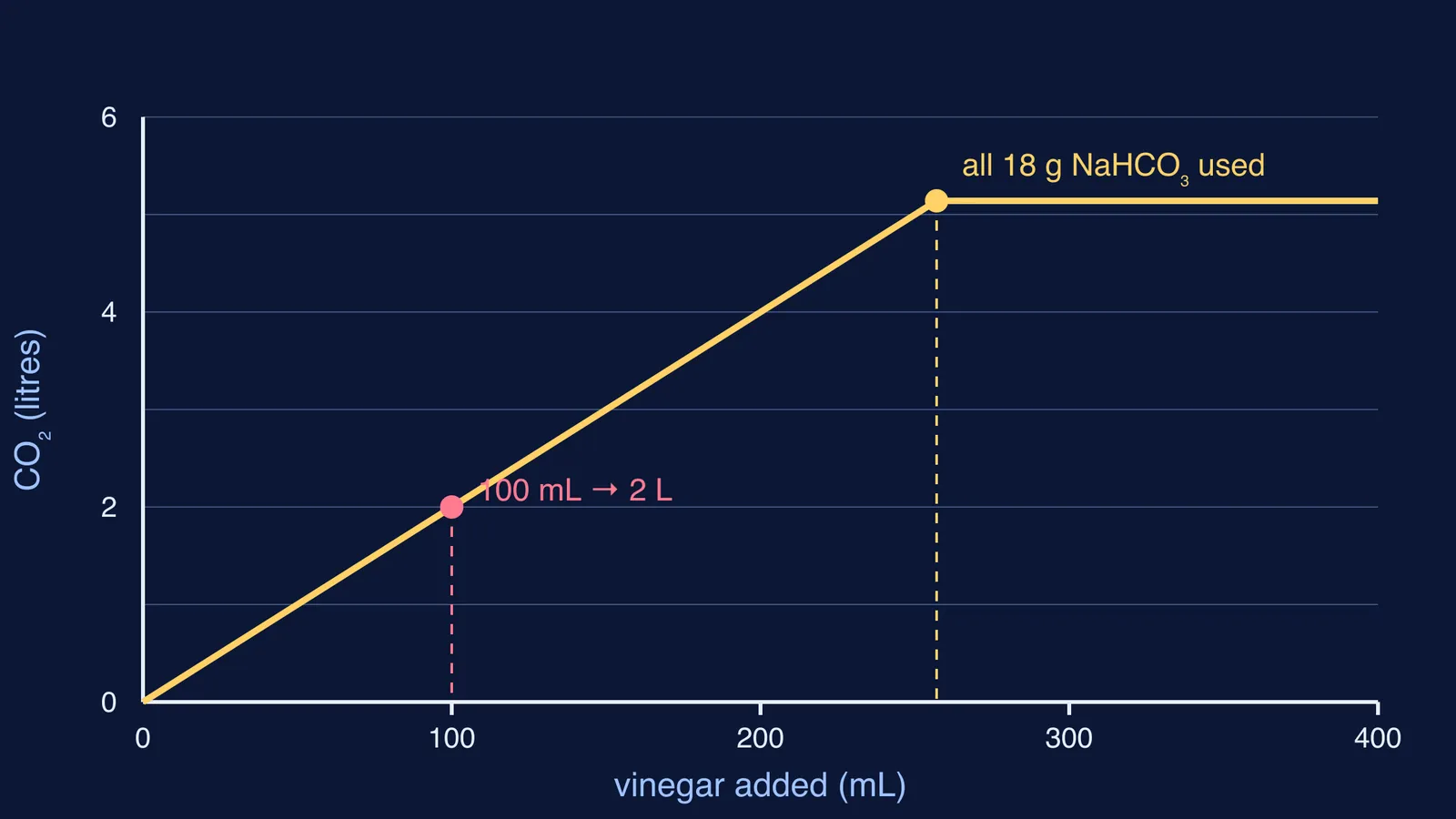
Vinegar needed: take a 5% vinegar, roughly 50 g of acetic acid per litre. Acetic acid is 60 g/mol, so that is about 0.83 mol per litre. To use up 0.21 mol of baking soda you need about 0.26 litres, around 260 mL.
What actually happens with 100 mL: that vinegar holds about 0.083 mol of acid. It makes about 2 litres of CO₂ and uses only about 7 g of the baking soda, leaving roughly 11 g unreacted.
So in the usual home volcano the vinegar runs out first, which is why the second splash fizzes again. Gas rises with every millilitre of vinegar until the baking soda is used up, then stays flat.
What can you try after the volcano?
Change one thing at a time and predict before each try.
Keep the vinegar fixed and double the baking soda. If vinegar is the limit, the calculation says the total gas will not grow.
Capture the gas in a balloon stretched over the bottle; our guide on how baking soda and vinegar inflate a balloon walks through it.
Pick another experiment from our list of five safe kitchen science experiments.
To go further into acids, bases and salts, the Fermi Concept Library has a lesson for each concept in chemistry and shows where it sits in the map. For the mole calculation, the Fermi Problem Library has worked problems with a step-by-step solver that explains the reasoning rather than printing an answer.
The questions around the experiment matter most; here is how to encourage curiosity at home by asking questions.


