

On this page
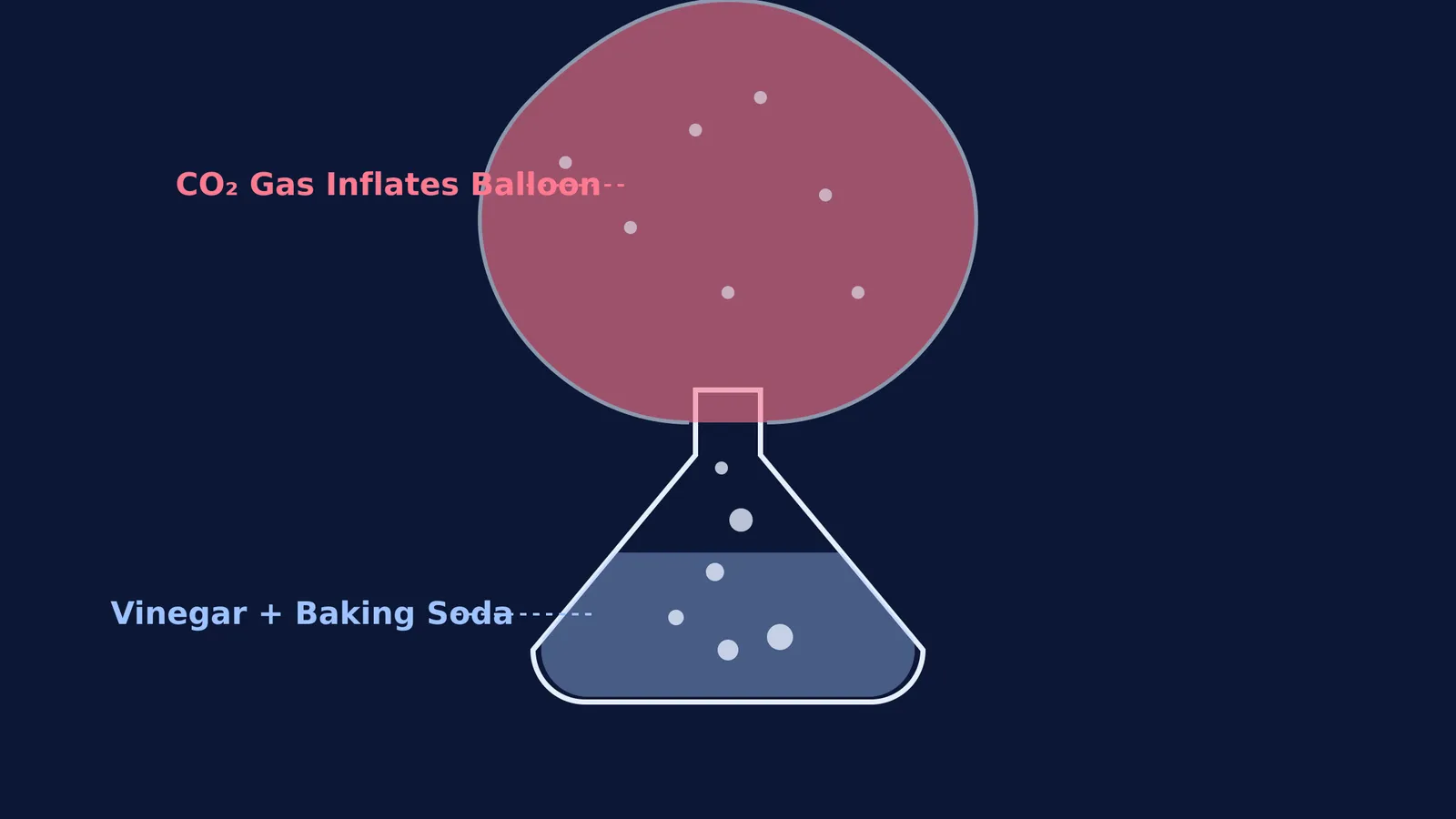
Mix baking soda and vinegar, and you get a satisfying fizz. Stretch a balloon over the bottle, and the invisible gas blows it up. This classic experiment is a safe, visible way to see how an acid and a carbonate react to create a completely new state of matter.
The reaction is a staple in the Class 10 science syllabus because it proves that mass is conserved while taking up far more volume. Here is exactly what happens inside the bottle.
What is the chemical reaction?
Baking soda is a basic salt called sodium hydrogencarbonate (or sodium bicarbonate), and household vinegar is a 5% solution of acetic acid (Teach Chemistry). When they meet, they perform a rapid, two-step chemical reaction.
First, the acetic acid and sodium hydrogencarbonate swap parts in a double displacement reaction to form sodium acetate and carbonic acid. Because carbonic acid is highly unstable at room temperature, it immediately breaks apart into liquid water and carbon dioxide gas (Teach Chemistry).
The complete balanced equation for this reaction is: NaHCO₃(s) + CH₃COOH(aq) → CH₃COONa(aq) + H₂O(l) + CO₂(g)
How much gas does it make?
The chemical equation tells us that one mole of baking soda reacts with one mole of acetic acid to produce exactly one mole of carbon dioxide, which you can verify using the methods in Balancing chemical equations in Class 10: a method that always works.
We can use this 1:1 ratio to predict how much gas our experiment will make.
Worked example: The 2.5-litre balloon Let us say you use 1.5 teaspoons (8.75 grams) of baking soda (Teach Chemistry).
Find the moles: The molar mass of baking soda (NaHCO₃) is 84 g/mol. Dividing 8.75 by 84 gives us 0.104 moles.
Find the gas volume: The reaction produces 0.104 moles of CO₂. At room temperature, one mole of any gas occupies about 24 litres. Multiplying 0.104 by 24 gives about 2.5 litres of carbon dioxide.
This small spoonful of baking soda generates 2.5 litres of gas. This is why the reactants start as a small pile of powder and a splash of liquid, but end up needing a large balloon to contain them.
Why does the balloon inflate?
The solids and liquids at the start of the reaction take up very little space. As the chemical bonds rearrange into new Carbon compounds in Class 10: homologous series and functional groups, the newly formed carbon dioxide gas molecules move rapidly and spread out.
Inside a sealed bottle, these gas molecules have nowhere to go. They collide with the walls of the bottle and the inside of the balloon. As more gas is produced, these collisions exert increasing pressure on the elastic rubber. The balloon stretches outward until the pressure inside equals the tension of the rubber plus the atmospheric pressure outside.
If you touch the bottle while this happens, you will notice it feels distinctly cold. This is because the reaction is endothermic. It absorbs heat energy from its surroundings in order to break the initial chemical bonds of the reactants.
How to test the gas?
If you were performing this in a school laboratory, you would need to prove that the gas inflating the balloon is actually carbon dioxide. The standard chemical test involves passing the gas through lime water (a dilute solution of calcium hydroxide).
When carbon dioxide bubbles through lime water, it reacts to form calcium carbonate, which is insoluble in water. This turns the clear liquid milky white. If you continue to pass the gas through the milky solution, it will eventually turn clear again as the calcium carbonate reacts further to form soluble calcium hydrogencarbonate.
Try it yourself: The balloon experiment
You can run this safely at home to see the chemistry in action.
Prepare the bottle: Pour half a cup of standard white vinegar into an empty plastic water bottle.
Load the balloon: Use a dry funnel to pour one or two tablespoons of baking soda inside a deflated balloon.
Seal it: Stretch the neck of the balloon carefully over the mouth of the bottle. Let the heavy part of the balloon hang to the side so the powder does not fall in yet.
React: Lift the balloon straight up so the baking soda drops directly into the vinegar. Watch it fizz and inflate the balloon immediately.
If you change the amounts, you will see the concept of a limiting reactant. Adding more baking soda will only inflate the balloon further if there is enough acetic acid left to react with it. If you want to explore how limiting reactants change the final volume without spilling vinegar on your desk, the Fermi Simulation Lab lets you run the reaction and see the changes interactively.


