On this page
A bowl of dahi in a shiny brass katori looks traditional, but the chemistry says move it. Curd is sour because it contains acid, and acids attack the zinc in brass and the coating that forms on copper, leaving metal salts in your food.
Why should curd not be kept in brass or copper vessels?
Curd is sour because bacteria turn milk sugar into lactic acid, as we explain in how Lactobacillus turns milk into curd.
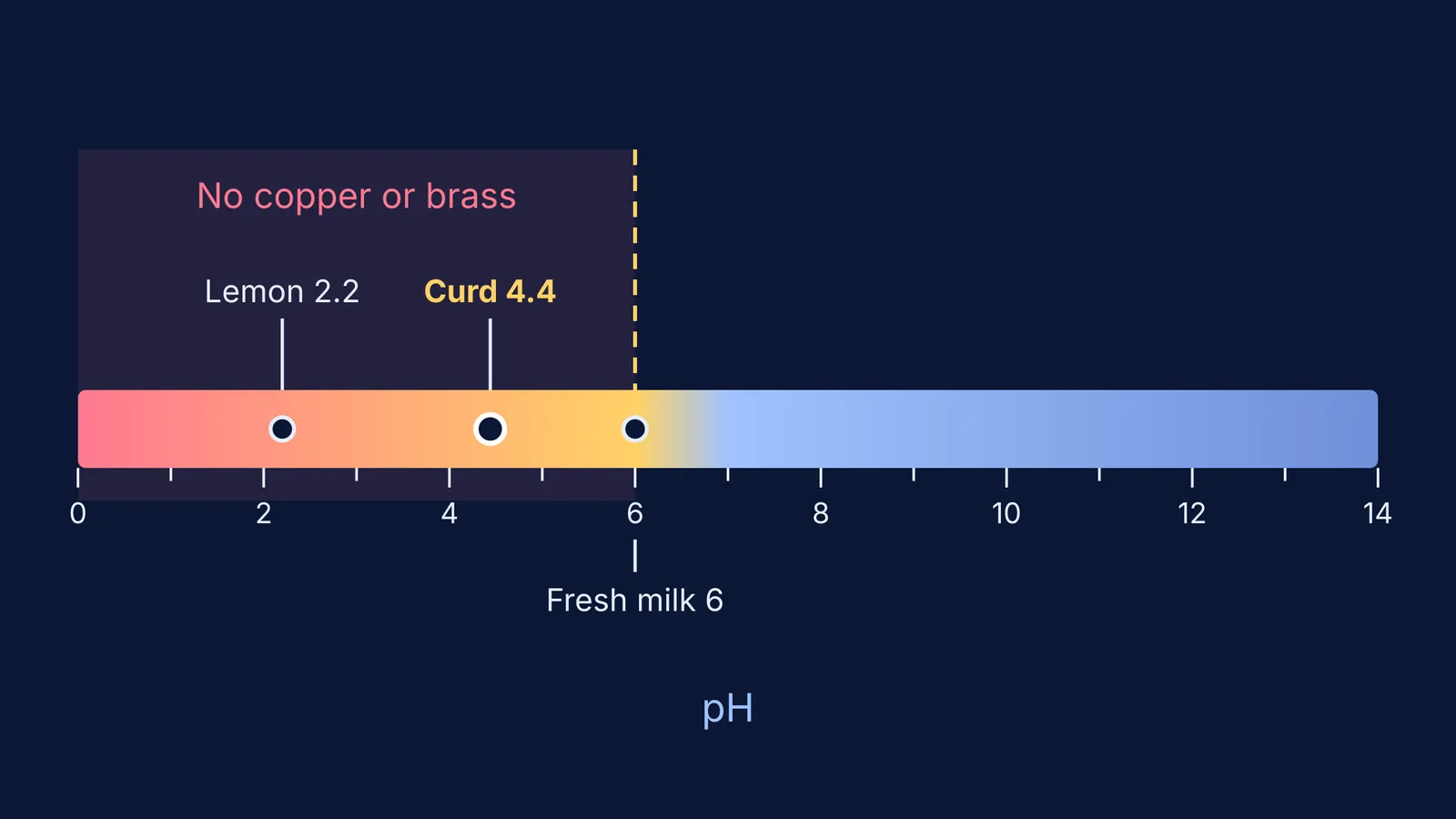
NCERT's Class 10 chapter Acids, Bases and Salts gives fresh milk a pH of 6 and defines any solution below pH 7 as acidic.
In a 2017 study in the Journal of Food Science and Technology, plain dahi measured pH 4.44 on the day it was made and pH 4.35 after eight days in the fridge (Veena et al., 2017).
Because pH is a logarithmic scale, falling from 6 to 4.44 means roughly 36 times more hydrogen ions (10 raised to 1.56).
Brass is an alloy of copper and zinc, according to NCERT's Class 10 chapter Metals and Non-metals. So a brass vessel exposes curd to two metals that react differently.
What happens when curd touches brass or copper?
NCERT's Metals and Non-metals chapter shows that zinc reacts with dilute acid and gives off hydrogen bubbles, while copper does not react with dilute hydrochloric acid. Copper gets into food by a second route. Here is the worked version, writing lactic acid as C3H6O3 and the lactate ion as C3H5O3.
Zinc in brass reacts directly, as NCERT's rule acid + metal gives salt + hydrogen predicts: Zn + 2C3H6O3 gives Zn(C3H5O3)2 + H2. The product is zinc lactate, dissolved in the curd.
Copper first forms a surface layer. NCERT notes that copper in moist air gains a green coat of basic copper carbonate, and heated copper forms black copper(II) oxide.
The acid dissolves that layer. NCERT's Acids, Bases and Salts shows copper oxide dissolving in dilute acid to give a blue-green copper salt (metal oxide + acid gives salt + water). With curd: CuO + 2C3H6O3 gives Cu(C3H5O3)2 + H2O.
The green coat goes the same way: CuCO3.Cu(OH)2 + 4C3H6O3 gives 2Cu(C3H5O3)2 + CO2 + 3H2O.
The longer the curd sits in the vessel, the more time the acid has to work on the metal surface and the more salt can end up in the food.
Are these copper and zinc salts actually harmful?
The amount matters. The World Health Organization sets a copper guideline value of 2 mg per litre of drinking water, chosen to protect against acute gastrointestinal effects (WHO copper fact sheet). The same fact sheet warns that highly acidic water can draw much higher copper levels out of copper pipes.
Food regulators draw the line by pH. The US FDA Food Code, section 4-101.14, says copper and copper alloys such as brass may not be used in contact with a food that has a pH below 6, such as vinegar, fruit juice or wine. Section 4-101.15 also bars galvanised metal, which NCERT describes as steel or iron coated with zinc, from contact with acidic food.
The code is written for US food businesses, but the chemistry is the same in India. At pH 4.4, curd sits well inside the zone the code keeps away from copper and brass. If someone feels unwell after eating food stored in a metal vessel, speak to a doctor rather than guessing.
Which containers are safe for curd?
Before anything sour goes into a container:
Stainless steel: NCERT describes it as iron mixed with nickel and chromium, hard and rust-resistant. Our post on why stainless steel does not rust explains the protective layer.
Glass: it does not react with food acids, and you can see when the curd is set.
Glazed ceramic: fine if it is made for food; the FDA Food Code sets lead limits for ceramic and china that touches food.
Bare brass or copper: keep them away from curd, raita, buttermilk, pickles, lemon juice (about pH 2.2 in NCERT's pH chart) and tamarind.
The same logic covers lab acids, which is why acids are not stored in metal containers.
How do you write this answer in a board exam?
A three-mark answer needs three ideas in order:
Curd is acidic because it contains lactic acid (pH below 7).
The acid reacts with zinc in brass, and with the copper oxide or basic copper carbonate on copper, to form soluble salts.
These salts make the food unsafe, so curd is stored in steel or glass.
Add one equation, such as the zinc lactate one, to show reasoning.
If the reactivity series still feels like a list to memorise, the Fermi Concept Library has every concept in chemistry, each with its own lesson and its place in the map. For practice, the Fermi Problem Library has worked problems with a step-by-step solver that explains the reasoning rather than printing an answer.
Next time you set dahi, reach for the steel dabba and keep the brass katori for dry snacks.