

On this page
Have you ever noticed that pickles and jams come in glass jars, and laboratory acids are never kept in metal cans? It is not just about keeping the container looking clean. The choice comes down to a fundamental chemical property of acids and how they interact with their environment.
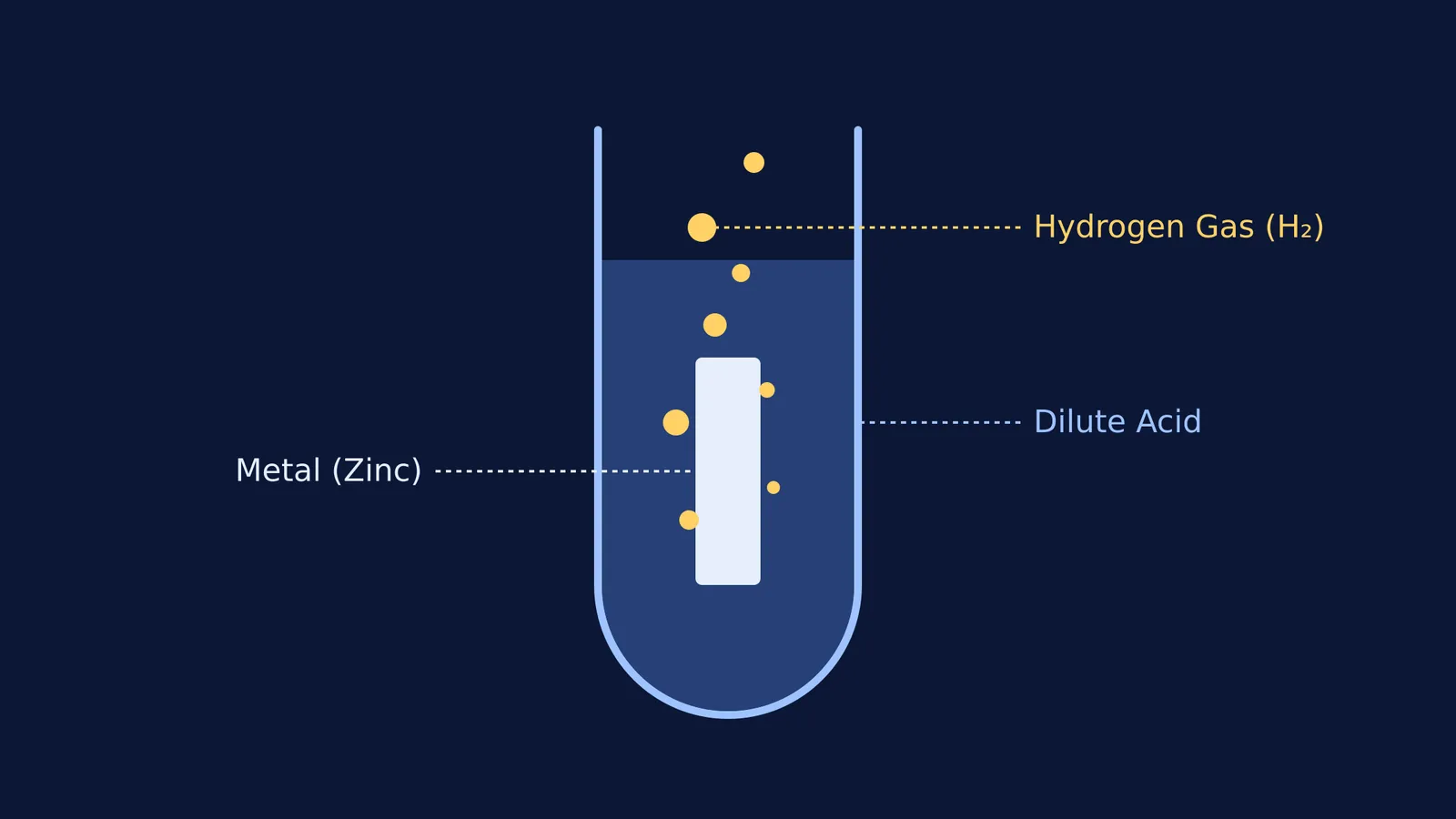
When an acid comes into contact with a reactive metal, it triggers a chemical reaction. The acid corrodes the metal, producing a metal salt and releasing hydrogen gas. This continuous breakdown means that storing an acid in the wrong container will inevitably lead to a spill, ruined contents, and potential safety hazards.
Why does the container corrode?
According to the general rule of acid reactions, acids react with certain metals to form salts and hydrogen gas. If you store dilute hydrochloric acid in a zinc container, the acid will slowly eat through the zinc walls. The zinc displaces the hydrogen in the acid, forming aqueous zinc chloride and bubbles of hydrogen gas.
At a microscopic level, this process is a redox reaction. The metal atoms lose electrons (oxidation) and dissolve into the solution as positive ions. Simultaneously, the hydrogen ions from the acid gain these electrons (reduction) to form hydrogen gas molecules. As more metal atoms dissolve, the walls of the container become thinner. Eventually, the metal container develops holes and leaks its contents entirely.
Because of this constant corrosion, laboratories store most acids in glass bottles. Glass is primarily made of silica, which is chemically inert to standard strong acids like hydrochloric, sulphuric, and nitric acid.
How does the reactivity series predict corrosion?
Not all metals react with acids in the same way. The reactivity series is a list of metals ranked from the most reactive to the least reactive. Metals placed above hydrogen in this series—such as zinc, iron, aluminium, and magnesium—will displace hydrogen from dilute acids, causing the container to corrode rapidly.
Conversely, metals placed below hydrogen in the series, such as pure copper, silver, and gold, do not react with dilute acids to release hydrogen. This means a pure copper vessel will not dissolve in dilute hydrochloric acid in the same way a zinc one would. However, the presence of atmospheric oxygen can complicate this in real-world scenarios, allowing slow reactions to occur even with less reactive metals.
If you are revising the reactions of acids for your board exams, you can explore the Fermi Concept Library. It places every concept—from the reactivity series to how salts form—into a map so you can see how they connect.
Why are curd and sour substances not kept in brass or copper vessels?
This rule is not just for the chemistry lab; it applies directly to your kitchen. Sour substances such as curd, lemon juice, vinegar, and tamarind paste contain natural acids, like lactic acid, acetic acid, and citric acid.
If you cook a highly acidic tomato sauce in an unlined aluminium pan or store it covered with aluminium foil, you might notice the food takes on a metallic taste. The acid dissolves small amounts of the aluminium. While this might not immediately eat a hole through the pan like strong laboratory acids would, it degrades the cookware over time and introduces metal ions into your food.
Similarly, when these acidic foods are kept in brass or copper vessels, the weak acids react with the metal. Over time, especially with exposure to air, this reaction produces toxic metal salts that dissolve into the food, altering its taste and potentially causing food poisoning. To keep sour foods safe, they should always be stored in glass, ceramic, or food-grade stainless steel (which is a stable alloy designed to resist corrosion).
Which acid is not stored in glass bottles?
While glass is the standard container for most acids, there is one major exception: hydrofluoric acid. Hydrofluoric acid is highly corrosive to siliceous materials and reacts with the silicon dioxide in glass to form a gas or water-soluble acid. Because it rapidly dissolves glass, hydrofluoric acid must be stored in containers made of specific plastics, such as polyethylene or Teflon, instead.
If you find it hard to predict whether a specific chemical will react with its container, Fermi's AI tutor can help. Instead of just giving you the answer, the tutor works out what you already know and teaches through the reasoning step by step, checking your understanding as it goes.
A quick guide to safe storage
You can use this simple framework to decide how to store common acids and sour foods at home and in the lab:
Standard laboratory acids (HCl, H₂SO₄, HNO₃): Store in glass bottles. Avoid all reactive metals like zinc, iron, or aluminium. (For more on how these reactions work, see how acids react with metal carbonates and hydrogen carbonates).
Sour foods (curd, lemon juice, pickles): Store in glass, ceramic, or food-grade stainless steel. Never use pure copper, brass, or aluminium.
Hydrofluoric acid (HF): Store in polyethylene or Teflon plastic. Never store in glass. (Understanding these storage rules also helps when identifying which salts are acidic, basic or neutral in Class 10).


