On this page
In 1929 a young Copenhagen biochemist noticed that chicks on a diet with almost no fat were bleeding under the skin, and their blood was slow to clot. Henrik Dam could have written it off. Instead he ruled out the known suspects one by one and found a new vitamin. The story connects straight to the blood clotting topic in school biology.
How did Henrik Dam discover vitamin K?
In his Nobel lecture, Dam explains that the work began as a study of cholesterol metabolism in chicks, carried out during 1928-1930 at the Biochemical Institute of the University of Copenhagen. He raised newly hatched chicks on artificial diets with the sterols extracted and vitamins A and D added back.
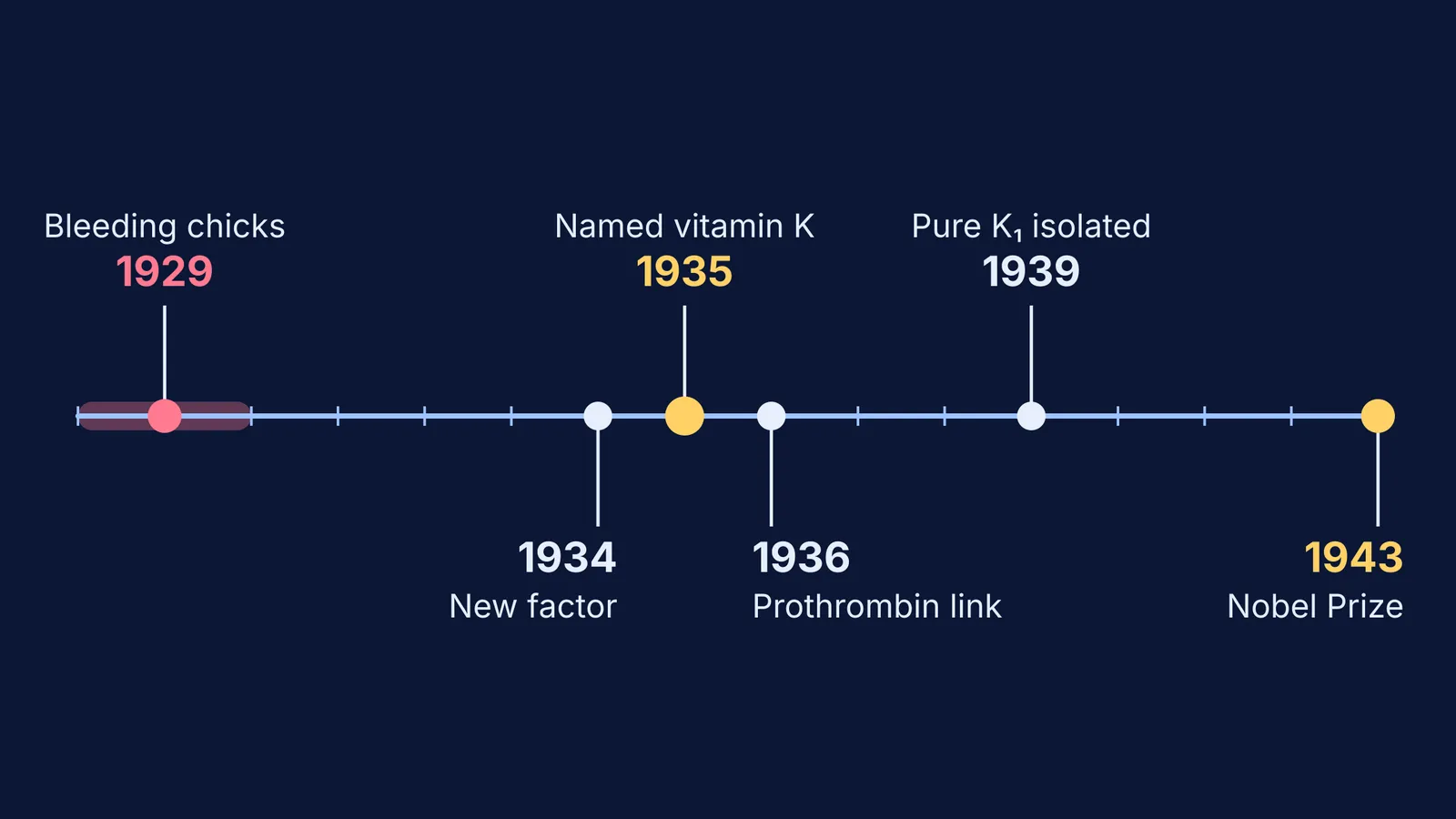
The bigger finding was what he called “an unexpected symptom”: some of the chicks kept on the diet for more than 2 or 3 weeks developed haemorrhages under the skin, in muscles or in other organs, and blood samples showed delayed coagulation (Dam, Nobel lecture). The Nobel presentation speech dates these observations to 1929 and describes the diet as “extremely poor in fat”.
How did Dam rule out the other causes?
A bleeding chick on an odd diet has many possible explanations, and Dam tested them one at a time (Nobel lecture):
Cholesterol? No. Chicks make their own, and the bleeding appeared even with a daily cholesterol supplement.
Too little fat? No. Linseed oil and triolein did not prevent it.
Scurvy? No. Lemon juice did not help, and later, injections of pure vitamin C failed too.
Minerals? No. Changing the salt mixture made no difference.
Something in whole foods? Yes. A diet high in cereals and seeds prevented the bleeding.
With the known causes excluded, Dam announced the bleeding as a new deficiency disease in a 1934 letter to Nature. The presentation speech adds that, working with F. Schønheyder, he found hempseed in the feed stopped the bleeding.
Others saw the clue too. Dam's lecture notes that a Canadian group observed the same bleeding in 1931 but “did not follow these observations further”.
Why is it called vitamin K?
Dam then tested animal organs and plants, and found green leaves and hog liver among the most potent sources (Nobel lecture). The factor was fat-soluble, and in 1935 he characterised it as a new fat-soluble vitamin and named it vitamin K. He gave two reasons for the letter: K was the first letter not already used for other vitamins, and it was the first letter of “koagulation” in Scandinavian and German spelling. That year he also published a paper titled The antihaemorrhagic vitamin of the chick in the Biochemical Journal.
Pure vitamin K from green leaves was first reported by Dam, Paul Karrer and co-workers in 1939, and its structure was worked out by Edward Doisy's group and by a group led by Fieser (Nobel lecture). The 1943 Nobel Prize in Physiology or Medicine was divided equally between Dam “for his discovery of vitamin K” and Doisy “for his discovery of the chemical nature of vitamin K”. To place K beside A, D, E and the B group, see our guide to fat- and water-soluble vitamins in Class 12 chemistry.
What does vitamin K do in blood clotting?
Dam's lecture describes clotting in two stages: thromboplastin and calcium ions turn prothrombin into thrombin, and thrombin turns fibrinogen into fibrin (Nobel lecture). He showed that prothrombin, and no other component, is what goes missing when vitamin K is withdrawn. In a deficient chick, prothrombin falls to about 1 per cent of normal over roughly 14 to 28 days. The liver, he noted, is the organ that makes prothrombin.
Our explainer on how blood clots: platelets, thrombin and fibrin walks through the full cascade. Questions about vitamin K for a newborn or for anyone on medication belong with a doctor.
How can you use Dam's method when you study?
Dam's reasoning is a five-step loop you can run on any “why did this happen?” problem:
Write the odd observation down exactly, as Dam did: who was affected, after how long, and how badly.
List every suspect, including the boring ones.
Change one thing at a time and check the result.
Cross out a suspect only on evidence, never on a hunch.
When everything known is crossed out, name what is left and look for where it lives.
Worked example: your organic chemistry marks in mock tests have dropped. Suspects: time, forgotten reagents, or the wrong mechanism. Redo five wrong answers untimed. Still wrong? Time is crossed out. Still wrong with your reagent notes open? Recall is out. What remains is the method.
When the leftover cause is method, the Fermi Problem Library has worked problems with a step-by-step solver that explains the reasoning rather than printing an answer. If the gap is a concept, such as how prothrombin becomes thrombin, the Fermi Concept Library gives each concept its own lesson.
For an earlier case where a feeding experiment exposed a missing nutrient, read about Christiaan Eijkman, beriberi and the road to vitamins.