

On this page
Collagen gives connective tissue its strength, and your body cannot build a stable version of it without vitamin C. That one dependency explains why scurvy makes gums bleed and wounds heal slowly, and why a biology exam can ask you to link a vitamin to a fibre.
What is collagen, and why does it have to be stable?
In humans, collagen makes up about one-third of all protein, according to a review of collagen structure and stability by chemists Matthew Shoulders and Ronald Raines. Each molecule is a triple helix of three chains; in type I collagen, one helix is less than 2 nm wide and about 300 nm long.
The chains pack so tightly that every third residue must be glycine, giving a Xaa-Yaa-Gly repeat. The Xaa position is often proline (28%) and the Yaa position often 4-hydroxyproline (38%), the same review reports.
These molecules line up into the white collagen fibres of areolar tissue, tendons and ligaments; our guide to connective tissue types and examples shows where each sits.
Why is vitamin C needed for collagen formation?
Hydroxyproline is not built into the chain by the ribosome. The cell adds an -OH group to proline afterwards, using the enzyme prolyl 4-hydroxylase, whose reaction needs Fe2+, 2-oxoglutarate, oxygen and ascorbate (vitamin C), according to a FASEB Journal review by Kari Kivirikko and colleagues.
Vitamin C's job is to keep the enzyme's iron usable. The enzyme suffers oxidative inactivation during catalysis, and ascorbate reactivates it by reducing its iron from Fe(III) back to Fe(II), as Vasta and Raines described in 2016. Ascorbate is also a cofactor for lysyl hydroxylase, which modifies lysine in collagen, according to a review by Sheldon Pinnell.
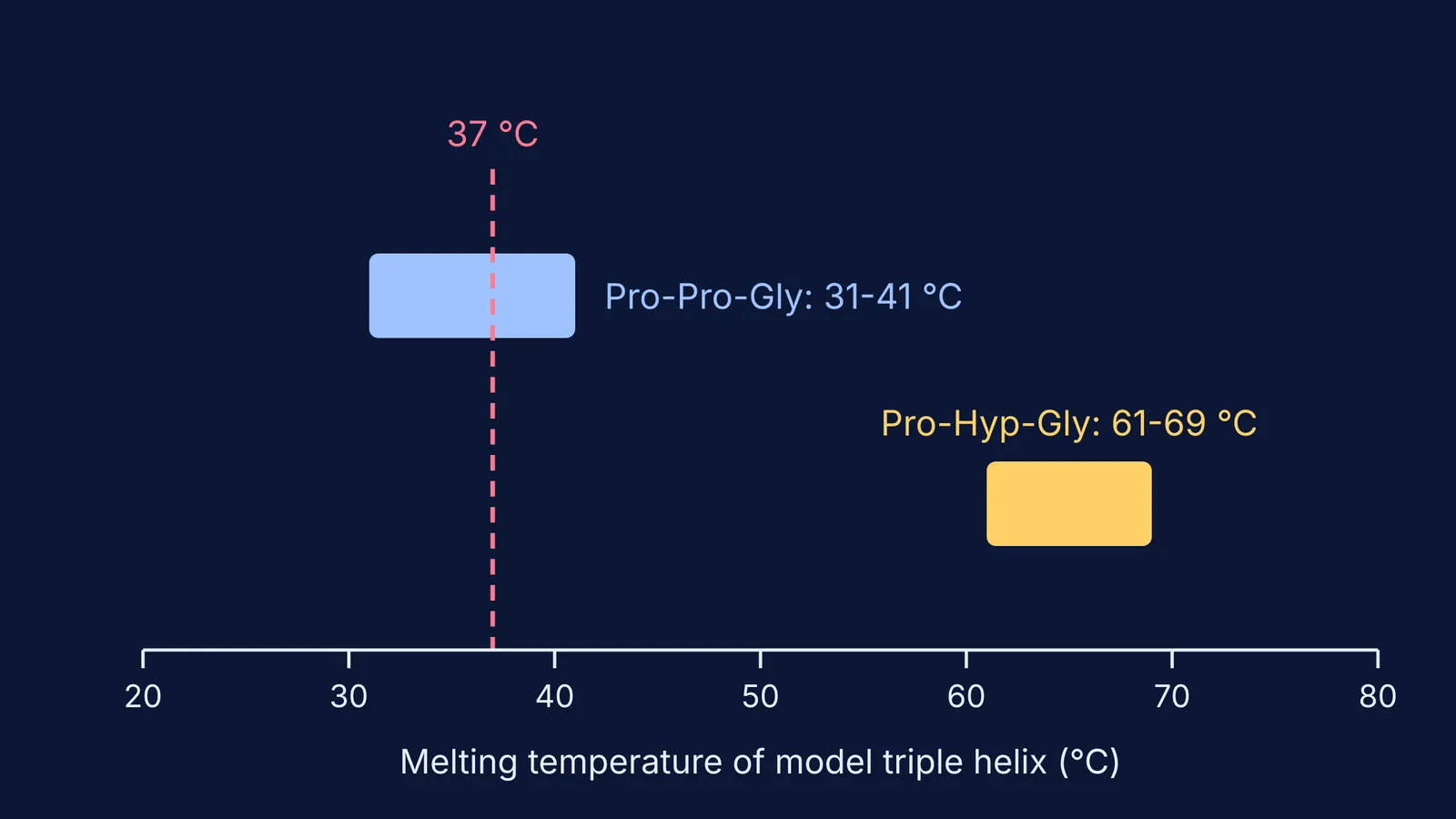
Why does one -OH group matter? Hydroxylating proline "increases dramatically the thermal stability of triple helices", Shoulders and Raines write. The model chain (Pro-Hyp-Gly)10 melts at 61-69 °C, while (Pro-Pro-Gly)10 melts at 31-41 °C (review), a range that includes body temperature, 37 °C. The chart at the top of this post plots that gap.
B. Peterkofsky of the US National Cancer Institute summed up the consequence in 1991: hydroxyproline stabilises the triple helix and "consequently, ascorbate stimulates procollagen secretion" (American Journal of Clinical Nutrition). The same paper notes that in vitamin C-deficient guinea pigs, collagen synthesis fell with only moderate effects on hydroxylation, a drop that tracked weight loss, so hydroxylation is not the whole story.
Why does a vitamin C shortage weaken gums, skin and blood vessels?
Gums, skin and small blood vessel walls rely on collagen fibres, so that is where poorly made collagen shows. A review of adult scurvy in the Journal of the American Academy of Dermatology70244-6) lists the signs:
Gums: swelling, purplish colour and bleeding, in people who have teeth.
Skin: bleeding around hair follicles, bruising, coiled hairs and poor wound healing.
Vessels and joints: bleeding into soft tissue and joints, with joint and back pain.
The same review notes that humans, unlike most animals, cannot make ascorbic acid, so it must come from food, mainly fruits and vegetables. Fatigue comes first, after many weeks of low intake, and vitamin C treatment brings rapid improvement. This is the biology behind James Lind's scurvy trial and what made it a fair test.
Bleeding gums or easy bruising have several possible causes, so if you notice them, see a dentist or doctor rather than diagnosing yourself.
How much vitamin C do Indians need?
The ICMR-National Institute of Nutrition's 2020 nutrient requirements note sets the recommended dietary allowance at 80 mg a day for adult men and 65 mg for adult women, up from 40 mg in 2010. Regular fresh fruit and vegetables are the everyday route; ask a doctor before taking supplements.
How do you write this in an exam answer?
Examiners reward the chain, not a pile of facts. Learn it as five steps:
Collagen is a Gly-X-Y triple helix whose stability depends on hydroxyproline.
Prolyl 4-hydroxylase makes hydroxyproline after translation.
The enzyme needs Fe2+; vitamin C reduces Fe3+ back to Fe2+.
Without vitamin C, collagen is under-hydroxylated, less stable and poorly secreted.
Weak fibres cause bleeding gums, skin bleeds and slow wound healing.
Then cover the list and explain it aloud to a parent in 30 seconds. Where you stall is what to revise.
If the triple helix is hard to picture, the Fermi Concept Library gives each biology concept its own lesson and its place in the map. Fermi's AI tutor notices where you are stuck, decides whether to explain, ask or show, and checks understanding as it goes.
For the Indian biophysicist whose name is tied to collagen's structure, read G. N. Ramachandran and collagen's triple helix.


