

On this page
Vitamin B12 is a large molecule that your body cannot make, and it has to pass through a chain of hand-offs before it reaches your blood. Humans get B12 only from their diet, mainly from animal-derived foods, according to a 2021 review in Nutrients. The same review notes that a plant-based diet raises the risk of running low.
The trip has a strict order of hand-offs. Once you see it as a relay in which B12 changes partner at each stage, the textbook paragraph turns into a diagram you can draw from memory.
Why does vitamin B12 need intrinsic factor?
Intrinsic factor is a glycoprotein secreted by the parietal cells of the stomach lining, as described in the Nutrients review by Vincenti and colleagues. It is also called Castle factor, a name a 2026 review in Gastric Cancer uses alongside intrinsic factor.
The key point is the receptor at the end of the route. A 2022 review by Guéant, Guéant-Rodriguez and Alpers explains that B12 is carried by three transport proteins (intrinsic factor, haptocorrin and transcobalamin), that B12 is transferred to intrinsic factor in the duodenum, and that a receptor made of two proteins, cubilin and amnionless, takes up B12 in the distal ileum. Think of intrinsic factor as the ticket: the ileum's receptor lets in the B12 that holds one.
There is a back door, but it is narrow. Only about 1% of an oral dose is absorbed by passive diffusion, according to the Gastric Cancer review.
How does B12 get from food to the ileum?
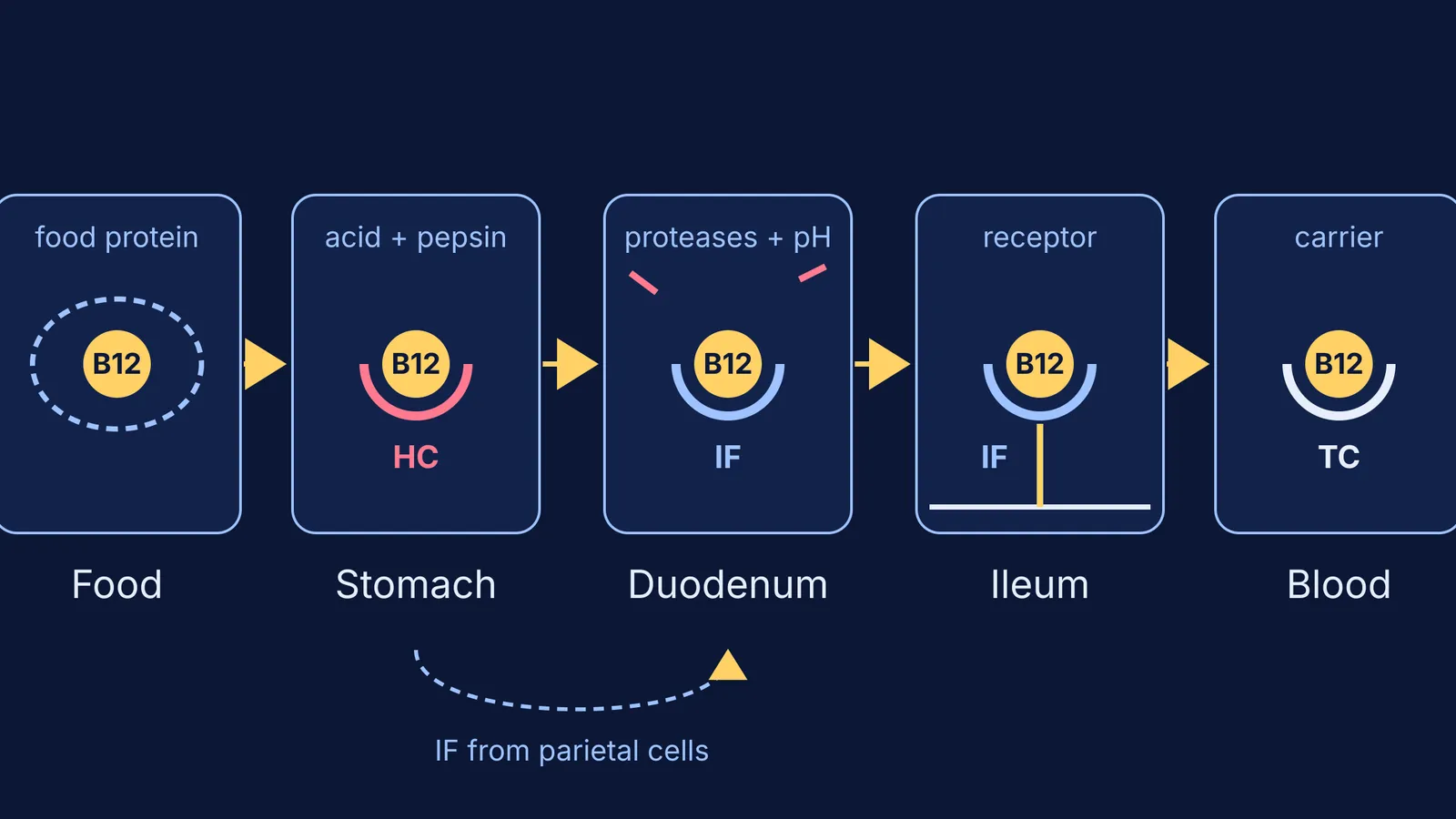
Here is the route in five steps, using the sequence in the Nutrients review and the Vitamins and Hormones review.
Food: B12 arrives stuck to food proteins.
Stomach: hydrochloric acid and pepsin release B12, which then binds haptocorrin (also called R-protein), made by the salivary glands and stomach.
Duodenum: pancreatic proteases (trypsin, chymotrypsin and elastase) break down haptocorrin, and the change in pH helps B12 move onto intrinsic factor.
Ileum: the B12–intrinsic factor complex travels to the terminal ileum and is taken in by endocytosis through the cubilin–amnionless receptor.
Blood: inside the body, B12 binds transcobalamin, which carries it on.
If you want the stomach's side of this in more detail, our post on which gastric gland cells make HCl and pepsinogen covers parietal and chief cells.
How do you draw the B12 flow on one page?
Try this in your notebook.
Draw five boxes in a row: Food, Stomach, Duodenum, Ileum, Blood.
In each box, draw B12 as a small filled circle.
Give the circle a different partner in each box: food protein, then haptocorrin (HC), then intrinsic factor (IF), then the receptor holding IF, then transcobalamin (TC).
Above the last four boxes, write what causes the change: acid and pepsin, proteases and pH, receptor, carrier.
Draw one dashed arrow from the stomach box to the duodenum box and label it "IF from parietal cells".
Now check yourself without the page:
Which partner does B12 hold in the stomach? (Haptocorrin.)
What frees B12 from haptocorrin? (Pancreatic proteases.)
Where is the B12–IF complex absorbed? (Terminal ileum.)
Which protein carries B12 in blood? (Transcobalamin.)
If you miss one, redraw only that box. For gaps in the surrounding ideas, such as what parietal cells do or how endocytosis works, the Fermi Concept Library gives each concept its own lesson and shows where it sits in the map.
What happens if one step fails?
Each box in your drawing is a place where the chain can break. The Vitamins and Hormones review lists causes of malabsorption that line up with the boxes: pernicious anaemia, intrinsic factor deficiency and gastrectomy (the stomach box), pancreatic insufficiency (the duodenum box), and conditions such as radiation damage to the distal ileum or short bowel (the ileum box). The same review says that B12 deficiency itself is mainly due to too little B12 in the diet in vegans.
Pernicious anaemia has a famous history: before anyone knew about intrinsic factor, doctors treated it with liver. You can read that story in our post on Minot, Murphy and the liver diet for pernicious anaemia. And to see why the ileum is built for absorption at all, read how villi increase absorption in the small intestine.
When you are ready to test the flow on exam-style questions, the Fermi Problem Library has worked problems with a step-by-step solver that explains the reasoning rather than printing an answer.


