

On this page
Before 1926, pernicious anaemia was close to a death sentence. The Nobel presentation speech of 1934 said the disease "almost invariably, with only very few exceptions, ended fatally in the course of a few years". The same speech describes red blood cell counts falling from about five million per cubic millimetre to one million or less, and doctors trying large doses of arsenic, removing the spleen, or giving transfusions.
Then two Boston doctors tried something the speech calls "quite a strange conception": food.
What did Minot and Murphy do in 1926?
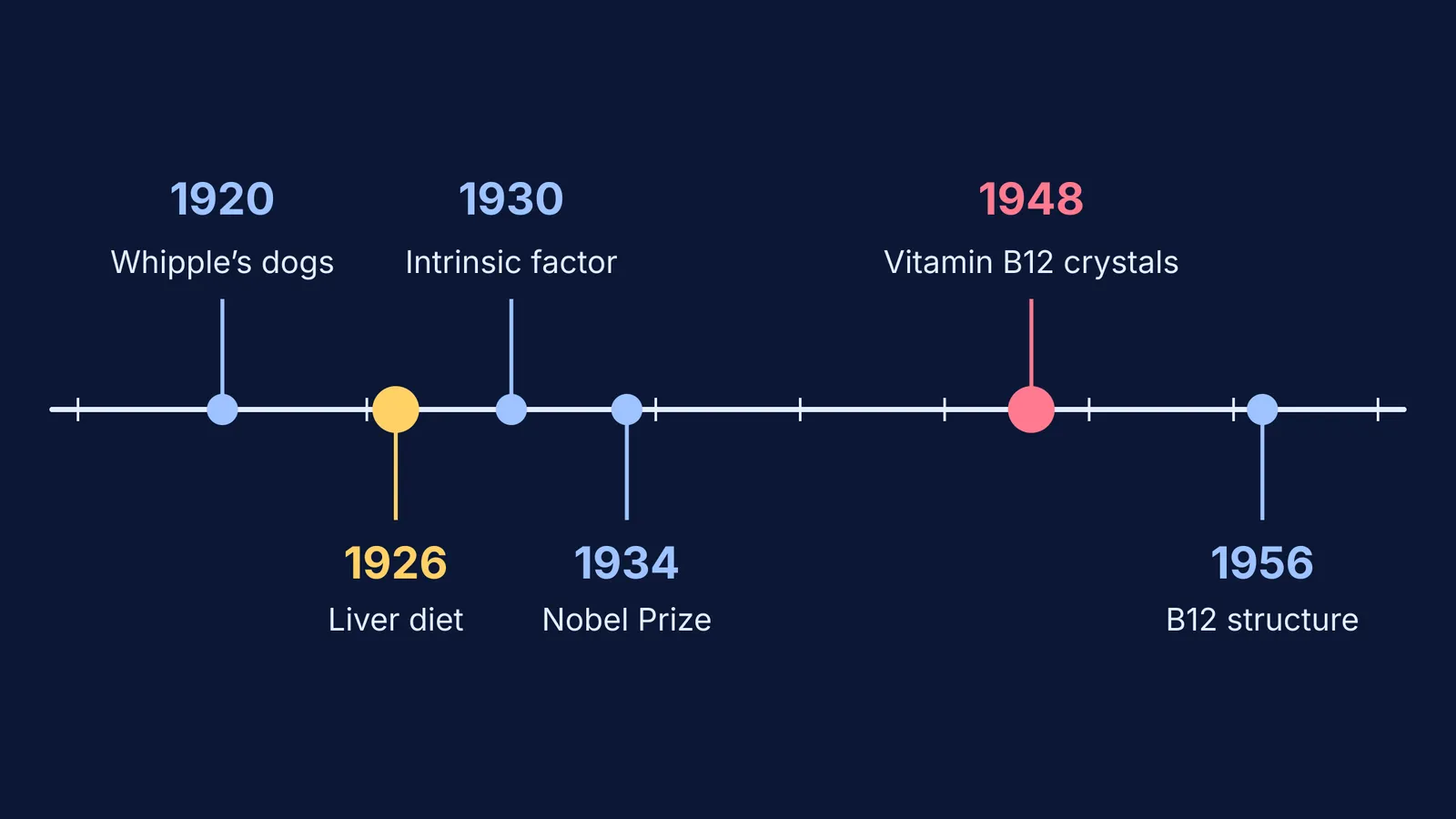
The clue came from George Whipple. According to the Nobel speech, Whipple began in 1920 to bleed dogs and feed them different foods, and found that liver rebuilt their blood best, then kidney, then meat. George Minot and William Murphy wondered whether the same foods might help pernicious anaemia, which most doctors thought was a completely different disease.
The James Lind Library's history of pernicious anaemia says Minot and Murphy described their results in 45 patients at a meeting in Boston on 4 May 1926. Their daily diet "contained 120-240 grams of liver and 120 grams of muscle meat". Their paper, Treatment of pernicious anemia by a special diet, appeared in JAMA on 14 August 1926.
William Murphy, Reginald Fitz and Robert Monroe reported the blood changes in detail. Within four to ten days of starting the diet, the same source reports, the reticulocyte count rose "from 1 per cent to an average of 8 per cent".
Reticulocytes are immature red blood cells made in the bone marrow, according to MedlinePlus. A jump in their number meant the marrow was working again; Minot later showed the value of this reticulocyte response for judging treatments, as his Nobel biography notes.
Why did eating liver cure pernicious anaemia?
The cure overturned the theory. Doctors had believed some poison was damaging the bone marrow. The Nobel speech explains that the liver result pointed the other way: the disease was "due rather to the absence of a substance" needed to make red blood cells, a substance present in liver.
It was not an easy cure. The same speech says patients often had to eat three to six hundred grams of liver a day, and keep eating it to stay well. Minot then worked with Edwin J. Cohn on fractions of liver, his Nobel biography records. By 1934, the speech adds, the active substance had been concentrated so far that an injection of less than a gram kept the blood normal for a fortnight.
In 1930 William Castle discovered and named "intrinsic factor", a substance from the stomach, as the James Lind Library describes. Today the NHS defines pernicious anaemia as an autoimmune condition that affects the stomach, and explains that vitamin B12 must combine with intrinsic factor to be absorbed in the distal ileum.
How did the liver clue lead to vitamin B12?
Chemists spent two decades hunting for the active substance. In April 1948 two groups reported it almost together: Karl Folkers' team at Merck published Crystalline vitamin B12 in Science, and E. Lester Smith published Purification of anti-pernicious anaemia factors from liver in Nature. The James Lind Library notes that they showed "a few micrograms could prevent relapse".
In 1956 Dorothy Hodgkin's team published the structure of vitamin B12 in Nature, worked out with X-ray crystallography.
How can you use this story when revising biology?
Discovery stories stick when you turn them into a chain of clues. Try these four questions on any textbook experiment:
What was observed? Pernicious anaemia patients had too few, misshapen red cells, and almost all died.
What was the guess? Foods that rebuilt blood in Whipple's bled dogs might help.
What was the test, and what was measured? A liver-rich diet, with reticulocyte counts checked within days.
What did the result change? The disease was a missing substance, not a poison, and the search led to vitamin B12 and intrinsic factor.
Now write the same chain, from memory, for two related stories: Lucy Wills and the discovery of folic acid in Bombay and how Joseph Goldberger proved pellagra was a diet disease.
If a link in your chain is shaky, say what intrinsic factor does or how bone marrow makes red cells, the Fermi Concept Library has each concept with its own lesson and its place in the map, so you can see how the pieces connect.
Should you eat liver to get vitamin B12?
Not as a treatment. The NHS says a diet that includes meat, fish and dairy usually provides enough vitamin B12, and that people on a vegan diet who skip supplements or fortified foods are at risk. Pernicious anaemia is an absorption problem, so it needs a doctor, not a diet plan.
Minot and Murphy's lesson for a student is simpler: take an odd clue seriously, measure something early and clearly, and let the result change your theory.


