

On this page
In 1928 the British doctor Lucy Wills began work in Bombay on a severe anaemia of pregnancy that was common among poorer women, particularly those in the textile industry (Wikipedia). Her breakthrough came from a sick monkey, a jar of Marmite and a careful comparison in patients. The substance she found, the ‘Wills factor’, was later recognised as folic acid, which the WHO now recommends for pregnant women.
Who was Lucy Wills?
Wills took a double first in botany and geology at Cambridge in 1911, nursed in South Africa during the First World War and gained a medical degree in London in 1920, according to a biography by Hilda Bastian. By the late 1920s she had turned to haematology, the study of blood, and begun travelling to India. She was born on 10 May 1888 and died in 1964 (James Lind Library).
What anaemia did Lucy Wills study in Bombay?
Margaret Balfour, working at the Haffkine Institute in Bombay, had noticed a particularly severe and often fatal form of anaemia in pregnancy, and Wills came to investigate it (James Lind Library). Doctors then called it ‘pernicious anaemia of pregnancy’ (Bastian).
Macrocytic anaemia is anaemia in which the red blood cells are larger than normal, and that is what these women had (Wikipedia).
Wills did not jump to an answer. She looked at possible infections and living conditions as well as diet, plating stool samples and running Widal blood tests, before the evidence pointed to food (James Lind Library).
How did Lucy Wills discover folic acid?
Her work can be read as five steps, a clear example of the scientific method at work.
Suspect the diet. The illness was worst among poorer women with poor diets (Wikipedia).
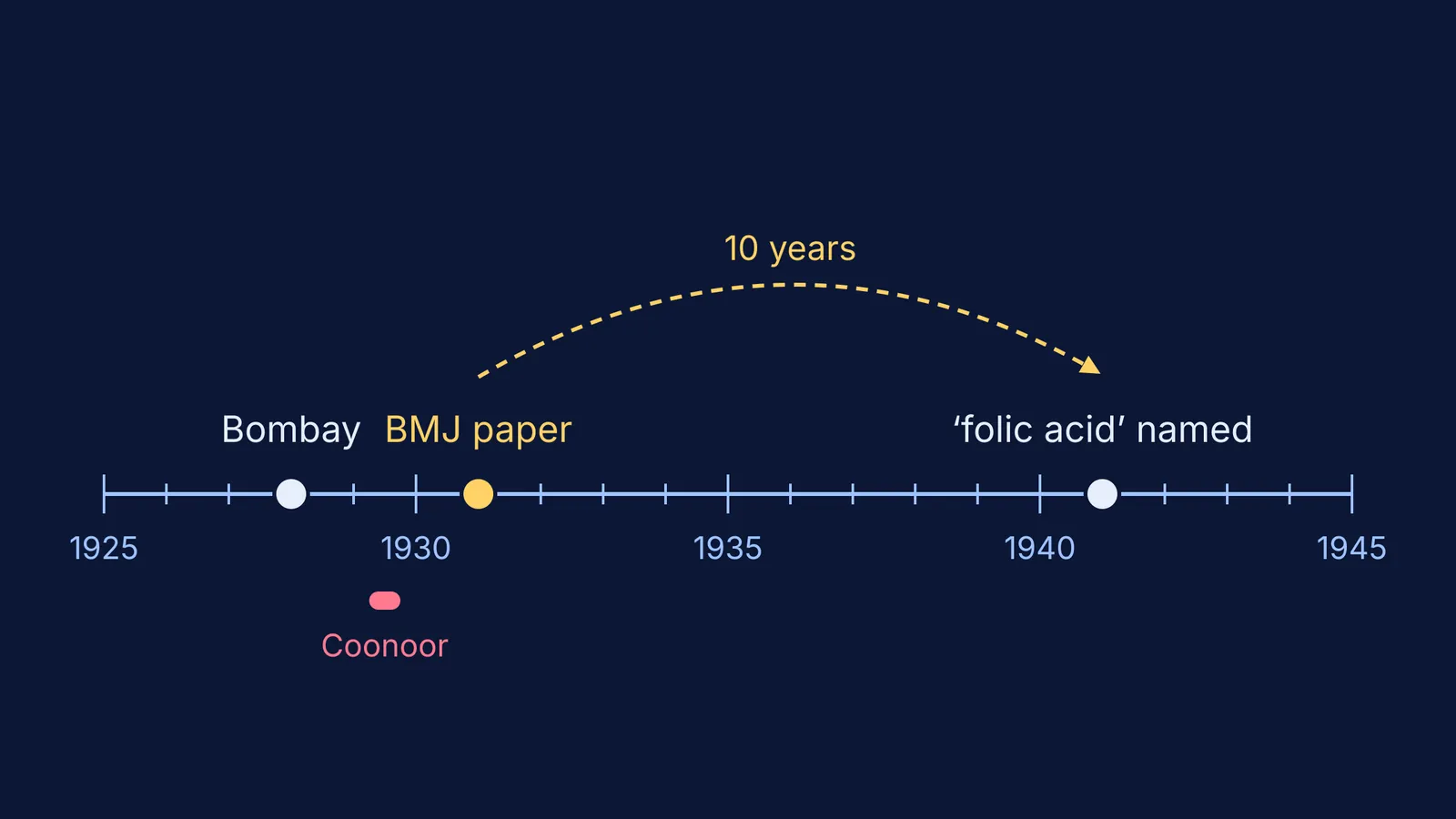
Test in animals. From April to October 1929 she worked at the Pasteur Institute of India in Coonoor, where Robert McCarrison directed nutrition research. Her rat results were spoiled by a lice infection, so she repeated the work in rhesus monkeys (Wikipedia).
Follow the surprise. One monkey did especially badly. Wills tried Marmite, a cheap yeast extract, and it had a dramatic effect; Bastian notes that her reason for trying it is not recorded (James Lind Library).
Compare treatments in patients. Back in Bombay she treated women with macrocytic anaemia. The Embryo Project's summary of her paper describes eight cases, four given liver and four given Marmite. In one pregnant woman given Marmite, the red blood cell count rose from 990,000 to 2,490,000 and the haemoglobin reading from 18% to 50%.
Publish. Her paper, ‘Treatment of “pernicious anaemia of pregnancy” and “tropical anaemia”’, appeared in the British Medical Journal in 1931.
Notice what she did not know. Marmite worked, but nobody could yet say which molecule inside it was doing the work. That came a decade later: ‘folic acid’ was named in 1941, when it was isolated from spinach (James Lind Library; Mitchell, Snell and Williams, 1941), and the Wills factor was later recognised as folic acid (Bastian). Making it in the laboratory is part of the story of Yellapragada Subbarow, who worked on folic acid and early cancer drugs.
Try this with any discovery story: ask what was ruled out, what was compared, and what was still unknown at the end.
Why does a lack of folate cause anaemia?
Folic acid, or vitamin B9, is a water-soluble B vitamin that helps produce DNA and form red and white blood cells (MedlinePlus). Because the body does not store much folate, blood levels can fall after only a few weeks of low intake (same source). Pregnancy adds demand, since folic acid is needed for a baby in the womb to grow properly (MedlinePlus).
To see where this fits in your syllabus, revise vitamins and their deficiency diseases in Class 12 chemistry alongside the formed elements of blood.
If vitamins, haemoglobin and blood cells feel like separate lists, the Fermi Concept Library gives every concept in biology and chemistry its own lesson and its place in the map, so you can see how folate links to red blood cells.
Why does Lucy Wills's work still matter in India?
The World Health Organization recommends daily oral iron and folic acid for pregnant women, with 30 mg to 60 mg of elemental iron and 400 µg of folic acid (WHO). The same WHO page says more than 40% of pregnant women worldwide have anaemia.
In India, the National Family Health Survey (NFHS-5) found that more than half of women, including pregnant women, are anaemic at the all-India level (Press Information Bureau).
The next time you see folic acid on a label, remember that it began as a spoonful of yeast extract in Bombay.


