

On this page
In 1914 the US Public Health Service sent Joseph Goldberger to the American South to investigate pellagra. Between 1900 and 1940 the United States recorded about three million pellagra cases and a hundred thousand deaths, according to the Science History Institute. Most doctors were sure a germ caused it. Goldberger showed, using nothing but food, that they were wrong.
Pellagra is due to a lack of the vitamin niacin and/or its precursor tryptophan, an essential amino acid, says the World Health Organization. Its signature signs are the "4 Ds": diarrhoea, dementia, dermatitis and death (Schmitz and Lowenstein, 2018).
Why did doctors think pellagra was caused by a germ?
Pellagra clustered in crowded institutions such as orphanages and asylums, and clusters look like infection. But Goldberger spotted a clue that did not fit. These places had hundreds of cases among residents and zero among the doctors and nurses, even though staff were in constant contact with patients (Science History Institute).
A germ would not pick out only the residents. Goldberger suspected the menu instead. Poor Southerners lived largely on the "3M" diet: cornmeal, molasses and fatback pork, as the same article describes.
How did Goldberger prove pellagra was a diet disease?
He changed the food and watched what happened. The work is summarised, with long extracts from his 1915 reports, by epidemiologist Alfredo Morabia in the James Lind Library.
In 1914 he began at two orphanages in Jackson, Mississippi, which had seen 79 and 130 pellagra cases that summer. Both sharply increased fresh animal and legume protein: milk, buttermilk, eggs, beans and peas. A year on, one orphanage had no recurrences among 67 children who had had pellagra, and the other had 1 recurrence among 105. Among 168 children who had never had it, there were no new cases.
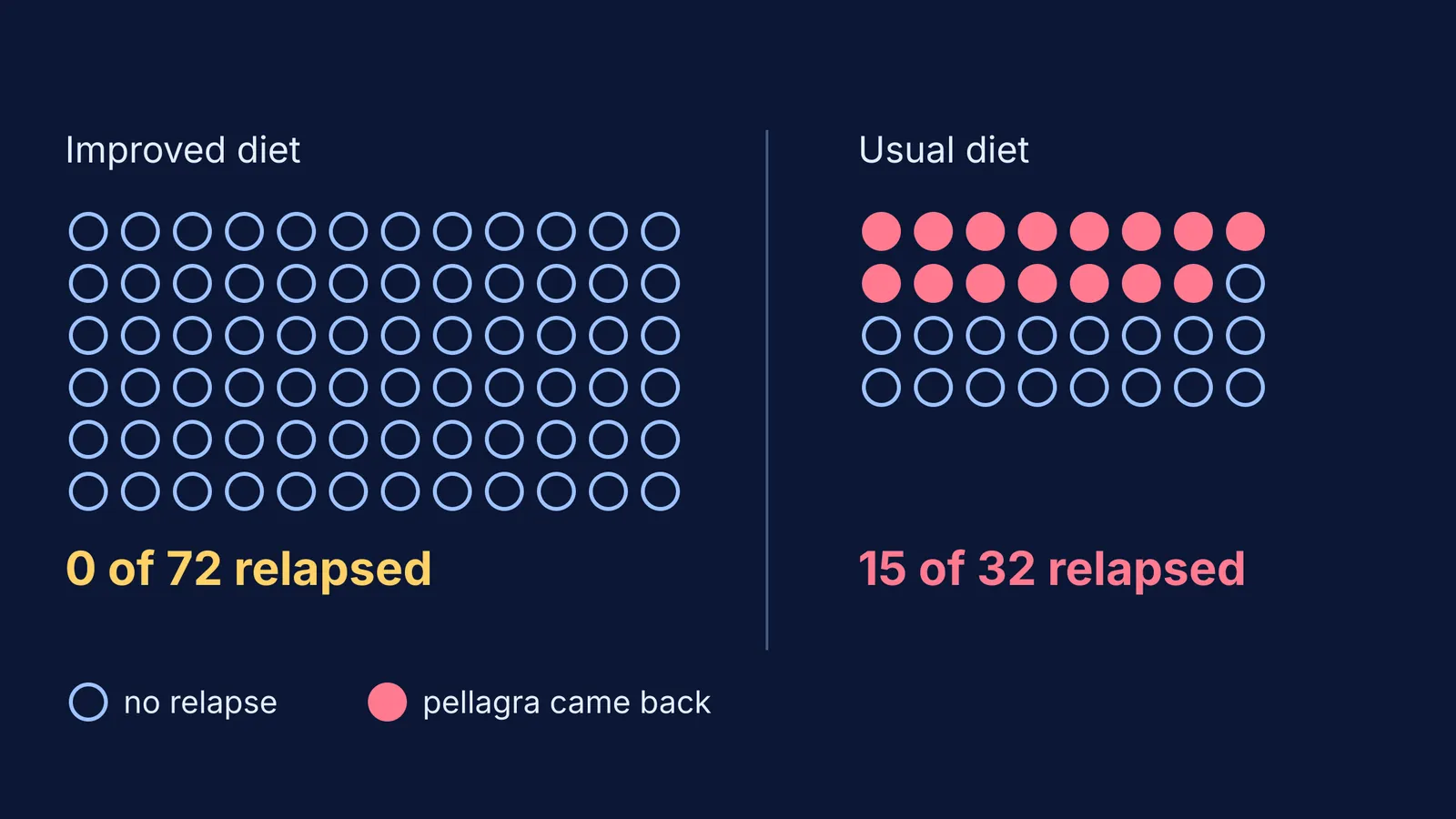
At the Georgia State Sanitarium, an asylum, two wards of 40 pellagra patients each got a similar diet from late 1914. By 1 October 1915 there were no recurrences among the 72 women still under observation. Women with pellagra in other wards, left on the usual diet, relapsed: 9 of 17 in one group and 6 of 15 in the other, about 47% overall (James Lind Library).
What did the prison experiment show?
Preventing a disease is half a proof. The other half is causing it. In 1915, at the Rankin prison farm in Mississippi, healthy volunteer prisoners were offered pardons to eat a diet of corn grits, pork fat and syrup. At the end of the roughly six-month trial, 6 of 11 had developed pellagra (Schmitz and Lowenstein, 2018). The men were kept in clean cells, so dirt was not the explanation (Science History Institute). An experiment like this on prisoners would face strict ethics review today.
Critics still held out, so in spring 1916 Goldberger hosted eight "filth parties" with 17 guests, including his wife, Mary. Volunteers swallowed and injected material from pellagra patients (Science History Institute). None of them got pellagra.
What was the missing factor in maize?
Goldberger died in 1929, aged 54, before the molecule was named (Science History Institute). In 1937 researchers at the University of Wisconsin identified the cause of pellagra as niacin deficiency (Schmitz and Lowenstein, 2018). That year Conrad Elvehjem and colleagues published a paper linking nicotinic acid to canine black tongue, a pellagra-like disease in dogs. Nicotinic acid is now called niacin, or vitamin B3.
The WHO notes that pellagra is classically associated with a diet based on maize that has not been treated with alkali (WHO). Goldberger's story sits alongside James Lind's 1747 scurvy trial and Christiaan Eijkman's work on beriberi, two more cases where a missing nutrient looked like an infection.
If vitamins and deficiency diseases feel hazy in your biology syllabus, the Fermi Concept Library gives each concept in biology and chemistry its own lesson and its place in the map. And if you are worried about your own diet, talk to a doctor or a registered dietitian rather than self-dosing vitamins.
How can you run a fair test like Goldberger?
His method works on everyday questions too. Say you want to know whether testing yourself beats rereading notes (why rereading feels like learning).
Name the rival explanations. Germ or diet for him; method or easier chapters for you.
Look for the clue that does not fit, like the healthy nurses.
Change one thing only. He changed the food and kept everything else the same.
Keep a comparison group. Revise two similar chapters, one each way.
Test from both sides: remove the suspected cause, then add it back.
Write the numbers down before you decide, the way he counted relapses.
Worked example: you revise one physics chapter by rereading and a similar one with closed-book recall, then take the same 20-question quiz on each a week later. If you score 9 and 15, you have a result worth repeating on the next pair of chapters. One trial is a clue, not a proof; Goldberger needed orphanages, an asylum and a prison before the case closed.


