

On this page
For most of the last century, many Indian trains stopped using nothing more than the weight of the air. A vacuum brake pulls air out of a pipe and lets the atmosphere push a piston. That makes it simple and fail-safe, but it also puts a hard ceiling on the force: you can never push harder than one atmosphere. A compressed-air brake has no such ceiling, and that one fact explains a lot of why Indian Railways changed over. This post works out the force on a single brake piston in each system, with figures taken from an Indian Railways training document.
How does a vacuum brake work?
A training presentation on braking systems used in Indian Railways, hosted by IRIMEE, the Indian Railways Institute of Mechanical and Electrical Engineering, sets out the system.
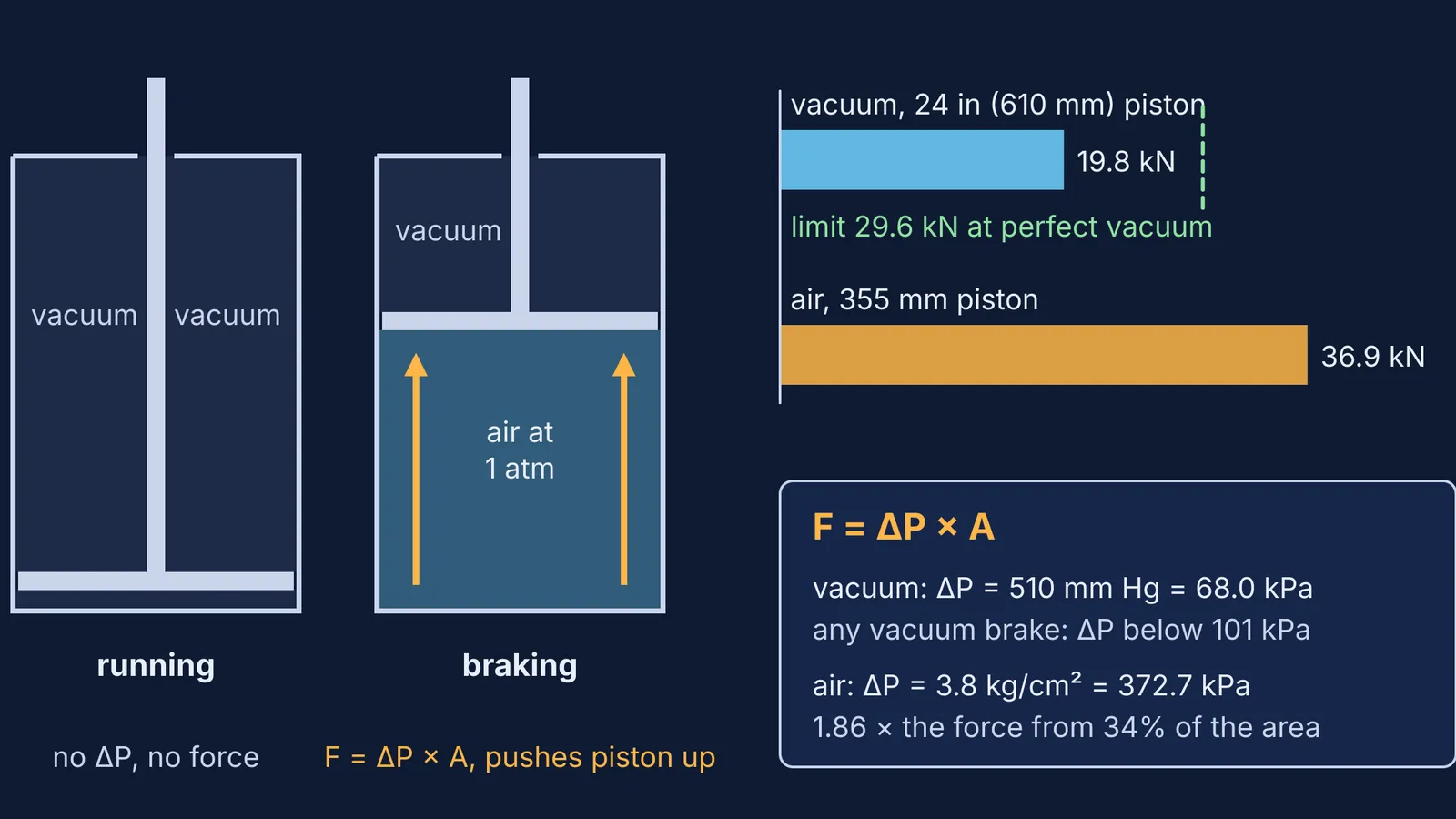
Running. An ejector or exhauster on the locomotive pulls air out of a single train pipe that runs the length of the train. The pipe connects to a brake cylinder under each coach. Air is drawn from both sides of the piston, so there is no pressure difference and the piston rests at the bottom under its own weight.
Braking. Air is let back into the train pipe. It reaches the space below each piston, but a valve stops it getting above, where the vacuum stays. Atmospheric pressure below and vacuum above push the piston up.
Rigging. The piston rod works a set of levers that press the brake blocks onto the wheels.
If a coupling parts, air rushes into the pipe and every coach brakes. That is the fail-safe feature, which the vacuum brake shares with the compressed-air brake that George Westinghouse patented. Using the atmosphere to push a piston is an old idea: Newcomen's atmospheric engine did the same with steam condensed under the piston.
What limits the force from a vacuum brake?
Force on a piston is the pressure difference across it times its area:
F = ΔP × A
In a vacuum brake, ΔP is the difference between the atmosphere below and the partial vacuum above. Even a perfect vacuum can only make ΔP equal to atmospheric pressure, about 101 kPa (the IRIMEE document uses 1.03 kg/cm², which is 101.0 kPa). No pump on the locomotive can change that. The only way to get more force is a bigger piston.
The same document gives the figures for Indian Railways' vacuum brake: a nominal vacuum of 510 mm in the train pipe and a 24-inch brake cylinder.
Worked example: how much force does a 24-inch vacuum cylinder give?
Convert the vacuum to a pressure difference. A vacuum of 510 mm of mercury means the pressure above the piston is 510 mm of mercury below atmospheric. ΔP = ρgh = 13,595 kg/m³ × 9.807 m/s² × 0.510 m = 68.0 kPa. That is 67% of an atmosphere.
Find the piston area. 24 inches = 609.6 mm, so the radius is 0.3048 m. A = π × 0.3048² = 0.292 m².
Multiply. F = 68.0 × 10³ Pa × 0.292 m² = 19,800 N, about 19.8 kN.
The ceiling. With a perfect vacuum, F = 101.3 × 10³ × 0.292 = 29.6 kN. No vacuum brake of this size can ever beat that.
Check units. Pa × m² = (N/m²) × m² = N. Good.
How much more does an air-brake cylinder give?
In the compressed-air brake, the locomotive charges the brake pipe to 5 kg/cm² and, in the twin-pipe system used on coaches, a feed pipe to 6 kg/cm². When the driver reduces brake-pipe pressure, a distributor valve on each coach lets air from a reservoir into the brake cylinder. The IRIMEE document gives the air-brake cylinder as 355 mm in diameter with a maximum pressure of 3.8 ± 0.1 kg/cm².
Convert the pressure. 1 kgf/cm² = 98,066.5 Pa, so 3.8 kg/cm² = 372.7 kPa. This is a gauge pressure: the other side of the piston is at atmospheric pressure, so 372.7 kPa is the pressure difference.
Area. A = π × 0.1775² = 0.0990 m².
Force. F = 372.7 × 10³ × 0.0990 = 36,900 N, about 36.9 kN.
Compare. 36.9 / 19.8 = 1.86 times the vacuum brake's force, from a piston with only 34% of the area. The pressure difference is 5.5 times larger, which more than makes up for the smaller piston.
To match 36.9 kN with a 68.0 kPa vacuum, you would need an area of 0.542 m², a cylinder 831 mm across. That is why a vacuum brake needs big, heavy cylinders.
Why else did Indian Railways move to air brakes?
The force ceiling is only part of the story. The same IRIMEE document lists other differences.
Long trains. Air must flow into the train pipe from the locomotive end and from valves along the train, and in a long pipe it takes time to reach the far end. The document notes a steep fall in vacuum along trains longer than 600 m, while air-brake pressure stays nearly even up to 2,000 m.
Stopping distance. For a 4,500 t freight train at 65 km/h on level track, it gives an emergency braking distance of 632 m with air brakes against 1,097 m with vacuum brakes.
Weight. About 275 kg of brake equipment per wagon for air brakes against 700 kg for vacuum.
High altitude. The vacuum brake works against atmospheric pressure, which is lower on hills, so its maximum force is lower there too.
How braking distance depends on speed and deceleration is covered in why trains take so long to stop, so it is not repeated here.
The change-over took years. A Ministry of Railways press release of June 2003 said all new rolling stock was being built with air brakes, about 70% of existing coaches had already been fitted, and older coaches were being converted during their periodic overhauls.
What is the physics to take away?
Pressure-difference problems look easy, but they reward care with units and with which pressures you subtract. Practise a few with the Fermi Problem Library, whose step-by-step solver explains the reasoning, and look up gauge and absolute pressure in the Concept Library if the difference is still fuzzy.
Quick checklist
Vacuum brake: atmosphere below the piston, vacuum above. ΔP can never exceed about 101 kPa.
510 mm of mercury = ρgh = 68.0 kPa.
24-inch vacuum cylinder: 0.292 m², 19.8 kN; 29.6 kN even with a perfect vacuum.
Air brake: 3.8 kg/cm² = 372.7 kPa gauge on a 355 mm piston gives 36.9 kN.
F = ΔP × A, with ΔP the difference across the piston, not an absolute pressure.
Piston force is multiplied by rigging before it reaches the wheel.
Both systems are fail-safe: a broken pipe applies the brakes.


