

On this page
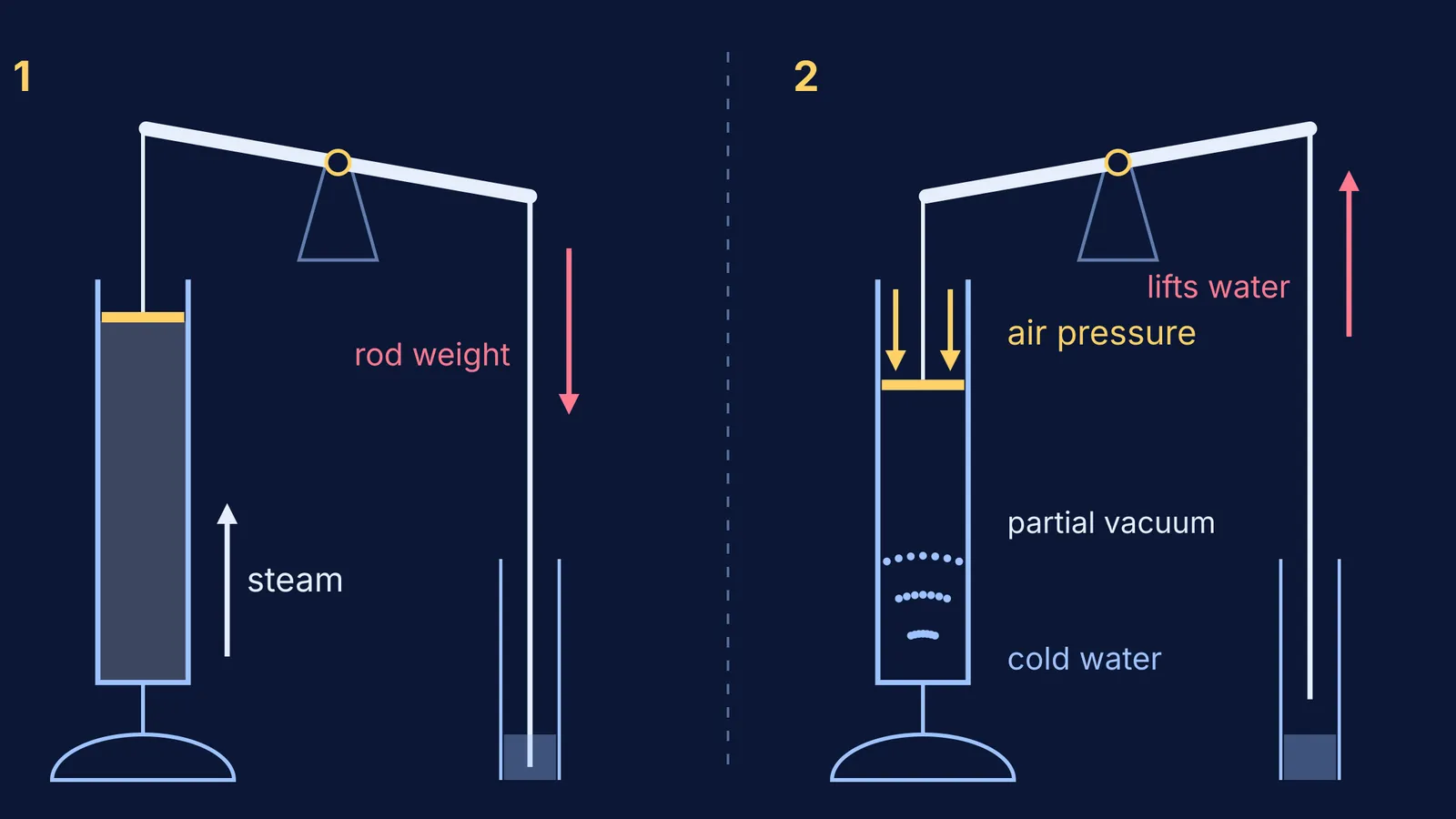
In 1712, Thomas Newcomen (1663–1729) of Dartmouth and his assistant John Calley built a mine-pumping engine near Dudley Castle in England's West Midlands, which the American Society of Mechanical Engineers' landmark brochure calls his first successful engine. Its trick is pure Class 11 physics: the steam did not push the piston down. The air did.
What problem was Newcomen's engine built to solve?
According to the ASME brochure, by the late 1600s British coal mines had grown so deep that many flooded and were abandoned, because the pumps of the day could not cope. Thomas Savery's 'Miner's Friend', patented in 1698, suited only modest lifts; the Linda Hall Library notes it could raise water only about 30 feet and was very inefficient.
Suction has a hard limit: the whole atmosphere only balances about 10 metres of water (why every 10 metres of water adds one atmosphere). Newcomen's piston instead hung from one end of a huge rocking beam, with pump rods running down the shaft from the other end.
How did the Newcomen atmospheric engine work?
The ASME brochure describes one cycle like this:
The pump rods outweigh the piston, so their weight tips the beam and pulls the piston up.
As the piston rises, steam from the boiler below, at about atmospheric pressure, fills the cylinder.
The steam valve closes and a jet of cold water sprays into the cylinder, condensing the steam and leaving a partial vacuum under the piston.
Atmospheric pressure on the open top of the piston forces it down: the working stroke, which rocks the beam and lifts water.
The cycle repeated around 12 times a minute, according to the history of the Newcomen engine. A plug rod on the beam soon worked the valves automatically.
How much force could air pressure give?
The Dictionary of National Biography gives the Dudley Castle cylinder as 21 inches in diameter and 7 feet 10 inches high. Standard atmospheric pressure is exactly 101,325 Pa (NIST).
Area: 21 inches is 0.533 m, so πr² is about 0.223 m².
Force with a perfect vacuum: 101,325 Pa × 0.223 m² is about 22,600 N, roughly the weight of 2.3 tonnes.
The real vacuum was partial. If the inside pressure fell to a quarter of an atmosphere (an assumption for illustration), the net push would be about 17,000 N.
Why does a spray of water make such a good vacuum? At 1 atmosphere, 1 kg of steam fills 1.6732 m³; as liquid water it fills only 0.0010434 m³ (NIST Chemistry WebBook). So steam shrinks about 1,600 times when it condenses: Newcomen's 0.53 m³ cylinder held roughly 0.32 kg of steam, which becomes about a third of a litre of water.
The crushed-can experiment is the same stroke without the piston. If pressure is still hard to picture, the Fermi Simulation Lab has interactive simulations for ideas that are easier to see than to read.
What did James Watt improve in Newcomen's engine?
The University of Glasgow says James Watt, then working as its instrument maker, was asked to repair the university's model Newcomen engine in the winter of 1763–1764. He realised that a great deal of heat was wasted because the same cylinder was cooled and reheated on every stroke. His answer, the separate condenser of 1765, condensed the steam in a different chamber so the cylinder could stay hot. Watt's first patent, granted in January 1769, was for "a new method of lessening the consumption of steam and fuel in fire-engines".
Until then, Newcomen's design ruled. The ASME brochure counts at least 95 engines in Britain by 1733, and notes that Watt's ideas only worked at full scale in 1776, when about 600 Newcomen-type engines had been built in Britain. The Science Museum Group says Newcomen's invention "turned the steady advance of industrial progress into an industrial revolution, by making possible the drainage of deep mines". Steam later moved onto wheels with Richard Trevithick's first steam locomotive.
How do you explain the Newcomen engine in an exam answer?
The classic slip is writing "the steam pushed the piston down". Check your answer covers four points:
Steam: the boiler fills the cylinder at about atmospheric pressure while the pump rods' weight lifts the piston.
Vacuum: a cold-water spray condenses the steam, which shrinks about 1,600 times (NIST data).
Work: atmospheric pressure drives the piston down, and the beam passes that force to the pumps.
Weakness: cooling and reheating one cylinder wastes heat every stroke, which Watt's separate condenser fixed.
The Newcomen Memorial Engine in Dartmouth has a 22-inch cylinder, says the ASME brochure.
If you get stuck on a pressure numerical like this, the Fermi Problem Library has worked problems with a step-by-step solver that explains the reasoning rather than printing an answer.
Next time you see a crushed can, you are looking at the push that once drained England's coal mines.


