

On this page
In the early 1800s, steam engines were massive, stationary machines typically used to pump water out of deep mines. James Watt's separate condenser and the physics of wasted heat had made low-pressure engines far more efficient than their predecessors, but they remained entirely too bulky to move themselves. Richard Trevithick, a skilled Cornish mining engineer who had grown up surrounded by these towering beam engines, realised that a completely different approach could set steam power free. By ditching the bulky condenser entirely and using steam at much higher pressures, he could build an engine that was light and compact enough to drive itself along a track.
On 21 February 1804, Trevithick put this idea to the ultimate test at the Penydarren Ironworks in Merthyr Tydfil, Wales. His unnamed locomotive became the very first in history to haul a train along rails.
How did the 1804 locomotive come to be?
The historic journey was not just a scientific demonstration; it was the result of a high-stakes wager. Trevithick had been working at the Penydarren Ironworks, owned by the ironmaster Samuel Homfray. Recognising the vast potential of Trevithick's high-pressure steam engine, Homfray made a 500-guinea bet with his rival, Richard Crawshay. Homfray wagered that Trevithick's new locomotive could successfully haul a massive load of iron along the Merthyr Tramroad from Penydarren to the Glamorganshire Canal at Abercynon.
This substantial bet provided the motivation and funding for Trevithick to adapt his high-pressure boiler design into a moving machine. He mounted the boiler and cylinder on wheels, creating an engine that relied on its own internal pressures to do the work that massive external condensers had done previously.
Why was high-pressure steam important?
Trevithick’s engine relied on "strong steam", operating at high pressures compared to the near-atmospheric pressure typical of Watt’s condensing engines. This fundamentally changed the engineering calculations, dramatically increasing the power-to-weight ratio. By working at high pressure, the engine could produce the exact same mechanical power from a much smaller cylinder. This meant the boiler could be built strongly enough to withstand the pressure while still being small enough to fit on a moving carriage.
Crucially, the high-pressure design meant the condenser and its heavy water supply could be eliminated entirely. Instead of turning steam back into water to create a vacuum, Trevithick exhausted the spent, high-pressure steam directly into the surrounding atmosphere. This simple but profound change made the locomotive light enough to travel across land.
How did smooth wheels grip the rails?
Before 1804, many engineers argued that smooth iron wheels on smooth iron rails would simply spin in place without moving forward. They incorrectly assumed that a toothed rack-and-pinion gear was absolutely necessary to haul heavy loads along a track.
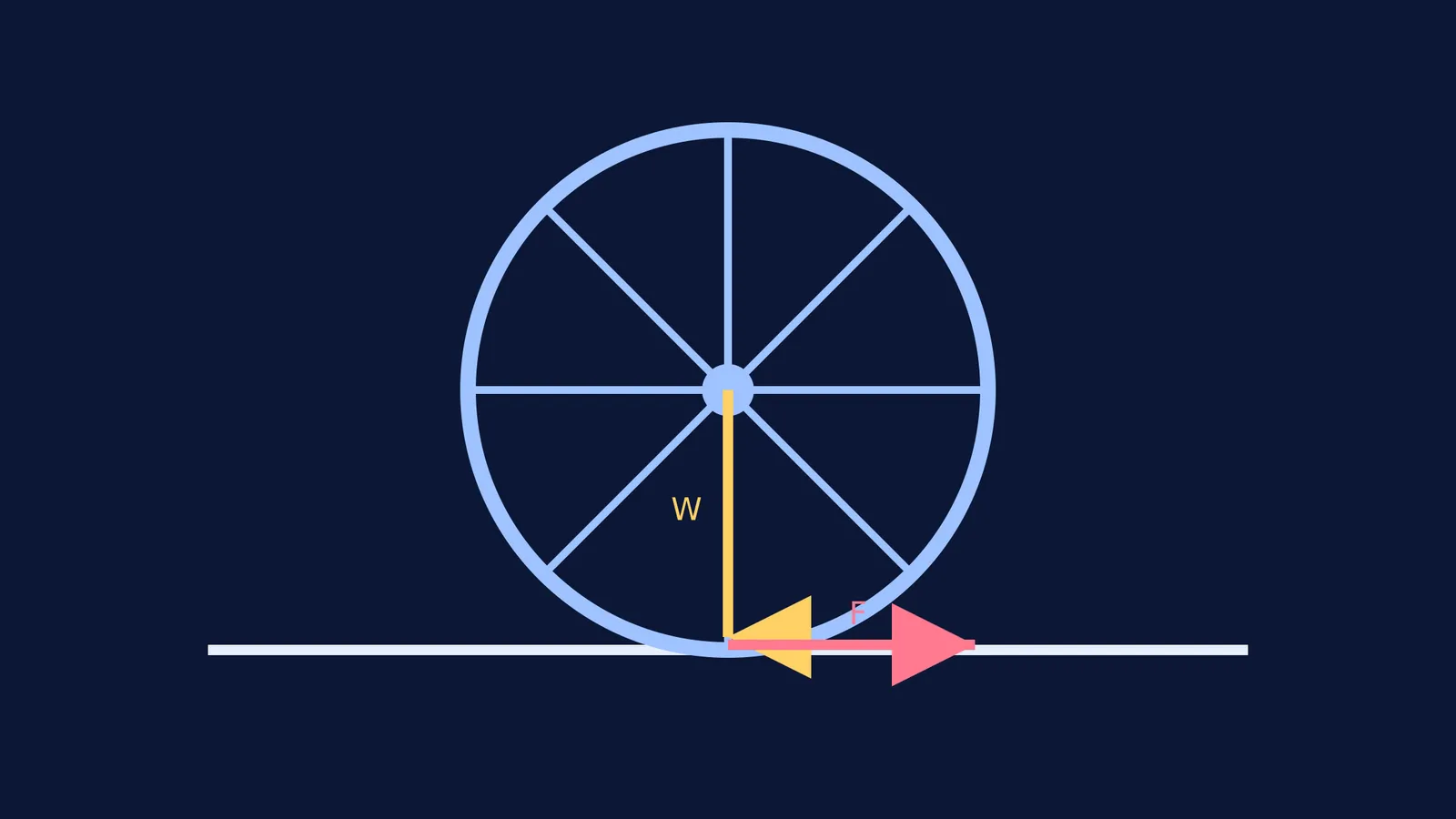
Trevithick proved the principle of adhesion. He demonstrated that the locomotive's weight created a large downward normal force. This "adhesive weight" generated enough tractive friction between the wheels and the rails to pull a heavy train, provided the track's gradient was gentle.
When studying forces, friction and motion, visualising these interactions makes them clear. The Fermi Simulation Lab offers interactive simulations for the ideas that are easier to see than to read, letting you adjust masses and surfaces to explore how objects grip and move in real time.
What happened on the first journey in 1804?
During the historic run, the Penydarren locomotive successfully hauled 5 wagons carrying 10 tons of iron and 70 men. The train covered a total distance of 9.75 miles (15.69 km). The journey took 4 hours and 5 minutes, at an average speed of 2.4 mph (3.9 km/h).
While the locomotive successfully proved the physics of high-pressure steam and adhesion, it was ironically too heavy for the cast-iron tramroad plates of the time. The engine frequently broke the rails, which had originally been designed for lighter horse-drawn wagons. As a result, the Penydarren locomotive was ultimately converted back into a stationary engine to drive a hammer at the ironworks.
Despite the fragile tracks, the 1804 journey laid the foundation for the railway age. Trevithick's high-pressure boiler and horizontal cylinder set the architecture for the century of steam that followed, paving the way for George Stephenson and the friction that made railways work.


