

On this page
Before a vaccine reaches anyone, it passes a series of tests in people called phases, and each phase asks a different question. Learn those questions and the one-line formula behind "efficacy", and you can judge any vaccine headline yourself.
What are phase 1, 2 and 3 vaccine trials?
The US Centers for Disease Control and Prevention (CDC) sets out the stages in its guide to how vaccines are tested and approved:
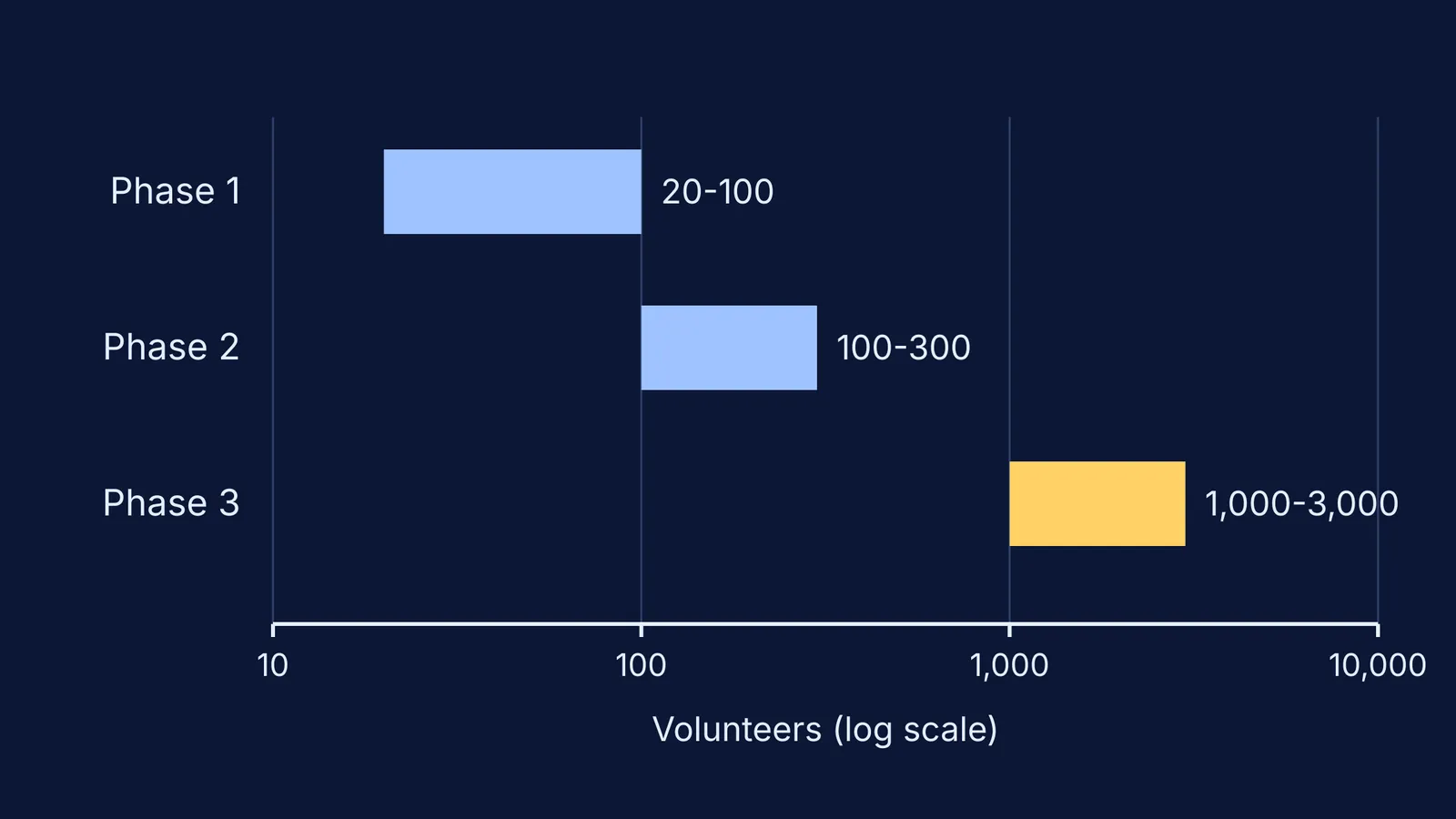
Phase 1 gives the trial vaccine to a small group of 20 to 100 people, mainly to check safety, side effects and whether it triggers an immune response.
Phase 2 expands to hundreds of people (100 to 300) similar to those the vaccine is meant for, and collects more safety and immune-response data.
Phase 3 enrols thousands of people (1,000 to 3,000) to confirm that the vaccine works and to watch for both common and uncommon side effects.
Phase 4 is a formal, ongoing study after approval that tracks safety and effectiveness over a longer period.
These are typical numbers. The US FDA's overview of clinical research gives phase 3 as 300 to 3,000 volunteers for medicines in general. Vaccine trials can be far larger: the phase 3 trial of the Pfizer-BioNTech COVID-19 vaccine randomised 43,548 people, according to its report in the New England Journal of Medicine.
Why so many? A side effect seen in one person in several thousand will almost never show up in a group of 50, so each phase is bigger than the last.
How is vaccine efficacy calculated from case counts?
In a phase 3 trial, volunteers are randomly split: one group gets the vaccine, the other a placebo, which India's New Drugs and Clinical Trials Rules, 2019 define as an inactive substance that looks identical to the drug being tested. Researchers then count who falls ill.
The CDC's epidemiology course gives the vaccine efficacy formula: efficacy = (risk in the unvaccinated group minus risk in the vaccinated group) divided by the risk in the unvaccinated group. Written another way, efficacy = 1 minus the risk ratio.
India's 2019 rules also separate two words headlines mix up: efficacy is the effect in a controlled clinical setting, and effectiveness is the effect in the real world after approval.
How does the efficacy maths work for Covaxin?
Bharat Biotech's Covaxin (BBV152) was tested on 25,798 adults at 25 hospitals or clinics in India, according to the phase 3 results in The Lancet02000-6). In the main analysis there were 24 symptomatic COVID-19 cases among 8,471 vaccine recipients and 106 cases among 8,502 placebo recipients:
Risk in the vaccine group: 24 divided by 8,471 is 0.0028, or about 0.28%.
Risk in the placebo group: 106 divided by 8,502 is 0.0125, or about 1.25%.
Risk ratio: 0.28% divided by 1.25% is about 0.227.
Efficacy: 1 minus 0.227 is 0.773, or about 77%.
The paper reports 77.8% (95% confidence interval 65.2 to 86.4) from its full statistical analysis; the simple version lands within a point of it. The confidence interval gives the range of efficacy values the data support. The Pfizer-BioNTech trial shows a shortcut.
A 77% efficacy does not mean 23% of vaccinated people got sick; only 0.28% did during the trial. It means the vaccinated group had about 77% fewer cases. Our probability practice questions for JEE Main train the same ratio habits.
What does CDSCO do in Indian vaccine trials?
The Central Drugs Standard Control Organisation (CDSCO) regulates trials under the New Drugs and Clinical Trials Rules, 2019. Its decision-maker, the Central Licencing Authority, is the Drugs Controller, India. Under those rules:
A vaccine always counts as a "new drug", so its trials need permission from the authority.
The authority must decide on an application within 90 working days, or 30 for a drug discovered in India, or developed and to be made and sold here.
Each trial site needs approval from a registered Ethics Committee before it starts.
Every trial must be registered with the Clinical Trial Registry of India, run by ICMR, before the first volunteer is enrolled.
Serious adverse events must be reported to the authority within 14 days, and the authority can inspect sites, suspend a trial or reject its results.
How should you read a vaccine trial headline?
Which phase? A phase 1 result is about safety, not proof of protection.
How many cases in each group? Few cases means a wide confidence interval.
Efficacy (a trial) or effectiveness (real-world use)?
Registered and approved? In India, look for a CTRI number.
For more, read why some vaccines are swallowed and others injected and the difference between an epidemic, endemic disease and a pandemic.
If the risk-ratio steps still feel shaky, the Fermi Problem Library has worked problems with a step-by-step solver that explains the reasoning rather than printing an answer. If the gap is in the biology, the Fermi Concept Library gives every biology concept its own lesson.
Whether a particular vaccine is right for you or your family is a question for a doctor.


