

On this page
These four words describe how many cases there are compared with what is normal, and over how wide an area. They do not describe how dangerous a disease is.
What is the difference between endemic, epidemic and pandemic?
Widely used definitions come from the US CDC's Principles of Epidemiology, Lesson 1.
Endemic: "the constant presence and/or usual prevalence of a disease or infectious agent in a population within a geographic area" (CDC).
Epidemic: "an increase, often sudden, in the number of cases of a disease above what is normally expected in that population in that area" (CDC).
Outbreak: the same definition as an epidemic, "but is often used for a more limited geographic area" (CDC).
Pandemic: "an epidemic that has spread over several countries or continents, usually affecting a large number of people" (CDC).
The same CDC lesson adds two words that examiners like: sporadic, a disease that "occurs infrequently and irregularly", and hyperendemic, "persistent, high levels of disease occurrence".
What are real examples of endemic, outbreak and pandemic diseases?
Malaria is the classic endemic example. A 2023 study in PLOS Global Public Health notes that India has committed to zero indigenous malaria cases by 2027 and elimination by 2030. The same paper reports that tribal people living in forested areas, about 6.6% of India's population, contributed almost 21% of malaria cases in 2019. Present year after year, concentrated in known places: that is endemic.
Nipah in Kerala is a clean outbreak example. WHO's Disease Outbreak News reports that from 12 to 15 September 2023, India's Ministry of Health and Family Welfare reported six laboratory-confirmed Nipah cases, including two deaths, in Kozhikode district, Kerala. WHO called it the sixth Nipah outbreak in India since 2001. Few cases, one district, above a normal level of zero: an outbreak.
Cholera shows that the labels describe situations, not diseases. WHO's cholera fact sheet says the first cholera pandemic was recorded in the 19th century, and that the current, seventh pandemic started in south Asia in 1961 and continues to affect populations globally. Inside that pandemic, a single town can still have a local cholera outbreak.
COVID-19 is the pandemic example everyone knows. In his 11 March 2020 remarks, WHO Director-General Tedros Adhanom Ghebreyesus reported more than 118,000 cases in 114 countries and said WHO had "made the assessment that COVID-19 can be characterized as a pandemic". He also warned: "Pandemic is not a word to use lightly or carelessly." For how an earlier pandemic shaped science, read what the 1918 flu pandemic taught science.
How do you classify a case in an exam answer?
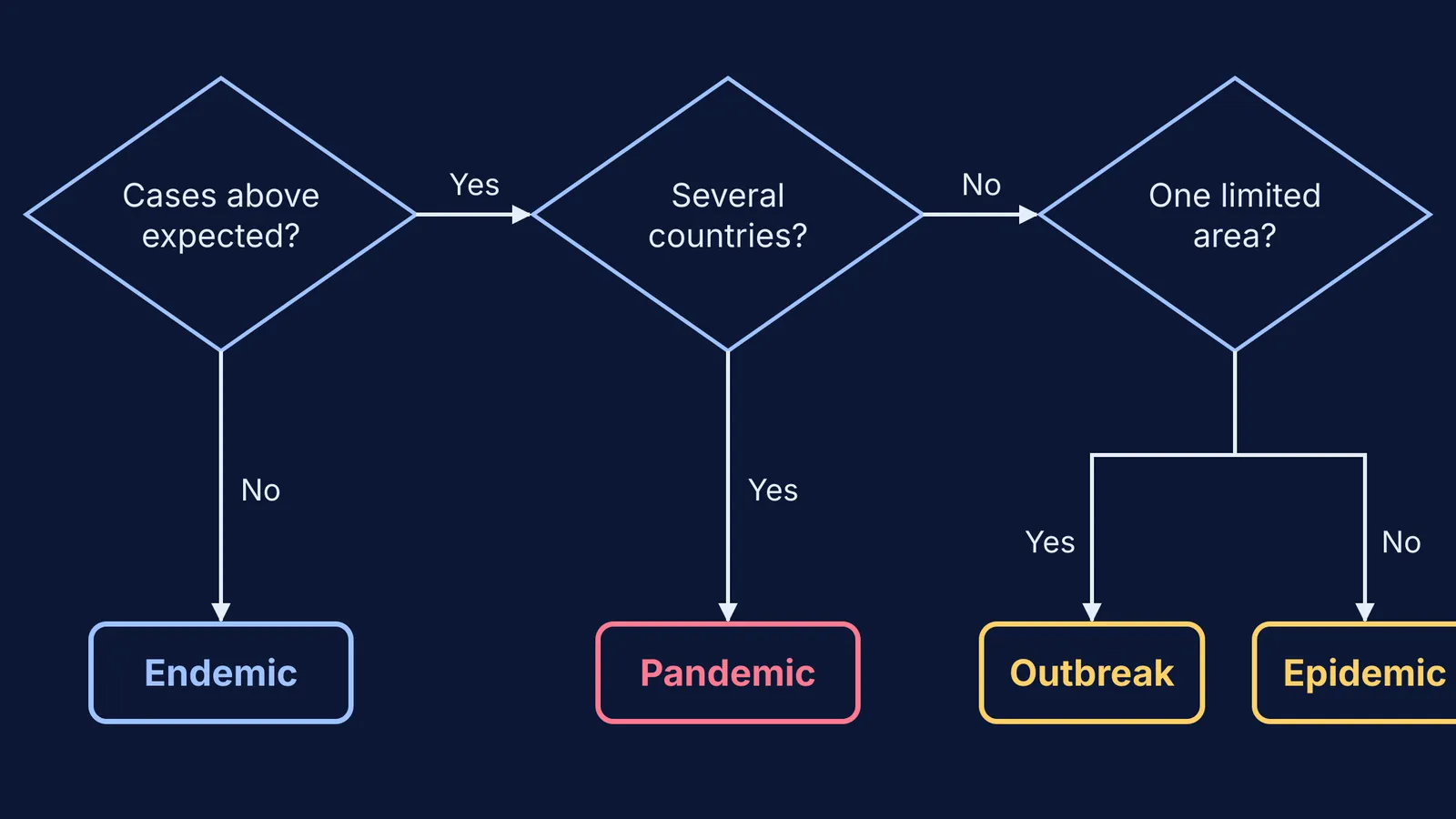
Ask these questions in order and stop at the first answer that fits.
Is the disease usually present in this area at a steady level? If yes and nothing has changed, write endemic. If cases are rare and irregular, write sporadic.
Are cases above what is normally expected for this place and time? If yes, go on.
Has the rise spread across several countries or continents? If yes, write pandemic.
Is the rise confined to a limited area, such as one village, district, hostel or wedding? If yes, write outbreak.
Otherwise, a rise across a larger region or a whole country is an epidemic.
Outbreak versus epidemic is a convention, not a fixed size, so follow your textbook's wording.
Here is a worked example. Suppose a question says: "A district in Odisha reports malaria cases every year. This monsoon, cases in one block are far above the usual number. Classify both situations." (A made-up practice question, not real data.)
Every year, in the district: present at a usual level, so endemic (step 1).
This monsoon, in one block: above expected (step 2), not across countries (step 3), limited area (step 4), so an outbreak.
Write the reason with the label: "outbreak, because cases rose above the expected level in a limited area".
Which mistakes cost marks?
Using "pandemic" for any big number. It is about spread across countries or continents, not size alone.
Forgetting the baseline. Ten cases of a disease that is normally absent can be an outbreak; ten cases of an endemic disease may be normal.
Treating the words as fixed labels for a disease. They describe a situation in a place and time, not the disease itself.
If terms like incubation period, vector and immunity still blur together, our list of Human health and disease Class 12 key terms puts them in one place.
To revise the biology around these words, the Fermi Concept Library covers every concept in biology, each with its own lesson and its place in the map. If you'd like a plan before you start, Fermi's AI tutor works out what you already know and builds a plan for the session.
For a health concern, speak to a doctor or your local health centre.


