On this page
In India's childhood schedule, as set out by UNICEF India, oral polio vaccine (OPV) and rotavirus vaccine (RVV) are the only two given by mouth; the rest are injections. The reason is where a germ gets in, and which antibody guards that door.
Why are some vaccines given by mouth?
Most pathogens enter the body through mucosal membranes, the moist linings of the gut, airways and genital tract, as immunologist Nils Lycke wrote in a 2012 review in Nature Reviews Immunology. Poliovirus is a clear example: it spreads mainly through the faecal-oral route and multiplies in the intestine, according to the WHO polio fact sheet.
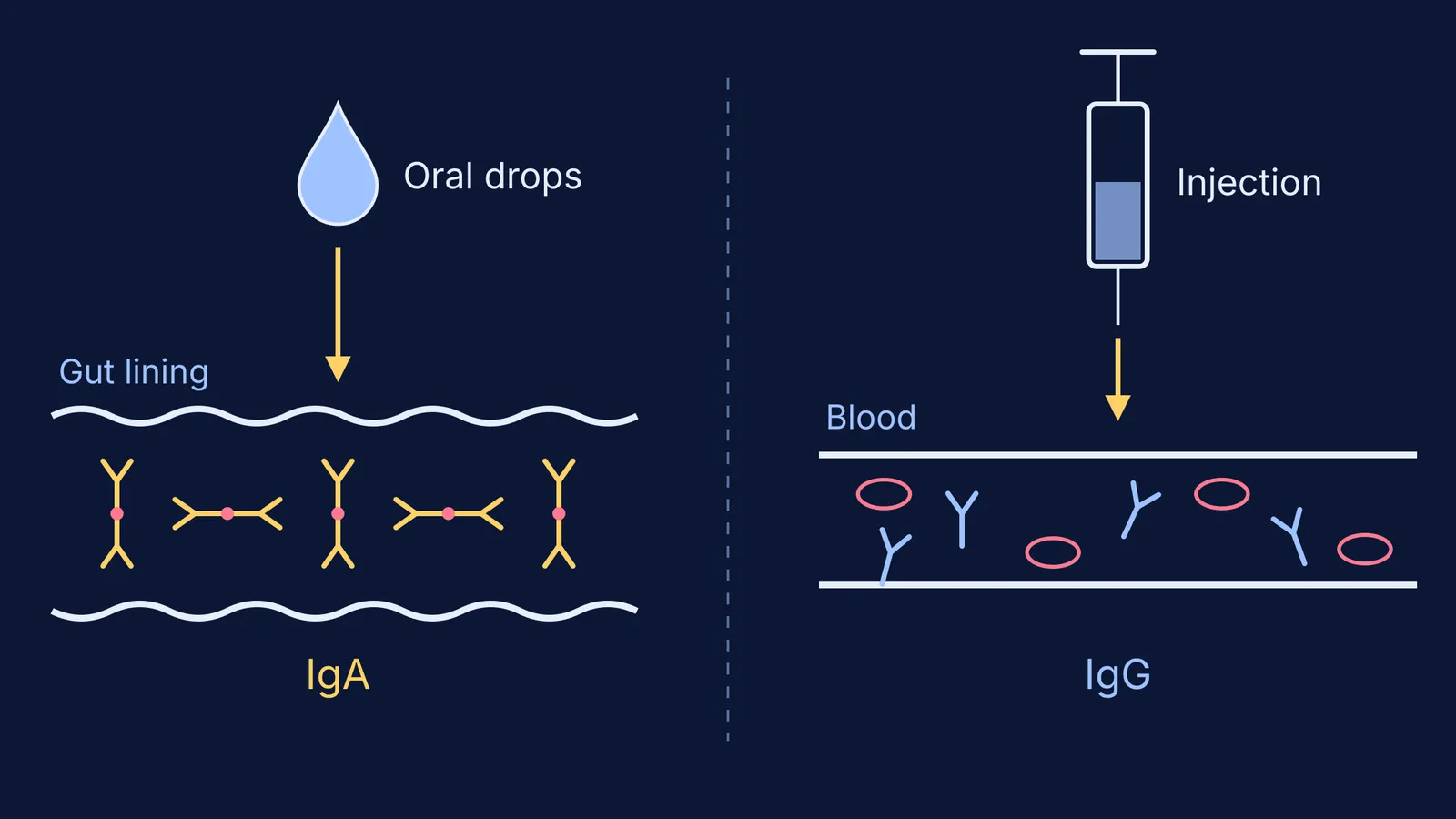
The antibody that guards these linings is secretory IgA. Secretory IgA is the principal antibody on the mucosal surfaces of humans, and globally more IgA is made than all other antibody classes combined, according to a review by Blaise Corthésy in Frontiers in Immunology. Our explainer on IgA, IgM, IgE and IgG sorts out the four classes.
An oral vaccine follows the real infection's route. The weakened virus in OPV replicates in the intestine for several weeks after vaccination, says the Global Polio Eradication Initiative (GPEI), so the gut's own immune tissue meets it at the door the wild virus would use.
What is the difference between OPV and IPV?
Inactivated polio vaccine (IPV) is given by intramuscular or intradermal injection, and it produces antibodies in the blood to all three types of poliovirus, according to the GPEI page on IPV. The same page says IPV induces very low levels of immunity in the intestine, and that IPV is over five times more expensive than OPV.
Unlike IPV, OPV has a unique ability to stop person-to-person spread of poliovirus, and it needs no health professionals or sterile needles (GPEI, OPV).
India uses both. The UNICEF India schedule lists OPV at birth, 6, 10 and 14 weeks with a booster at 16 to 24 months, plus fractional IPV (fIPV) injections starting at 6 and 14 weeks. Worldwide, wild poliovirus cases have fallen by over 99% since 1988, from an estimated 350,000 cases in more than 125 endemic countries, according to WHO.
Why are most vaccines injected instead of swallowed?
The gut is built to digest things. Stomach acid, bile salts and digestive enzymes stand between a swallowed vaccine and the immune system, and the gut leans towards tolerating what it meets, according to a 2021 review by Coffey, Gaiha and Traverso. The same review notes that oral vaccines in use today are effectively limited to live-attenuated and inactivated vaccines against gut diseases. Lycke's review adds that few new mucosal vaccines followed OPV in the 50-plus years before he wrote, partly because safe, effective mucosal adjuvants (ingredients that boost a response) are hard to make.
Polio and rotavirus show the pattern: both are gut viruses with live, weakened oral vaccines. WHO lists four oral, live, attenuated rotavirus vaccines as prequalified (WHO rotavirus page). For the Indian side of that story, read about M K Bhan and the rotavirus vaccine.
An injection skips the gut entirely. That suits tetanus, which is acquired through a cut or wound and cannot pass from person to person (WHO). With no gut door to guard, an injected toxoid works; see our guide to toxoid, killed and live vaccines.
Route, vaccine type and immune response at a glance
Each line: vaccine, route, type, response. Sources: GPEI on OPV and IPV; WHO on rotavirus, cholera and tetanus; the UNICEF India schedule.
OPV: by mouth, live weakened virus, gut immunity that can stop person-to-person spread.
Rotavirus vaccine: by mouth, live weakened virus, protection against severe gastrointestinal disease.
Oral cholera vaccine: by mouth, two doses to fully protect an adult, protection for at least 3 years.
IPV and fIPV: injection into muscle or skin, inactivated virus, blood antibodies to all three poliovirus types but very low gut immunity.
Tetanus toxoid-containing vaccines (such as Td at 10 and 16 years in India): injection, inactivated toxin, protection against a disease that enters through wounds.
How do you explain a vaccine's route in an exam answer?
Ask four questions:
Where does the germ get in: gut, airways, skin or a wound?
Where does it do harm first?
Can the vaccine work after the trip through the stomach? Today's oral vaccines are live or inactivated vaccines against gut diseases.
Is stopping spread part of the goal? If so, immunity at the entry site helps.
Worked example: why is rotavirus vaccine oral but tetanus vaccine injected? Rotavirus enters and harms the gut, so a live oral vaccine that builds gut IgA at the entry site wins. Tetanus enters through wounds and does not spread between people, so an injected toxoid that builds blood antibodies is enough.
Parents: this explains the schedule; it is not a guide to changing it. If your child missed a dose, ask your paediatrician, ANM or ASHA worker.
If IgA, IgG and live versus inactivated still feel tangled, the Fermi Concept Library gives every biology concept its own lesson and its place in the map, so you can see how mucosal immunity links to vaccination.