On this page
The cells in your dal, rice or fish carry DNA and RNA, so every meal hands your gut some nucleic acid. Exam questions on it turn on three names that look almost the same: nucleases, nucleotidases and nucleosidases. Know what each cuts and where, and the chain is easy to rebuild.
How are nucleic acids digested in the human body?
The OpenStax Anatomy and Physiology textbook describes two pancreatic nucleases: deoxyribonuclease, which digests DNA, and ribonuclease, which digests RNA. It then says brush-border enzymes break the resulting nucleotides into pentose sugars, phosphates and nitrogenous bases.
Here is the chain in the order it happens:
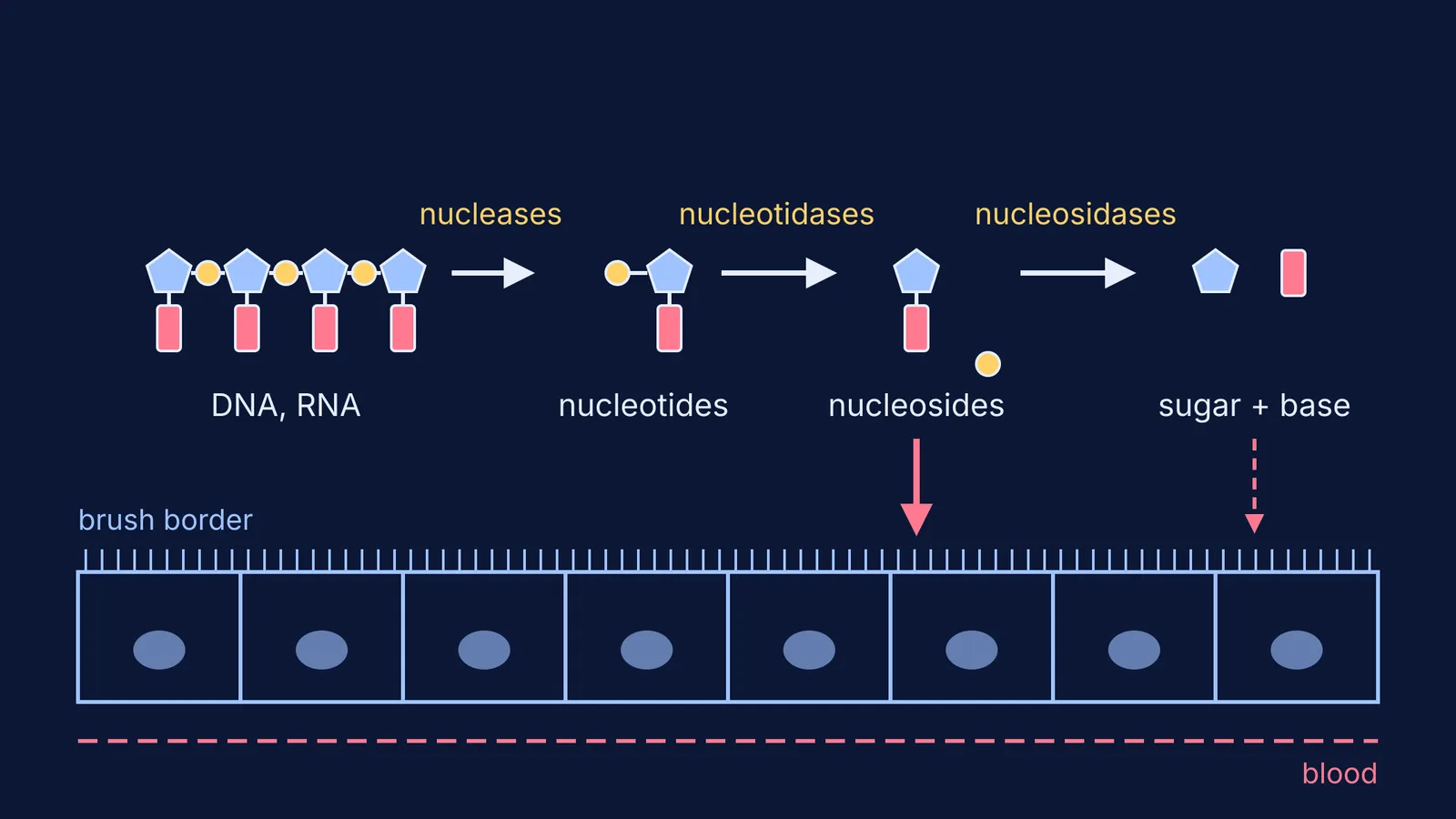
Nucleases (DNase and RNase from the pancreas) cut DNA and RNA into nucleotides and short oligonucleotides.
Nucleotidases and phosphatases on the intestinal brush border remove the phosphate, turning nucleotides into nucleosides.
Nucleosidases split a nucleoside into its pentose sugar and its nitrogenous base.
The naming trick: each enzyme is named after the thing it attacks. A nuclease attacks the nucleic acid, a nucleotidase attacks the nucleotide, and a nucleosidase attacks the nucleoside. If the difference between a nucleotide and a nucleoside is shaky, read nucleoside vs nucleotide, with examples first.
Where does each enzyme act?
The locations come from a 2021 review of pancreatic DNase by John A. Williams of the University of Michigan, published in Pancreapedia.
Stomach: acid separates proteins such as histones from DNA, and the gastric enzyme pepsin starts breaking DNA into small fragments called oligonucleotides.
Small intestine, inside the lumen: pancreatic DNase 1 then breaks it down to a greater extent. The review notes it is most active at pH 7.5.
Small intestine, brush border: enzymes such as 5'-nucleotidase and alkaline phosphatase break oligonucleotides into nucleotides and nucleosides, and nucleosidases can split nucleosides further into purine and pyrimidine bases.
Colon: the same review states that no digestion of DNA takes place there.
Our post on enzymes of pancreatic juice and succus entericus lists them side by side.
What is finally absorbed: sugars and bases, or nucleosides?
Here textbook summaries and research reviews differ, so know both.
The OpenStax textbook states that pentose sugars, nitrogenous bases and phosphate ions are carried across the villus epithelium by active transport and then enter the bloodstream.
The Williams review adds detail: nucleosides are the major form absorbed at the brush border. They enter through three sodium-linked concentrative transporters (CNT1, CNT2 and CNT3), and equilibrative transporters on the basolateral side let them leave the cell for the blood. Bases freed by nucleosidases can also be absorbed.
A 2019 cell-culture study in PLOS ONE by Narumi and colleagues fits this picture. Working with human intestinal Caco-2 cells and with COS-7 cells engineered to carry human transporters, the authors concluded that the nucleotide dAMP is dephosphorylated by an ecto-5'-nucleotidase called CD73 and efficiently absorbed as the nucleoside deoxyadenosine. The absorbing cells line the villi, covered in villi in the small intestine: structure, absorption and labels.
Fill-in-the-blank flowchart: can you complete the chain?
Cover the answers and fill each blank aloud. Then check.
DNA, RNA → (A) → nucleotides
Nucleotides → (B) → (C) + phosphate
(C) → (D) → (E) + (F)
Enzyme in step 1 comes from the ______ (G).
Enzymes in steps 2 and 3 sit on the ______ (H) of the small intestine.
The main form absorbed, per the 2021 review, is ______ (I).
Answers: (A) nucleases, DNase and RNase; (B) nucleotidases or phosphatases; (C) nucleosides; (D) nucleosidases; (E) pentose sugar; (F) nitrogenous base; (G) pancreas; (H) brush border; (I) nucleosides.
Now check yourself on three common slips:
Swapping nucleotidase and nucleosidase. Ask: which molecule still has its phosphate? Only the nucleotide.
Naming the wrong source for nucleases. In the textbook scheme they come from pancreatic juice, not bile.
Writing "amino acids" or "fatty acids" as the end product. Nucleic acids end as sugars, bases and phosphate, with many nucleosides absorbed whole.
If one link in the chain still feels fuzzy, the Fermi Concept Library gives every concept in biology and chemistry its own lesson, so you can revisit the nucleotide itself first.