On this page
Natural killer cells get about one line in NCERT, but that line hides a neat trick: a cell that kills by noticing what is missing.
What do natural killer cells do?
Natural killer (NK) cells are “effector lymphocytes of the innate immune system that control several types of tumors and microbial infections”, in the words of a 2008 review in Nature Immunology by Eric Vivier and colleagues. They are lymphocytes, like B and T cells, but they work on the fast, non-specific side of defence.
NK cells make up about 5–20% of the lymphocytes circulating in human blood, according to a 2018 review in Frontiers in Immunology.
They kill in two main ways:
Direct killing: they release granules holding perforin, a pore-forming protein, and granzymes, enzymes that drive the target cell to die (Abel and colleagues, 2018).
Antibody-guided killing: many NK cells carry a receptor called CD16 that grips antibodies already stuck to a target cell, a route called antibody-dependent cell cytotoxicity, or ADCC (Wu and colleagues, Molecular Cancer, 2020).
In 1975, Rolf Kiessling, Eva Klein and Hans Wigzell described these “natural” killer lymphocytes in mouse spleens that, in lab tests, began killing Moloney leukaemia cells within one to four hours (European Journal of Immunology, 1975).
How do NK cells find cells that hide their MHC?
Almost every nucleated cell in your body displays MHC class I molecules, which show pieces of its proteins to cytotoxic T cells. Viruses have evolved ways to block this display so their peptides are never shown, as a 2009 review in Nature Reviews Immunology describes. Tumour cells often “lack or only express low levels of MHC-I to evade CD8+ T cell-mediated cytotoxicity”, according to Wu and colleagues.
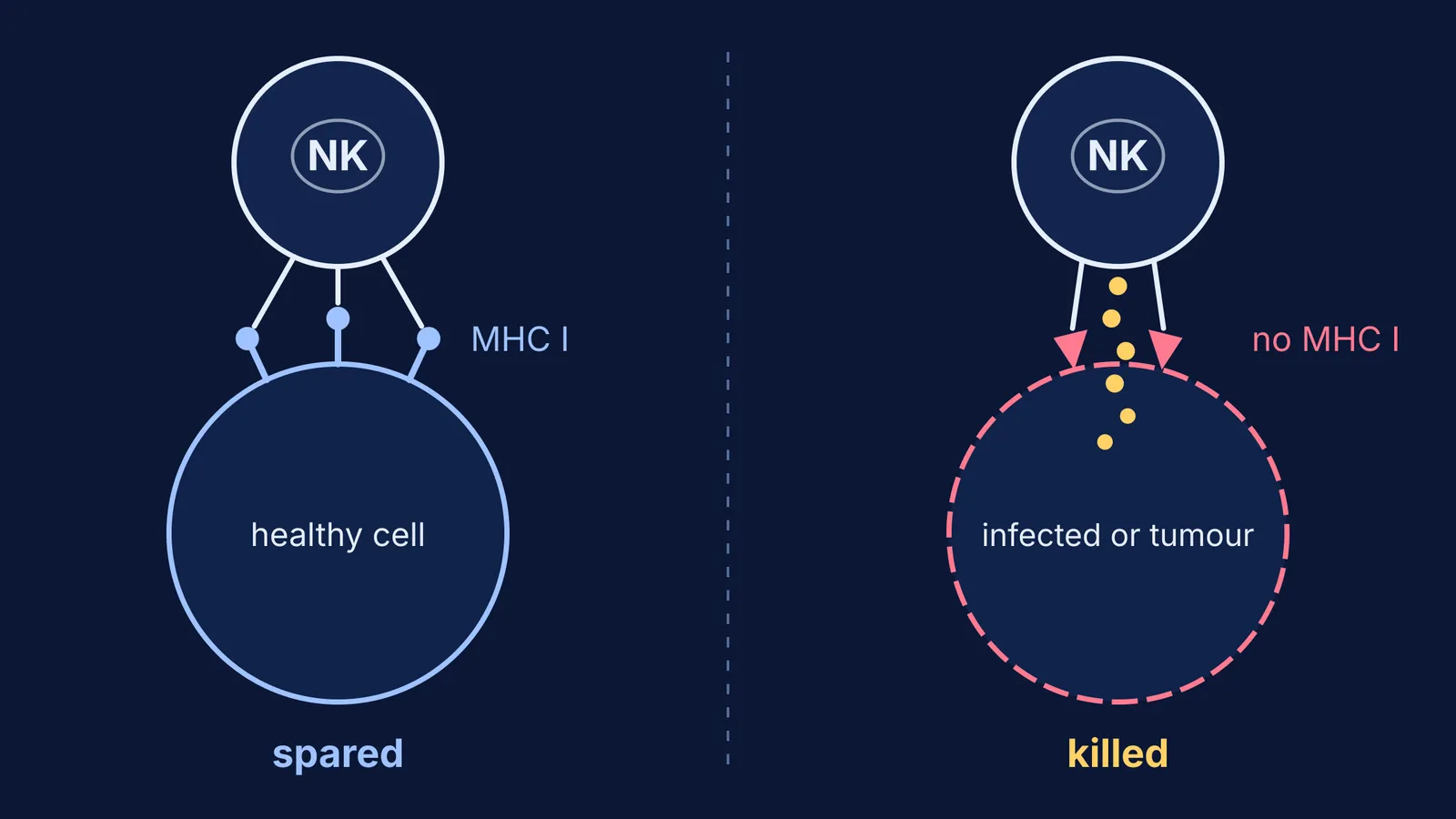
Hiding from T cells has a cost. In 1986, Klas Kärre and colleagues showed that mouse lymphoma cells selected for loss of MHC class I were rejected in a non-adaptive way, and proposed that organisms may also tell self from non-self “by the absence of normal self markers” (Nature, 1986). This is the missing-self idea.
An NK cell weighs two kinds of signal:
Brakes: inhibitory receptors, mostly the KIR family in humans, bind MHC class I and tell the NK cell to hold off (Abel and colleagues).
Accelerators: activating receptors such as NKG2D bind stress molecules like MICA and MICB that tumour cells can carry (Wu and colleagues).
A healthy cell shows plenty of MHC class I, so the brakes win. A cell that has dropped MHC class I and shows stress molecules loses its brakes and can be killed.
How are NK cells different from cytotoxic T cells?
Both are lymphocytes that can kill with perforin and granzymes. They differ in how they choose targets.
Recognition: a cytotoxic (CD8+) T cell uses its T cell receptor to spot one specific foreign peptide held on MHC class I. NK cells lack that T cell receptor (Abel and colleagues) and instead read missing MHC class I plus stress signals.
What MHC class I means: for a T cell, it is the display it must see. For an NK cell, it is a stop sign.
Speed: compared with effector T cells, NK cells respond to target cells more quickly (Wu and colleagues); cytotoxic T cells belong to acquired, cell-mediated immunity.
For the acquired side, see what B cells and T cells each do.
Where do NK cells fit in NCERT’s innate immunity?
NCERT’s Class 12 chapter Human Health and Disease splits innate immunity into four barriers: physical, physiological, cellular and cytokine. NK cells sit in the cellular barrier, with neutrophils, monocytes and macrophages, as our guide to NCERT’s four barriers of innate immunity sets out.
Two traps follow:
NK cells are lymphocytes, yet they belong to innate immunity. Not every lymphocyte is “acquired”.
Cytotoxic T cells kill much as NK cells do, yet they are acquired, cell-mediated immunity.
A three-question check for exam statements
When an assertion-reason or match-the-list item mentions NK cells, ask:
How does it recognise the target? NK cells: missing MHC class I plus stress signals. Cytotoxic T cells: one specific antigen on MHC class I.
Which arm? NK cells: innate, cellular barrier. Cytotoxic T cells: acquired, cell-mediated.
What does MHC class I do here? A brake for NK cells, a required display for T cells.
Worked example 1. “Natural killer cells kill only cells that display a foreign antigen on MHC class I.” Question 1 flags it: that is the T-cell rule. NK cells go after cells with too little MHC class I. False.
Worked example 2. “A tumour cell that loses MHC class I escapes cytotoxic T cells but may be killed by NK cells.” Questions 1 and 3 agree. True.
For how tumour cells escape control more broadly, read our cancer biology guide for NEET.
If innate and acquired immunity keep blurring together, the Fermi Concept Library gives every biology concept its own lesson and its place in the map. For worked problems, the Fermi Problem Library has a step-by-step solver that explains the reasoning rather than printing an answer.
The rule to remember: T cells look for something foreign; NK cells look for something missing.