On this page
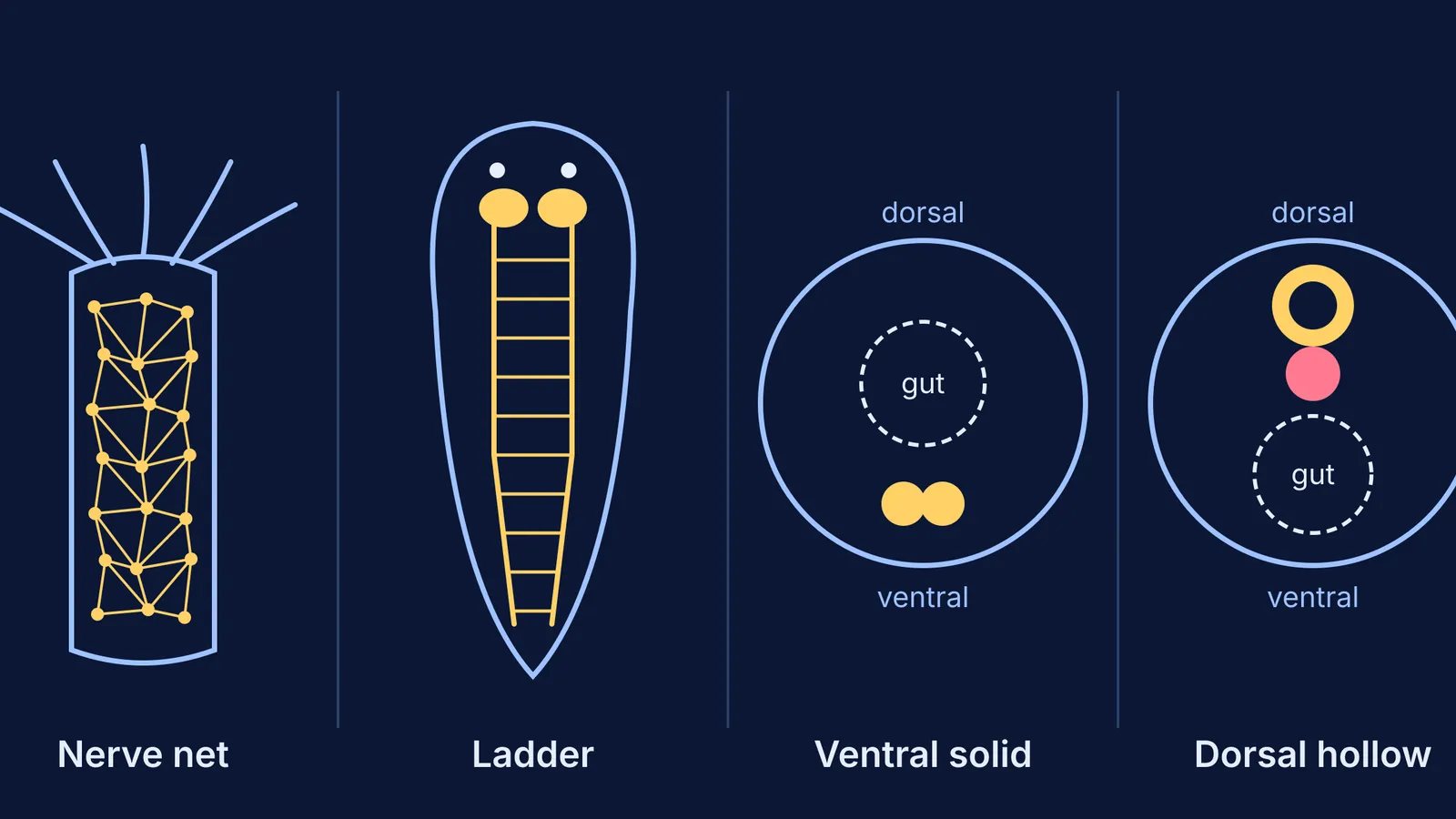
If you are revising the Animal Kingdom chapter, the nervous system is one of the cleanest ways to tell phyla apart. Learn four layouts, and most "which phylum has..." questions answer themselves: a net, a ladder, a ventral solid cord and a dorsal hollow cord.
What are the main types of nervous system in animals?
Start one step before the first layout. Sponges have no specialised nervous system, though their cells still signal to each other to control body contraction and the activity of their collar cells, according to OpenStax Biology 2e on Porifera.
1. Nerve net (Cnidaria). In cnidarians such as Hydra, the nervous system is rudimentary: nerve cells form a network scattered across the body, as OpenStax Biology 2e on Cnidaria describes. The same page notes that parts of the net can gather into plexuses or cords, and that cnidarians are radially or biradially symmetrical.
2. Ladder (Platyhelminthes). A flatworm's nervous system is a pair of lateral nerve cords running the length of the body, joined by transverse connections, with two cerebral ganglia at the front linked to light- and chemical-sensing cells, according to OpenStax Biology 2e on flatworms. The two cords are the rails and the cross-links are the rungs. The same page uses flatworms to introduce cephalization, the concentration of nervous tissue and sense organs in the head.
3. Ventral solid cord (Annelida, Arthropoda). In annelids, the nerve cord is ventral and carries a ganglion in each segment, with a ring of fused ganglia around the pharynx, per OpenStax Biology 2e on annelids. In arthropods, the ganglia are joined by a ventral nerve cord, with larger ganglia in segments that carry sense organs or appendages, per OpenStax Biology 2e on arthropods.
4. Dorsal hollow cord (Chordata). The chordate nerve cord forms from ectoderm that rolls into a hollow tube, and it lies dorsal to the notochord, according to OpenStax Biology 2e on chordates. In vertebrates, that neural tube becomes the brain and spinal cord.
How is a ladder nervous system different from a ventral nerve cord?
Both are built from paired cords, so students often mix them up. Three differences settle it:
Segments. The flatworm ladder runs through an unsegmented body. The annelid cord has a ganglion in each segment, like beads on a string.
Position. The flatworm cords run along the sides (lateral). The annelid and arthropod cord runs along the belly (ventral), below the gut.
Body cavity. Flatworms are acoelomate, as the OpenStax flatworm section notes. Our post on the first phylum with a true coelom and segments shows where the cavity and the segments arrive.
Exam questions compress all of this into one line: non-chordates have a central nervous system that is "ventral, solid and double", and chordates have one that is dorsal, hollow and single, as in this typical multiple-choice question. The textbook wording is more careful: protostome nerve cords are solid and lie ventrally and/or laterally to the gut, per OpenStax on chordates. The flatworm's lateral cords fit that "laterally".
Why is the chordate nerve cord dorsal and hollow?
It is hollow because of how it forms. The ectoderm rolls into a tube, so a canal is left inside, per OpenStax. It is dorsal because it lies above the notochord, on the back side of the body.
How nets and cords are related is still being worked out. A 2016 review in Nature Reviews Neuroscience by Detlev Arendt, Maria Antonietta Tosches and Heather Marlow (DOI 10.1038/nrn.2015.15) says the puzzle of how complex nervous systems emerged remains unsolved. The authors propose that integration centres at opposite ends of an early nerve net expanded and fused to give the bilaterian nerve cord and brain. Treat that as a hypothesis, not a syllabus fact.
Which phylum has which nervous system?
Copy this out once by hand, then cover everything after the colon and test yourself.
Porifera: no specialised nervous system; cells signal directly.
Cnidaria: nerve net; no central brain; radial symmetry; example Hydra.
Platyhelminthes: ladder of two lateral cords with cross-connections; cerebral ganglia; eyespots; example planaria.
Annelida: ventral solid cord; a ganglion in every segment; ring around the pharynx; example earthworm.
Arthropoda: ventral cord linking ganglia; bigger ganglia where there are appendages or sense organs; example cockroach.
Chordata: dorsal hollow single cord above the notochord; becomes the brain and spinal cord in vertebrates.
Now the self-check. Draw a circle for a cross-section of the body, mark the gut, and place the nerve cord for an earthworm and for a fish. If the earthworm's cord sits below the gut and the fish's sits above the notochord, you have it.
If you keep forgetting which phylum is which, phylum names decoded ties each name to the body plan. To revise neurons, synapses and reflex arcs next, try neural control mistakes in NEET Biology. If a term like ganglion or notochord is still fuzzy, the Fermi Concept Library gives every biology concept its own lesson and shows where it sits in the map.