

On this page
The eight slips below are tested against Chapter 18, Neural Control and Coordination, of NCERT Class 11 Biology (NCERT chapter kebo118, Reprint 2026-27). Unit 5, Human Physiology, of the NMC's NEET (UG) 2026 syllabus includes this topic. Planning the full unit? Start with our chapter-by-chapter Human Physiology guide for NEET.
Where does each part sit in the neural system?
"The spinal cord belongs to the peripheral neural system."
Why it tempts: spinal nerves branch off the cord, so the cord and its nerves get filed together.
What NCERT says (18.2): the CNS is the brain together with the spinal cord, where information gets processed and control is exercised. The PNS is made up of every nerve linked to the brain and spinal cord.
Check: sort into CNS or PNS: medulla, spinal cord, a nerve running from the spinal cord to the leg, an afferent fibre from the skin. (CNS: medulla and spinal cord. PNS: the nerve and the fibre.)
Habit: the cord is CNS; the nerves leaving it are PNS.
"The autonomic neural system is part of the CNS."
Why it tempts: it runs organs without your choice, which sounds like the brain's own job.
What NCERT says (18.2): the PNS has two divisions, somatic and autonomic. The autonomic division carries impulses from the CNS to involuntary organs and smooth muscles, and is split again into sympathetic and parasympathetic systems.
Check: write the branching from "human neural system" down to "parasympathetic". Which two levels sit in between? (PNS, then autonomic.)
Habit: place every named system on one tree before judging it.
Which counts and charges get swapped?
"A multipolar neuron has several axons."
Why it tempts: "multi" seems to count every process leaving the cell body, axons included.
What NCERT says (18.3): neurons are classed by their number of axons and dendrites. A multipolar neuron (cerebral cortex) has one axon plus at least two dendrites; a bipolar neuron (retina) has one axon and one dendrite; a unipolar neuron (usually embryonic) has one axon only.
Check: add up the axons in one multipolar, one bipolar and one unipolar neuron. (Three, one in each.)
Habit: hold the axon count at one and count only the dendrites.
"A resting neuron has no voltage across its membrane."
Why it tempts: "resting" sounds like "switched off".
What NCERT says (18.3.1): in a resting axon the membrane's outer face is positive and its inner face negative, so the membrane is polarised. NCERT calls this potential difference the resting potential, and links the polarised state to neurons being excitable.
Check: one probe sits inside a resting axon, one outside. Which reads more positive, and can the difference be zero? (Outside; no, a polarised membrane has a difference.)
Habit: read "resting" as "polarised and ready", never as "zero".
Which way do ions and signals move?
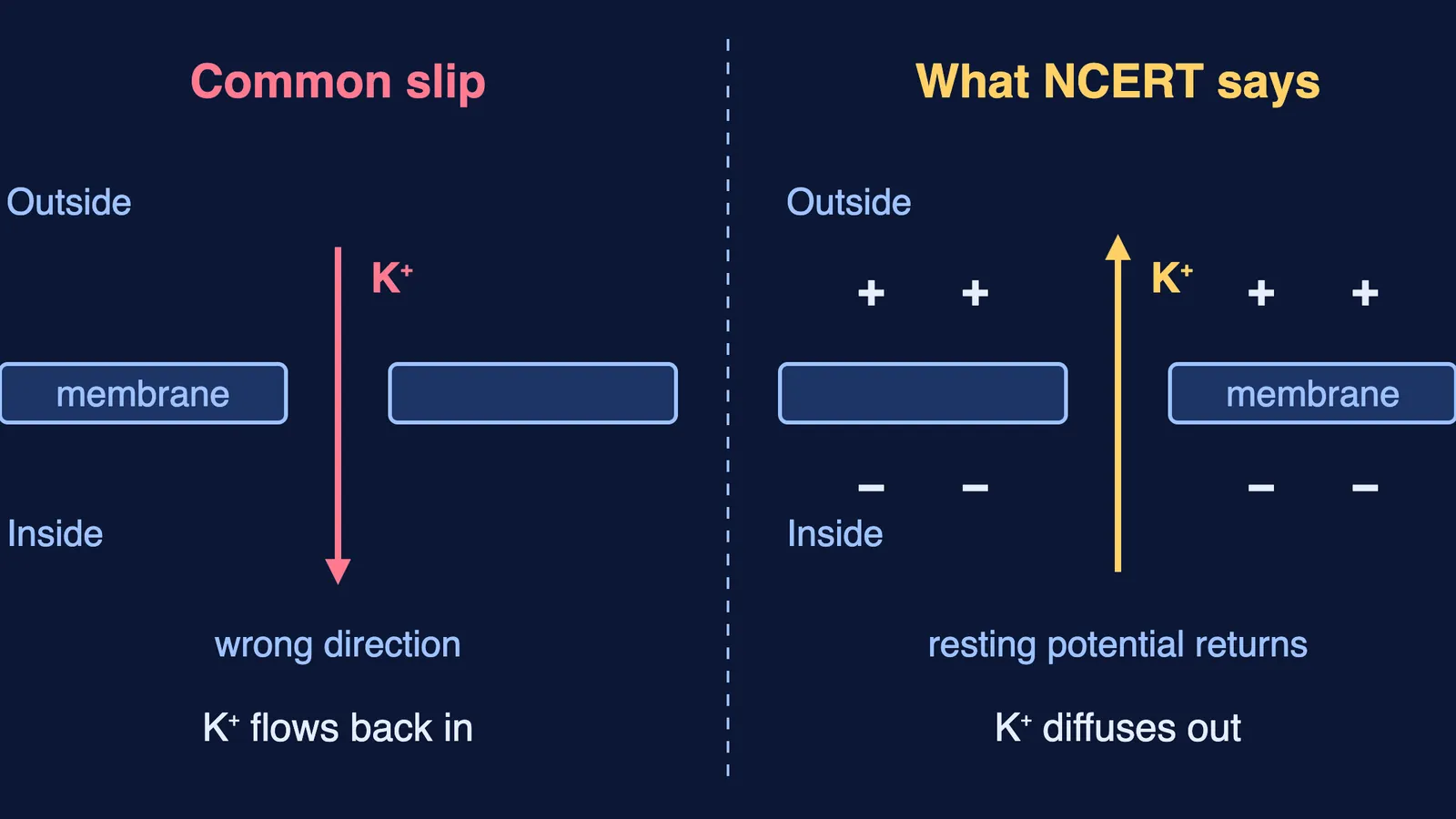
"To reset after an impulse, K+ flows back into the axon."
Why it tempts: a resting axon is rich in K+ inside, so students picture K+ refilling it.
What NCERT says (18.3.1): the stimulus-driven rise in Na+ permeability is very brief, and a rise in K+ permeability follows. K+ then diffuses to the outside, the resting potential returns at the excited site, and the fibre can respond again.
Check: at point P on an axon the inside has just turned positive. To make it negative again, must positive ions leave or enter, and which ion does NCERT name? (Leave; K+.)
Habit: reason from charge: a positive inside turns negative only when positive charge leaves.
"The neurotransmitter enters the next neuron and becomes its impulse."
Why it tempts: the neurotransmitter crosses the gap, so it seems to pass into the next cell too.
What NCERT says (18.3.2): released neurotransmitters attach to their own receptors on the membrane of the post-synaptic neuron. The binding opens ion channels, ions enter, and a new potential, excitatory or inhibitory, may arise in the post-synaptic neuron.
Check: at a chemical synapse, name what crosses the cleft and what enters the post-synaptic neuron. (Neurotransmitter crosses; ions enter.)
Habit: write the hand-off as transmitter, receptor, channel, ions.
Which brain region does what?
This is a study summary, not medical advice.
"White matter is the outer layer of the cerebrum."
Why it tempts: grey and white are learnt as a pair, and outer versus inner is easy to flip.
What NCERT says (18.4.1): the cerebral cortex, the folded layer covering each hemisphere, is grey because neuron cell bodies are concentrated in it. The inner part of the hemisphere is made of tract fibres with myelin sheaths, which look opaque white.
Check: a slice of one cerebral hemisphere is stained so that only myelin shows. Does the stain light up the folded outer layer or the inner part, and in which layer would you look for the association areas? (Inner part; the outer cortex.)
Habit: grey outside with cell bodies, white inside with myelin.
"Body temperature is controlled from the medulla, with the other life-support centres."
Why it tempts: the medulla gets labelled the life-support region, so every survival job is sent there.
What NCERT says: the hypothalamus, at the base of the thalamus, holds centres that control body temperature and the urges for eating and drinking (18.4.1). The medulla holds centres controlling respiration, gastric secretions and cardiovascular reflexes (18.4.3).
Check: a classmate writes that the temperature centre sits in the brain part that joins the spinal cord. Which part joins the spinal cord, and which holds the temperature centre? (Medulla; hypothalamus, at the base of the thalamus.)
Habit: learn each centre with its region as a pair, not by how vital it sounds.
A 60-second check before you mark an option
System: CNS (brain and spinal cord) or PNS (nerves and their divisions)?
Neuron type: one axon every time; how many dendrites?
Rest: polarised, positive outside and negative inside?
Recovery: K+ out, not in?
Synapse: transmitter binds, ions enter?
Cerebrum: grey cortex outside, white myelinated tracts inside?
Centres: temperature and thirst in the hypothalamus; respiration in the medulla?
To test these in a NEET question format, try our statement and match-the-list practice set on neural control.
Unsure where your own slips cluster? Fermi's AI tutor works out what you already know and builds a plan for the session.


