On this page
Step into a lift, press 10, and for a moment you feel pressed into the floor. Then the feeling fades, though the lift is still climbing. Near the top you feel briefly light. Two small organs in each inner ear, the utricle and the saccule, explain all three feelings.
What are the otolith organs in the inner ear?
The utricle and saccule are the otolith organs: two small sacs in the vestibule of the inner ear, beside the semicircular canals and the cochlea (our guide to the outer, middle and inner ear shows where they sit). Each has a patch of sensory hair cells called the macula, covered by a gel layer that carries tiny crystals.
Otoconia are “bio-crystals of calcium carbonate (CaCO3) and proteins”, according to a review by Lundberg and colleagues in Developmental Dynamics. The same review explains that head tilt and linear head motion displace this crystal layer, producing a shearing force that bends the hair bundles and switches the hair cells on.
The crystals matter because they are heavy. An earlier mini-review in Brain Research describes the otoconial complex as “an extremely dense matrix” that “provides inertial mass” so the hair cells can sense gravity and linear acceleration.
The two organs face different ways. “The utricular macula is aligned horizontally, and the saccular macula is aligned vertically,” states a 2024 review of otolith testing by Hegemann, Bery and Kheradmand in Audiology Research. With your head upright, the utricle mostly reports forward-back and side-to-side pushes; the saccule reports up-and-down ones.
How are otoliths different from the semicircular canals?
The semicircular canals detect angular acceleration (turning), while the otolith organs detect straight-line movement and tilt against gravity, as the Hegemann review sets out. The canals work by fluid lagging inside three rings (see how the semicircular canals keep you balanced). A lift moves you straight up without turning your head, so it is mainly an otolith job.
There is a catch: tilting and accelerating shove the crystals the same way. A 1999 study in Nature by Merfeld, Zupan and Peterka notes that, by Einstein's equivalence principle, all linear accelerometers must measure both linear acceleration and gravity. Their experiments, which tilted people after spinning them, supported the idea that the brain uses internal models to tell the two apart.
How does the inner ear sense movement in a lift?
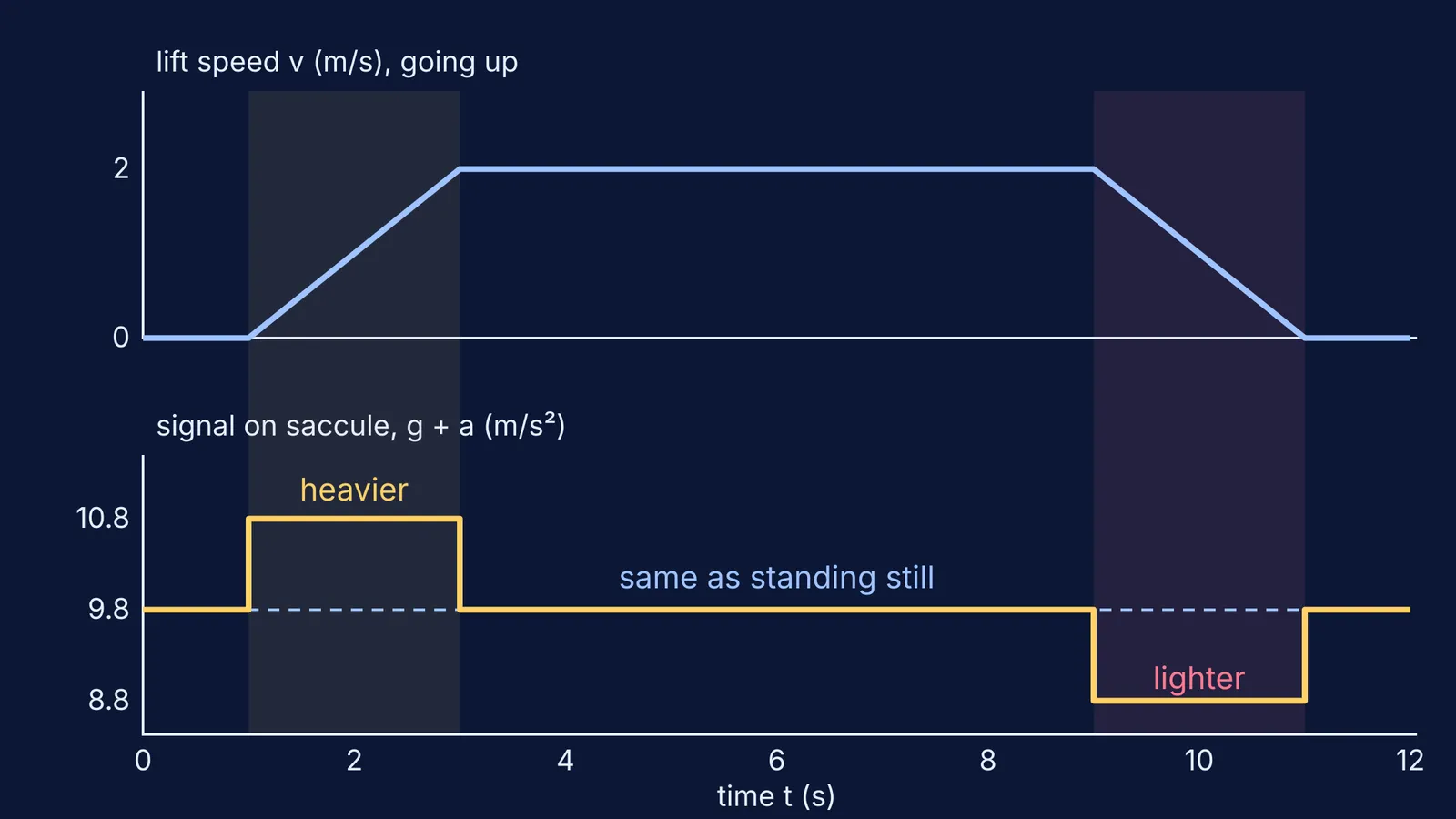
Here is a worked ride with round example numbers, not measurements of a real lift. Take g = 9.8 m/s². The lift speeds up at 1 m/s² for 2 s, cruises at 2 m/s, then slows at 1 m/s² for 2 s.
Standing still: only gravity acts, so the crystals press down with the everyday 9.8 m/s². Your brain calls this normal.
Speeding up on the way up: the gel must drag the crystals upwards as well as hold them against gravity. They lag downwards, as if gravity were 9.8 + 1 = 10.8 m/s². You feel heavier.
Cruising at a steady 2 m/s: acceleration is zero, so the signal drops back to 9.8 m/s², identical to standing still. This is Newton's first law in your head.
Slowing near the top: the acceleration is 1 m/s² downwards, the crystals lag upwards, and the signal falls to 9.8 − 1 = 8.8 m/s². That is the light, stomach-lifting moment.
Going down, the order flips: light as the lift starts, heavy as it stops.
These are the same numbers a bathroom scale shows in a moving lift, worked through in our post on weighing machine readings in a lift. Your saccule is, in effect, a tiny scale for each ear.
How do you answer an exam question on the utricle and saccule?
Use this sorting checklist before you pick an option:
Rotation (spinning, shaking your head “no”) → semicircular canals, crista, cupula.
Straight-line acceleration (lift starting, car braking) or tilt (nodding, lying down) → utricle and saccule, macula, otoconia.
Mainly horizontal push with head upright → utricle; mainly vertical → saccule.
Steady speed in a straight line → no change in the otolith signal.
What the crystals are made of → calcium carbonate with proteins.
Try three quick ones: a bus braking hard (utricle, crystals lag forwards); a lift starting downwards (saccule, you feel light); tipping your head towards one shoulder while sitting still (utricle, because gravity now pulls across the macula).
If the macula and the crista keep swapping places in your notes, the Fermi Concept Library gives every concept in biology and physics its own lesson and its place in the map. For the lift numericals, the Fermi Problem Library has worked problems with a step-by-step solver that explains the reasoning rather than printing an answer.
The Lundberg review notes that otoconia problems can cause vertigo and imbalance. Frequent spinning dizziness is something to raise with a doctor.
Next time the lift jolts, count the phases: heavy, nothing, light. That is your saccule doing physics.