On this page
Almost everyone alive in India today, from Kashmir to the Andaman Islands, descends mostly from people whose ancestors lived in Africa. Here is the evidence, the route to India, and how to use it in an exam.
What is the Out of Africa theory?
The Out of Africa theory says that our species, Homo sapiens, first evolved in Africa and later spread to the rest of the world, mostly replacing older human groups but sometimes mixing with them. Two independent lines of evidence, fossils and DNA, both point to Africa, and stone tools help trace the journey that followed.
What fossil evidence shows humans came from Africa?
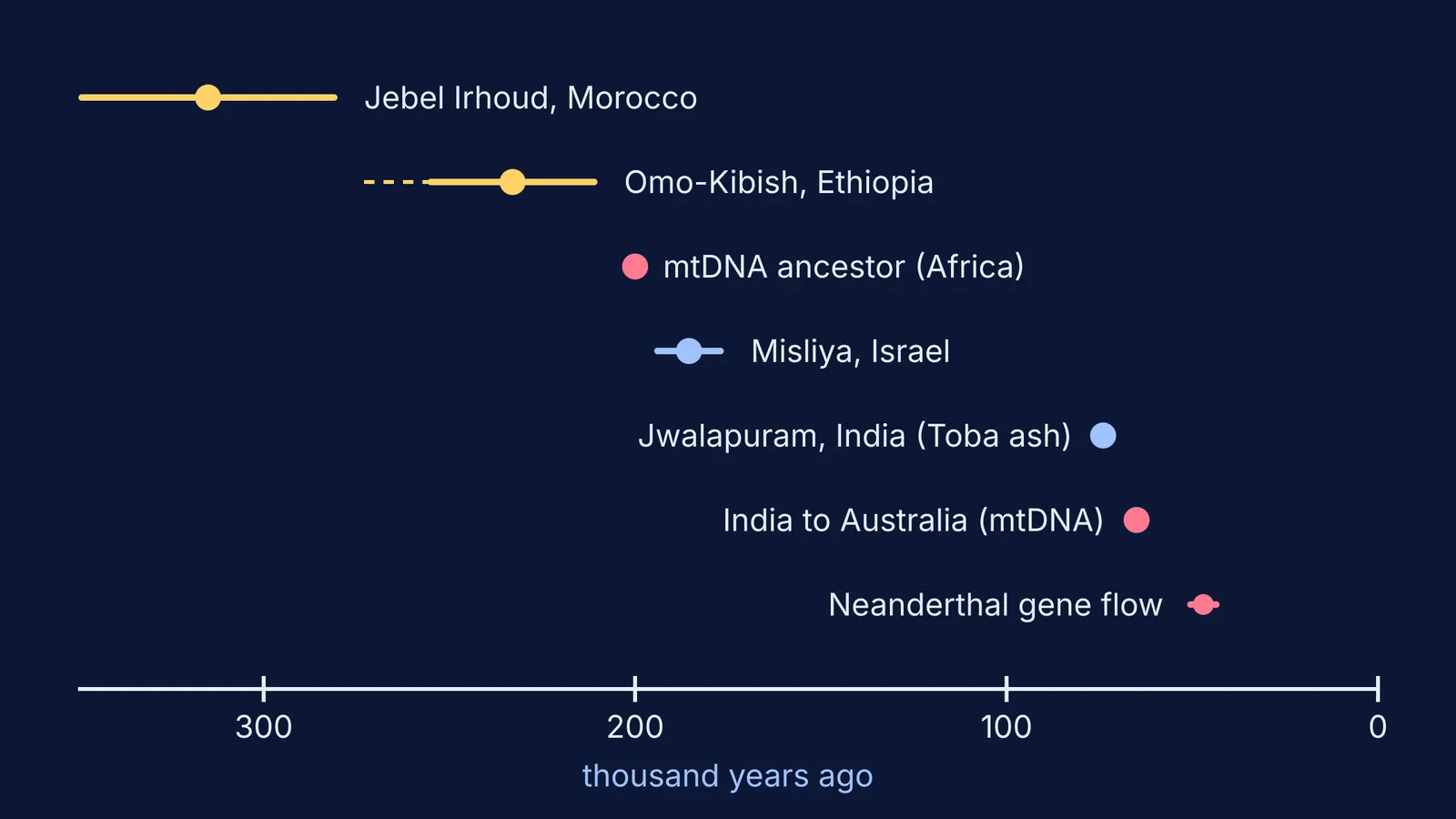
The oldest fossils of our species come from Africa. At Jebel Irhoud in Morocco, fire-heated flint tools found with Homo sapiens fossils were dated to 315,000 ± 34,000 years ago using thermoluminescence (Richter et al., Nature, 2017). A companion study found that these people had a modern-looking face and teeth but an older-style braincase, and argued that the whole African continent was involved in the emergence of Homo sapiens (Hublin et al., Nature, 2017).
In Ethiopia, the Omo I skull from Omo-Kibish now has a minimum age of 233,000 ± 22,000 years, based on dating the ash of a volcanic eruption that lies above it (Vidal et al., Nature, 2022).
Outside Africa, an upper jawbone with teeth from Misliya Cave in Israel was dated to between 177,000 and 194,000 years ago; when it was reported in 2018, it was the oldest member of the Homo sapiens lineage found outside Africa (Hershkovitz et al., Science, 2018).
What does genetic diversity tell us about human origins?
In 1987, Rebecca Cann, Mark Stoneking and Allan Wilson compared mitochondrial DNA from 147 people from five regions and traced all of it back to one woman who lived about 200,000 years ago, probably in Africa (Cann et al., Nature, 1987). Mitochondrial DNA passes down only from mothers, which is why this ancestor is nicknamed mitochondrial Eve, the ancestor of our mother line.
A worldwide study found that genetic difference between populations grows steadily with the distance between them, and that the pattern of genetic diversity is best explained by an expansion from Africa (Ramachandran et al., PNAS, 2005). The authors call this a serial founder effect: each small group that moved on carried only part of its parent group's genetic variety.
The people who left also met Neanderthals. An analysis of more than 300 genomes found that most Neanderthal gene flow into modern humans happened in one shared period, between 50,500 and 43,500 years ago (Iasi et al., Science, 2024). For how that DNA was first read, see our story on Svante Pääbo and the Neanderthal genome.
How did modern humans reach India?
Mitochondrial DNA from isolated populations in Southeast Asia supports a single dispersal from Africa, most likely along a southern coastal route through India. The same study puts the main move from India to Australia at about 65,000 years ago, most likely taking only a few thousand years (Macaulay et al., Science, 2005).
Stone tools add an Indian chapter. At Jwalapuram in Andhra Pradesh, Middle Palaeolithic tools come from both before and after the Toba super-eruption in Indonesia 74,000 years ago, with broad continuity in technology across the eruption (Petraglia et al., Science, 2007). Who made those tools, and exactly when modern humans first arrived, is still debated.
Later migrations mixed in more ancestry. A study of 25 Indian groups found two ancient source populations, Ancestral North Indians and Ancestral South Indians; most groups carry 39 to 71% Ancestral North Indian ancestry, while Andaman Islanders are related to Ancestral South Indians without it (Reich et al., Nature, 2009). Ancient DNA from more than 500 people who lived over the past 8,000 years has since traced these later movements into South and Central Asia (Narasimhan et al., Science, 2019).
How do you write an exam answer on Out of Africa?
For a question such as "Give evidence that modern humans originated in Africa", write one line per type of evidence:
Fossils: the oldest Homo sapiens fossils are African, from Jebel Irhoud in Morocco (about 315,000 years) and Omo-Kibish in Ethiopia (at least 233,000 years).
Genes: mitochondrial DNA traces back to a common female ancestor who lived about 200,000 years ago, probably in Africa.
Diversity: genetic variety thins out with distance from Africa, which fits a serial founder effect.
India link: mitochondrial DNA points to a southern coastal route through India towards Australia, about 65,000 years ago.
For the NCERT sequence of hominins and brain sizes, pair this with our guide to human evolution for NEET, from Dryopithecus to Homo sapiens.
If terms like founder effect or maternal inheritance still feel shaky, the Fermi Concept Library has a lesson for each biology concept and shows where it fits in the map, so you can fill the gap before revising this chapter.