On this page
Between your nostrils and the back of your throat, every breath is cleaned, heated and humidified before it reaches your windpipe. Breathe through your mouth and most of that work is skipped, so your airways get colder, drier and dirtier air.
What happens to air on its way through the nose?
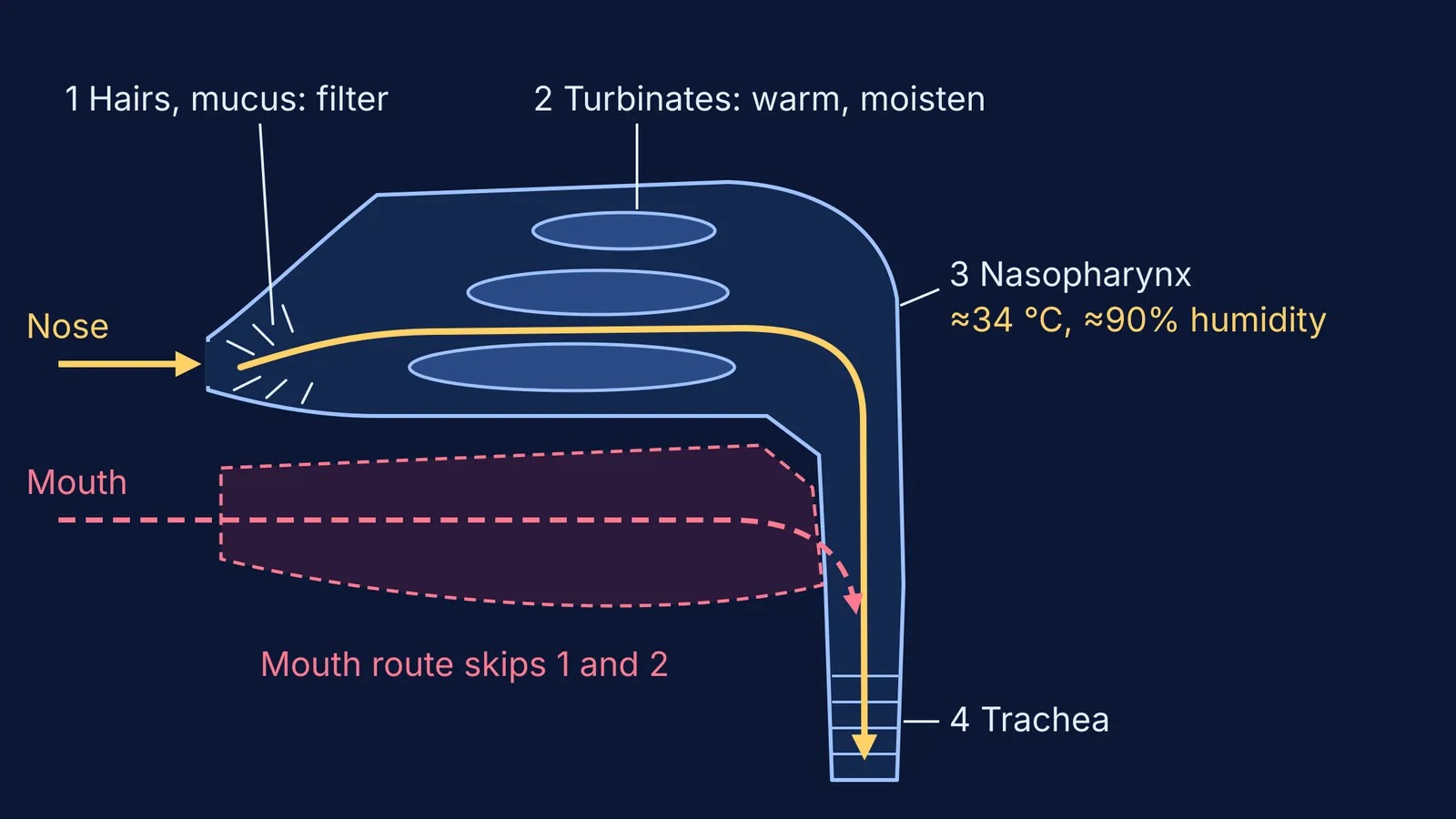
The nose has three main jobs: helping you breathe, filtering and defending against particles and allergens, and smell, according to the StatPearls chapter on nasal physiology from the US National Library of Medicine. Here is the path, from nostril to windpipe.
Nostrils (coarse filter). Coarse hairs called vibrissae line the entrance and filter inhaled particles (StatPearls, nasal cavity anatomy), and mucus further in traps more. Particles larger than about 8 micrometres tend to hit the airway walls high up, from the nasal passages down to the larger bronchioles, explains a 2013 review in Virulence.
Front of the nose (fast heating). In a study of 23 volunteers, the biggest rise in temperature and humidity happened in this short front segment; the further rise between the turbinates and the back of the nose was smaller (Keck et al., Rhinology, 2000).
Turbinates (warm and moisten). Shelf-like conchae, or turbinates, project into each side of the nasal cavity; they are rich in glands and have an abundant blood supply (StatPearls). Air flowing past them meets warm, moist lining, and cilia sweep mucus and trapped particles back towards the throat to be swallowed.
Nasopharynx (conditioned air). By the end of a breath in, air at the back of the nose is at about 34 °C and about 90% relative humidity, according to a review by Tilman Keck and Jörg Lindemann.
Trachea (the lungs take over). When a hospital breathing tube bypasses the nose and mouth, any shortfall in heat or moisture has to be made up by the airway walls inside the lungs (Tawhai and Hunter, 2004).
The same review by Keck and Lindemann gives the scale of the job: humans breathe roughly 10,000 to 15,000 litres of air a day, and the nasal lining that conditions it covers only about 100 to 200 square centimetres.
There is a chemical step too. Researchers at the Karolinska Institute found that cells lining the paranasal sinuses produce nitric oxide in very high concentrations, and suggested it helps keep the sinuses free of bacteria (Lundberg et al., Nature Medicine, 1995).
Why is breathing through the mouth worse?
Your mouth is a wide tube with no vibrissae and no turbinates. Four findings show what that costs.
Less filtering. Switching to mouth-and-nose breathing during exertion lets larger particles into the airways, because the oral cavity is wider and bypasses nasal filtration (Thomas, 2013).
Less conditioning. Keck and Lindemann describe mouth breathing as "considerably less favourable" for conditioning inhaled air (review).
Cold, dry air can tighten the airways. In young people with asthma, breathing only through the nose during treadmill exercise almost completely blocked the narrowing of airways afterwards, while mouth-only breathing made it worse (Shturman-Ellstein et al., 1978). A second study by the same team, in children with asthma, pointed to relatively cold, dry air stimulating the upper airway as the trigger (Zeballos et al., 1978).
A more acidic mouth at night. When 10 healthy adults slept wearing a nose clip, mean intraoral pH during sleep fell to 6.6, compared with 7.0 on normal nights; the authors note this has been proposed as a cause of tooth erosion and decay (Choi et al., 2016).
How can you breathe through your nose more often?
Try this for one week.
Check at every study break. Notice whether your lips are apart. Close them and breathe through your nose for the next block.
Test your pace on walks. If you can climb stairs with your mouth closed, stay nasal. During hard exercise, opening your mouth is normal.
Breathe in through your nose on cold or dusty days. This is when the filtering and warming described above matter most.
Don't force a blocked nose. A cold will pass. If your nose is blocked most days, or a child snores or sleeps with their mouth open most nights, see a doctor (an ENT specialist or paediatrician) rather than trying to fix it at home.
How does this come up in Class 11 biology?
The nasal passage opens the chapter on breathing; our Class 11 guide to breathing and exchange of gases covers the full pathway. For a "functions of the nose" question, use three verbs: filter, warm, moisten, then add that cilia carry trapped particles to the pharynx. Related ideas worth revising are why some inhaled air never reaches the alveoli and the 9+2 structure of cilia.
If the pathway still feels like a list of names, the Fermi Concept Library gives every biology concept its own lesson and its place in the map, so you can see how the nose links to the trachea and alveoli.
Tonight, close your lips at your first study break and notice how the air feels by the time it reaches your throat.