

On this page
Many Animal Kingdom questions ask one thing in several disguises: which phylum shows a feature first? If you know the order of the phyla, you can answer all of them from one list, sponges to chordates. Everything below is checked against the current NCERT Class 11 Biology chapter, Chapter 4, Animal Kingdom (reprint 2026-27).
Which phylum shows each feature first?
NCERT's classification chart (Figure 4.4 in the Animal Kingdom chapter) lists the phyla in this order: Porifera, Coelenterata (Cnidaria), Ctenophora, Platyhelminthes, Aschelminthes, Annelida, Arthropoda, Mollusca, Echinodermata, Hemichordata and Chordata. Read along that order and stop at the first phylum where each feature turns up:
Tissues: Cnidaria. Sponges have a cellular level of organisation; cnidarians are the first with a tissue level.
Organs: Platyhelminthes. NCERT says the organ level is shown by Platyhelminthes and the phyla after it.
Bilateral symmetry: Platyhelminthes. Sponges are mostly asymmetrical, cnidarians and ctenophores are radial, and flatworms are the first bilateral phylum.
Third germ layer (mesoderm): Platyhelminthes. Triploblastic animals have mesoderm between the ectoderm and endoderm, and NCERT gives the range as platyhelminthes to chordates.
Anus (complete gut): Aschelminthes. A flatworm's gut has one opening that serves as both mouth and anus; in roundworms the alimentary canal is complete.
Body cavity, a false one: Aschelminthes. Roundworms are pseudocoelomates.
True coelom: Annelida.
Metameric segmentation: Annelida.
Notochord: Chordata.
What is the first phylum with a true coelom and segmentation?
Annelida. The NCERT text calls annelids "triploblastic, metamerically segmented and coelomate animals" in a single sentence, which is why the same phylum answers both questions.
A coelom is a body cavity lined by mesoderm. A pseudocoelom is a body cavity that is not lined by mesoderm; the mesoderm sits only as scattered pouches between the ectoderm and endoderm, as in roundworms. Metamerism means the body is divided, outside and inside, into segments that repeat at least some organs, and NCERT's example is the earthworm.
For worked examples of each cavity type, see our guide to acoelomate, pseudocoelomate and coelomate animals. For why a tapeworm's chain of pieces is a different thing, read what metameric segmentation means.
Why is Platyhelminthes triploblastic but not coelomate?
Having mesoderm does not mean having a coelom. Flatworms have all three germ layers, but NCERT calls them acoelomates because the body cavity is absent. So Platyhelminthes collects three firsts at once (bilateral symmetry, mesoderm and organs) and misses the cavity. Roundworms add a cavity and an anus, but the cavity is a false one. Annelids are the first phylum in the NCERT order where mesoderm lines a true coelom.
How can you remember the order of firsts?
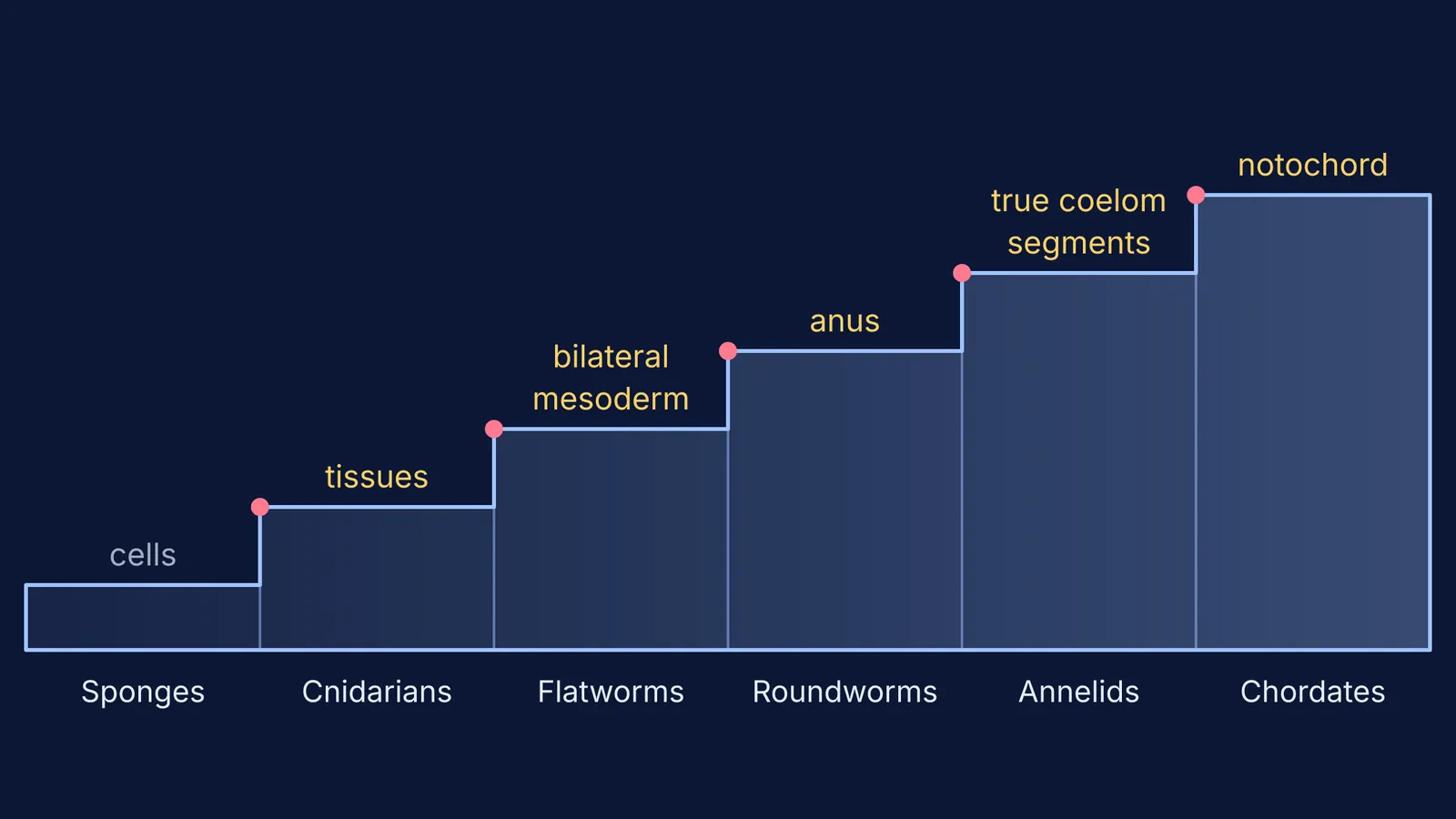
Use a ladder with one new idea on each rung. Say it aloud once a day this week:
Sponges: cells, no tissues.
Cnidarians: tissues.
Flatworms: a left and a right side, plus a middle layer.
Roundworms: a back door (the anus) and a false cavity.
Annelids: a true cavity and repeating rings.
Chordates: a rod along the back.
Here is the ladder at work on a typical question: "Which of these is triploblastic and acoelomate: *Hydra*, *Fasciola*, *Ascaris* or *Pheretima*?"
*Hydra* is a cnidarian, so it is diploblastic. Out.
*Ascaris* is a roundworm, so it is pseudocoelomate. Out.
*Pheretima*, the earthworm, is an annelid, so it is coelomate. Out.
*Fasciola*, the liver fluke, is a flatworm: three germ layers, no body cavity. That is the answer.
One caution: the ladder is a way to learn, not a settled family tree. A 2023 Nature study, with Darrin Schultz as first author, used ancient gene linkages to argue that comb jellies, not sponges, are the sister group to all other animals. For your exam, follow the NCERT order.
If a term on the ladder still feels shaky, the Fermi Concept Library gives each biology concept its own lesson and shows where it sits next to related ideas.
How do you check yourself on the order of firsts?
Use the chart in the NCERT chapter as your answer key:
Without looking, write the phyla in NCERT order down the left side of a page.
Add columns for tissues, symmetry, germ layers, body cavity, gut and segments, and fill every cell.
Circle the first phylum in each column.
Check against Figure 4.4 and each phylum's own section, and mark every wrong cell in red.
Redo only the red rows tomorrow.
If you keep picking the wrong option in practice questions and cannot see why, the Fermi Problem Library has worked problems with a step-by-step solver that explains the reasoning rather than printing an answer.
Then test the gut column against our list of which phyla have a blind-sac gut and which have a complete gut.


