

On this page
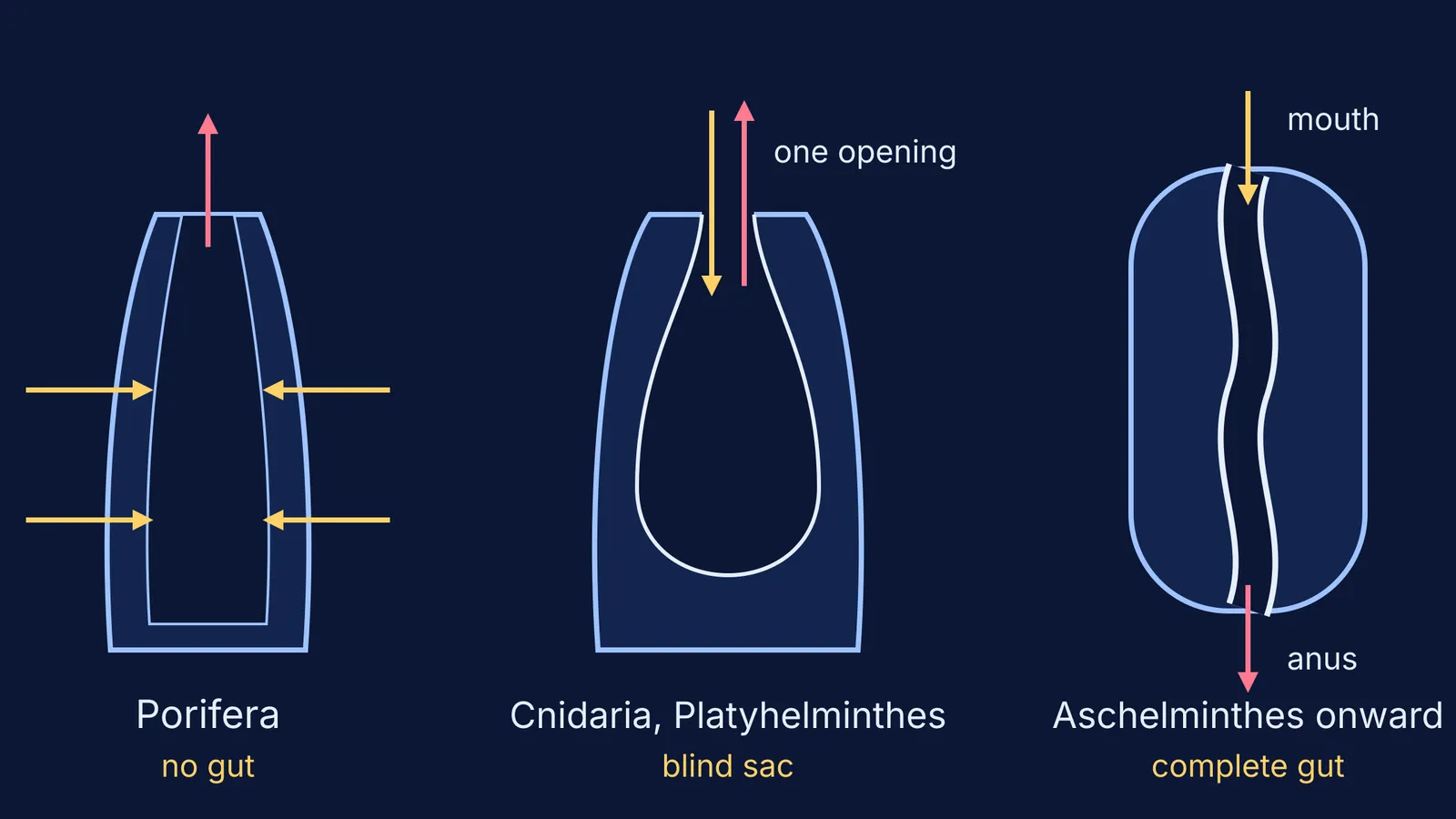
Ask one question of any phylum: how many openings does its gut have? The answer is always none, one or two. That single test sorts most digestion questions in the Animal Kingdom chapter of NCERT Class 11 Biology. It also explains why "first animals with an anus" keeps turning up in NEET options.
Which animals have an incomplete digestive system?
An incomplete digestive system is a gut with only one opening to the outside. NCERT says the digestive system in Platyhelminthes "has only a single opening to the outside of the body that serves as both mouth and anus, and is hence called incomplete" (NCERT Class 11 Biology, Chapter 4: Animal Kingdom). The same chapter says cnidarians have "a central gastro-vascular cavity with a single opening, mouth on hypostome".
OpenStax Biology 2e calls this kind of gut "a blind tube or cavity with only one opening, the 'mouth', which also serves as an 'anus'", and lists flatworms, comb jellies and cnidarians as animals that have one (OpenStax Biology 2e, 34.1 Digestive systems).
A complete digestive system has two openings, mouth and anus (NCERT Chapter 4). OpenStax describes this alimentary canal as "one tube with a mouth at one end and an anus at the other".
Which phyla have no gut, a blind sac or a complete gut?
Here is the quick list, row by row, in NCERT order. Every line comes from the NCERT Animal Kingdom chapter unless marked otherwise.
Porifera (Sycon, Spongilla): no gut. Water enters through ostia, passes through the spongocoel and leaves by the osculum. Digestion is intracellular.
Coelenterata/Cnidaria (Hydra, Aurelia, Adamsia): blind sac. There is one opening, the mouth on the hypostome. Digestion is both extracellular and intracellular.
Ctenophora (Pleurobrachia, Ctenoplana): NCERT says only that digestion is both extracellular and intracellular. Textbooks such as OpenStax group them with the blind-sac animals, but see trap 4 below.
Platyhelminthes (Planaria, Fasciola, Taenia): blind sac, with one opening serving as both mouth and anus. Some parasitic flatworms absorb nutrients from the host directly through their body surface.
Aschelminthes (Ascaris, Wuchereria, Ancylostoma): complete. NCERT says the "alimentary canal is complete with a well-developed muscular pharynx".
Annelida, Arthropoda, Mollusca, Echinodermata, Chordata: complete. These are the protostomes and deuterostomes, and OpenStax notes that "most animals have openings at both ends of the gut: mouth at one end and anus at the other" (OpenStax Biology 2e, 27.2).
Where does the anus first appear?
In NCERT's sequence, Aschelminthes (the roundworms) are the first phylum described with a complete alimentary canal, so this is where the anus first appears (NCERT Chapter 4). They are also NCERT's pseudocoelomates, sitting just after the acoelomate flatworms in Figure 4.4. So two milestones arrive at the same step: the first body cavity (a false coelom) and the first two-ended gut.
OpenStax adds an embryology detail. The blastopore is the opening that first connects the embryo's gut cavity to the outside. In protostomes the mouth forms at the blastopore, and in deuterostomes the anus forms there (OpenStax Biology 2e, 27.2). If coelom types still blur together, our post on acoelomate, pseudocoelomate and coelomate examples sorts them out.
Which NEET options do students usually get wrong?
"Sponges have an incomplete digestive system." Wrong. Sponges have no gut at all. Food is digested inside cells, and water moves through the canal system.
"The anus first appears in Annelida." Wrong. The anus comes in at Aschelminthes. Annelida is the first phylum NCERT describes as metamerically segmented, and students mix up the two "firsts".
"Earthworm and roundworm belong to the same phylum." Wrong. Pheretima is an annelid and Ascaris is an aschelminth. Both have a complete gut, but they are separate phyla.
"Ctenophores have a blind sac with one opening." Many textbooks, including OpenStax, say so. But a 2016 Current Biology study by Presnell and colleagues reported that comb jellies have a "unidirectional, functionally tripartite through-gut", and called the idea of a sac-like blind gut with only one major opening "a commonly held misconception". NCERT itself doesn't state a gut type for ctenophores, so be wary of any option that depends on it.
Try it: a 60-second practice question
Which pair has the same type of digestive system? (a) Hydra and Ascaris (b) Planaria and Hydra (c) Spongilla and Fasciola (d) Pheretima and Planaria.
Count openings: Hydra 1, Ascaris 2, Planaria 1, Spongilla 0, Fasciola 1, Pheretima 2. Only (b) matches, so the answer is (b).
Use this drill on any option list: name the phylum, count the openings, check the traps. For more of these, try our Animal Kingdom NCERT exceptions and odd-one-out questions. If you want the whole chapter on one page, read Animal Kingdom Class 11: phyla, coelom and chordate classes.
If gut type keeps slipping out of your memory, the Fermi Concept Library gives each biology concept its own lesson and shows its place in the map. When you get a question wrong and can't see why, the Fermi Problem Library has a step-by-step solver that explains the reasoning rather than just printing an answer.
Tonight, write the six rows above from memory, then check them against the list.


