On this page
The cancer section of NCERT's Human Health and Disease chapter is short, but almost every line in it can become a question: what contact inhibition is, how a benign tumour differs from a malignant one, what CT uses that MRI does not. This post goes through the section in order, adds the research framework behind it, and works through one calculation that shows why cancers are usually found late.
This post is about biology for exams. If you or someone in your family has a health worry, speak to a doctor.
What does the syllabus include?
The NEET (UG) 2026 syllabus lists "Cancer, HIV and AIDS" under Health and Disease. The CBSE Class 12 curriculum for 2026-27 has the same line. The text to learn is section 7.4 of the NCERT chapter on human health and disease. Check the current year's syllabus before your exam.
What goes wrong in a cancer cell?
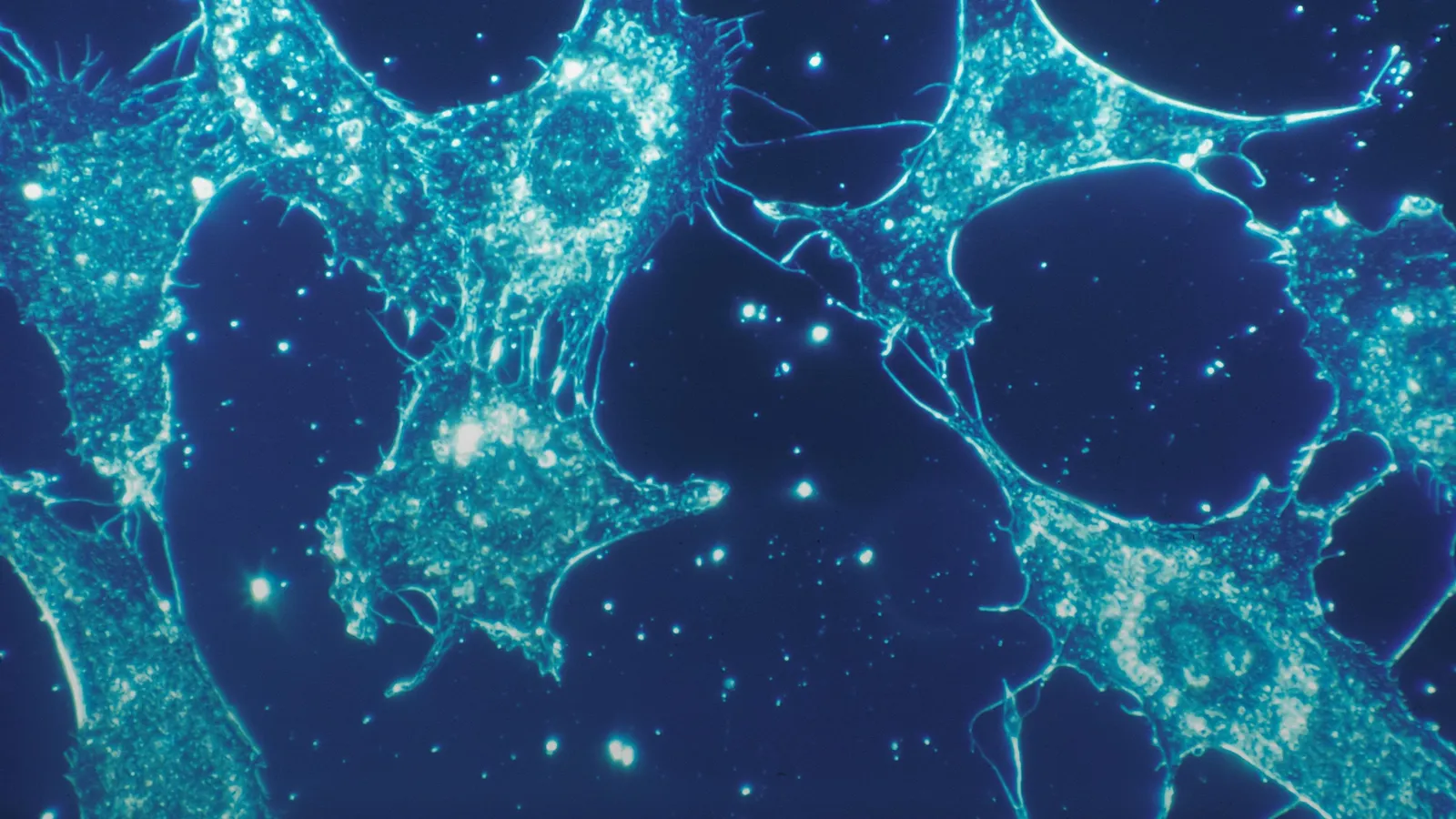
Normal cells show contact inhibition: touching other cells stops them dividing. NCERT explains that cancer cells appear to have lost this property, so they keep dividing and form masses called tumours.
Benign tumours stay where they started and cause little damage.
Malignant tumours are masses of neoplastic cells that grow quickly, invade nearby tissue and compete with normal cells for nutrients. Cells that break away travel through the blood and start new tumours elsewhere. This is metastasis, which NCERT calls the most feared property of malignant tumours.
Researchers summarise what a cell must gain to become cancerous as a set of "hallmarks". The idea was set out by Hanahan and Weinberg in Cell (2000) and updated by Hanahan in 2022, who describes the hallmarks as a tool for distilling the complexity of cancer into a provisional set of underlying principles. You do not need the list for the exam, but it explains why loss of growth control and the ability to spread are central.
What causes cancer?
NCERT groups carcinogens into three kinds:
Physical: ionising radiation such as X-rays and gamma rays, and non-ionising UV, which damage DNA.
Chemical: carcinogens in tobacco smoke, named as a major cause of lung cancer.
Biological: oncogenic viruses carrying viral oncogenes.
Normal cells also carry proto-oncogenes, or cellular oncogenes (c-onc). When activated under certain conditions, they can lead to oncogenic transformation.
How is cancer detected and treated?
Detection, as NCERT describes it:
Biopsy and histopathology: a piece of tissue is cut into thin sections, stained and examined by a pathologist.
Blood and bone marrow tests for raised cell counts in leukaemias.
Radiography and CT use X-rays; CT builds a three-dimensional image.
MRI uses strong magnetic fields and non-ionising radiation.
Antibodies against cancer-specific antigens, and molecular tests for genes that raise inherited risk.
Treatment combines surgery, radiotherapy and chemotherapy. Because tumour cells avoid the immune system, patients may also be given biological response modifiers such as alpha-interferon, which activate the immune system.
How common is cancer in India?
Using data from 28 population-based cancer registries, Sathishkumar and colleagues (Indian Journal of Medical Research, 2022) estimated 14,61,427 new cancer cases in India in 2022, and that one in nine people in India is likely to develop cancer in their lifetime. Lung cancer was the leading site in men and breast cancer in women.
Worked example: how many doublings to a detectable tumour?
A tumour of about 1 cubic centimetre, roughly 1 gram, is commonly assumed to hold 10^9 cells. Starting from one cell, how many doublings does that take?
After n doublings there are 2^n cells.
2^10 = 1024, about 10^3. So 2^30 = (2^10)^3, about 10^9.
About 30 doublings take one cell to a 1-gram tumour.
One more check: 2^30 = 1,073,741,824, just over 10^9.
Del Monte (Cell Cycle, 2009) points out that for epithelial tumours a figure ten times smaller, 10^8 cells per gram, is more realistic. Then 2^27 = 134,217,728, about 1.3 x 10^8, so about 27 doublings. Either way, most of a tumour's doublings happen before it is big enough to find, which is why NCERT stresses early detection.
Common mistakes
Calling every tumour cancer. Benign tumours do not invade or metastasise.
Mixing up proto-oncogenes and oncogenes. The proto-oncogene is the normal gene; an activated form can drive cancer.
Listing UV as ionising. NCERT calls it non-ionising.
Calling alpha-interferon a chemotherapy drug. It is a biological response modifier.
A practice routine
Write the NCERT section as five headings: properties, causes, detection, treatment, prevention. Fill each from memory.
Make a two-column list of ionising and non-ionising agents mentioned in the chapter.
Redo the doubling calculation for a 10-gram tumour.
Revise cell division in our post on the cell cycle, mitosis and meiosis, since cancer is a failure of its controls.
If you want a fuller picture of how cell-cycle control connects to this chapter, the Fermi Concept Library covers every concept in physics, chemistry, biology, mathematics and computing, so you can trace the link.
Next step: close the book and list the three kinds of carcinogens with one example each.