

On this page
Mumbai is one of the few megacities in the world with a large wild cat living inside it. Sanjay Gandhi National Park (SGNP) sits in the north of the city, and its leopards walk out at night into housing colonies, slums and Aarey Milk Colony.
How many leopards live in Mumbai?
A camera-trap survey from February to June 2024 found at least 54 leopards in SGNP and nearby areas, reported the Free Press Journal. The Wildlife Conservation Society-India and the Maharashtra forest department ran it with cameras at 90 locations across SGNP, Aarey Milk Colony and Tungareshwar Wildlife Sanctuary. It identified 36 females and 16 males, plus four cubs; the sex of two leopards could not be determined.
That is a crowded park. A study in Frontiers in Conservation Science by Nikit Surve, Vidya Athreya and colleagues measured 26.34 leopards per 100 square kilometres in SGNP, among the highest leopard densities recorded in India. The same paper notes the 104 square kilometre park is ringed by roughly 20,000 people per square kilometre. Each cat is told apart by its unique rosette pattern in the photos, the same trick that Ullas Karanth used to count tigers with camera traps.
What do Mumbai's leopards eat?
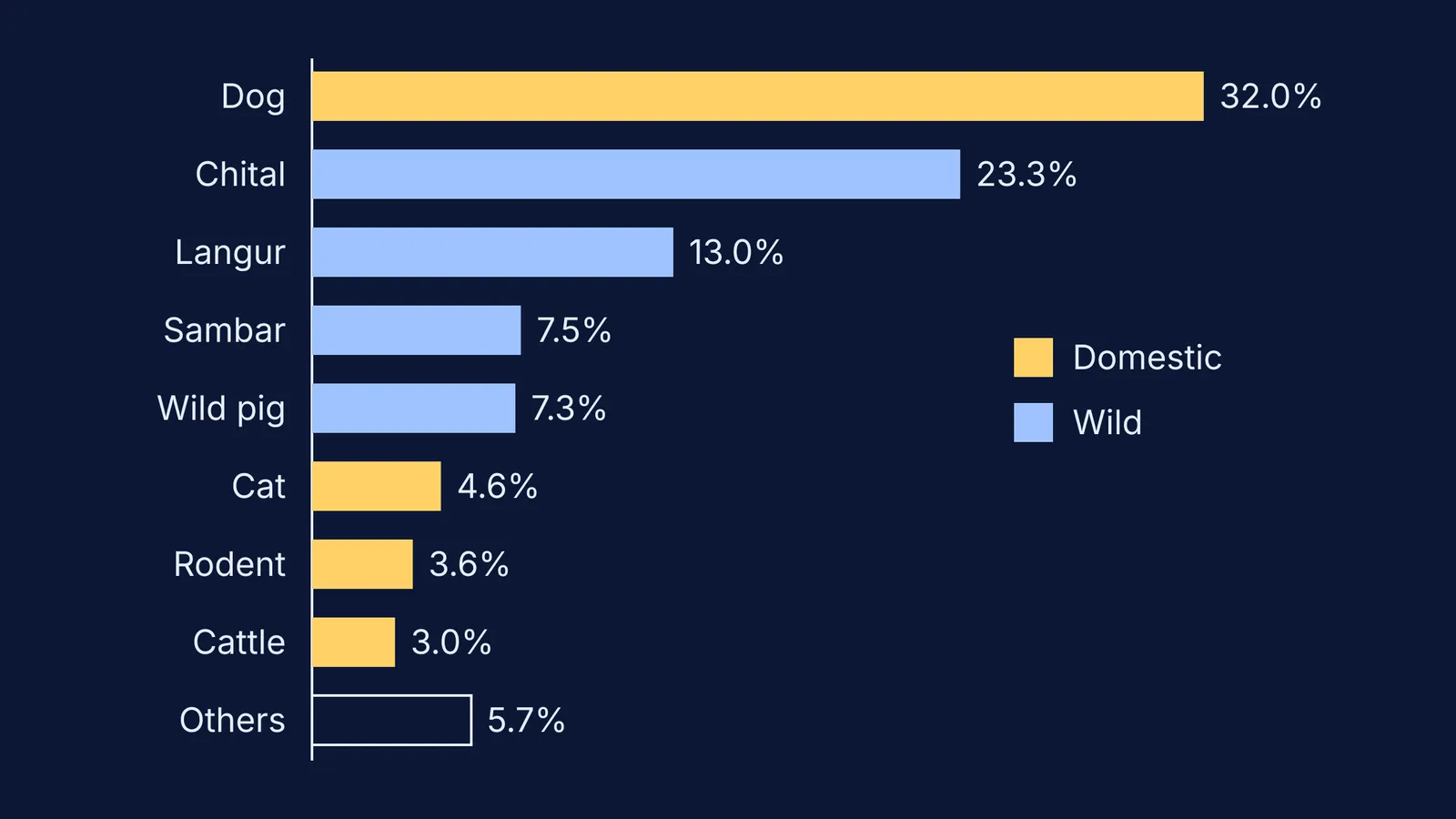
Wild animals, plus a lot of stray dogs. In the 2022 SGNP study, scat analysis showed domestic dogs made up 32.01% of the biomass leopards ate, the single largest item. Chital deer came next at 23.27%, then langurs at 12.97%, sambar at 7.50% and wild pigs at 7.30%. Wild prey made up 53.97% overall, so the park's forest still matters.
Dogs matter outside the city too. In the croplands of Ahmednagar district, Athreya and colleagues found in Oryx that 87% of leopard prey biomass was domestic animals, with dogs alone at 39%.
This is where garbage comes in. Open rubbish feeds stray dogs and pigs, and those animals are leopard food. Vidya Athreya told Down To Earth that attacks can be minimised by precautions such as not venturing out alone in the dark and keeping surroundings clean, "thereby not attracting pigs and dogs on which the wild cats feed".
There may even be an upside. A 2018 paper in Frontiers in Ecology and the Environment by Alexander Braczkowski and colleagues suggested that, by eating stray dogs, Mumbai's leopards reduce dog bites and rabies risk, and could save up to 90 human lives a year under one set of assumptions. It is an example of a top predator shaping the animals below it, the idea behind a trophic cascade.
Why do leopards rarely attack people in Mumbai?
As the diet data above shows, leopards here feed on dogs, deer, monkeys and pigs rather than people. The safety advice from researchers and the forest department centres on a few situations: being alone outdoors after dark, children out at night without an adult, and crowds that panic a leopard.
Around SGNP there were 84 attacks between 2002 and 2004, about 28 a year, then an average of about two a year from 2005 to 2010, according to Down To Earth's 2013 report. The Wildlife Conservation Society said in 2016 that in the previous two years no leopards had been trapped and no attacks reported. It credited research, training for forest staff, workshops for the media, coordination with the police and the municipality, and outreach by the citizen group Mumbaikars for SGNP.
Does trapping and moving leopards make people safer?
Research from Maharashtra suggests not. In one programme, 29 leopards were caught in rural areas and released in forests about 39.5 km away. A study in Conservation Biology by Athreya, Odden, Linnell and Karanth found that leopard attacks in Junnar, which had averaged four a year in 1993-2001, rose to an average of 17 after the releases. The authors concluded that translocation induced attacks on people.
How can you stay safe near a leopard forest?
A "Living with Leopards" leaflet for north Mumbai residents, released on World Environment Day 2016, gives simple rules. Here they are as a household checklist:
Make sure garbage is disposed of properly and keep dogs indoors.
Make sure an adult supervises children, especially after dark.
Do not walk alone after dark. If you must, play music on your phone so a leopard knows people are near.
If you see a leopard, give it right of way and let it move off peacefully.
Never form a crowd around one. Mob behaviour makes the animal panic.
Call the forest department control room promptly.
If your housing society spots a leopard, here is a short script for the WhatsApp group: "Leopard seen near Gate 2 at 9 pm. Please keep children and pets inside, stay off that path, and do not go to look. We have informed the forest department."
For ideas in ecology that are easier to see than to read, the Fermi Simulation Lab has interactive simulations, and the Fermi Concept Library covers every concept in biology, each with its own lesson. For how animals like leopards space themselves out, read our guide to territorial behaviour in animals.


