

On this page
A pied bush chat singing from a fence post is telling other males that this patch of field is taken. That one idea, territory, explains why birds sing, why animals leave scent on paths, and why neighbours often fight less.
What is territorial behaviour in animals?
A territory is a space that an individual, a pair or a group defends against members of its own species, so that it alone gets the resources inside, according to a 2018 review in Behavioral Ecology by Charlotte Christensen and Andrew Radford. The same review lists mammals, birds, fishes, reptiles, amphibians, crustaceans and insects among territorial animals. The resources at stake include food and water, breeding and sleeping sites, and mates. Defence ranges from a call, a smell or a display to a real fight.
Defending space costs time and energy, so it only pays when the prize is worth it. In a 1975 study in Ecology, Frank Gill and Larry Wolf found that golden-winged sunbird feeding territories held enough nectar to meet a bird's daily energy needs. When nectar in undefended flowers was low, the energy saved by feeding on richer defended flowers could easily cover the cost of defence. When nectar outside was plentiful, they argued, that cost probably could not be recovered.
Compare our post on interspecific competition examples: a territory holder chases rivals of its own kind.
How do animals mark their territory with song and scent?
The Christensen and Radford review notes that costs rise as an encounter grows more intense and lasts longer, so a signal that settles things early saves effort.
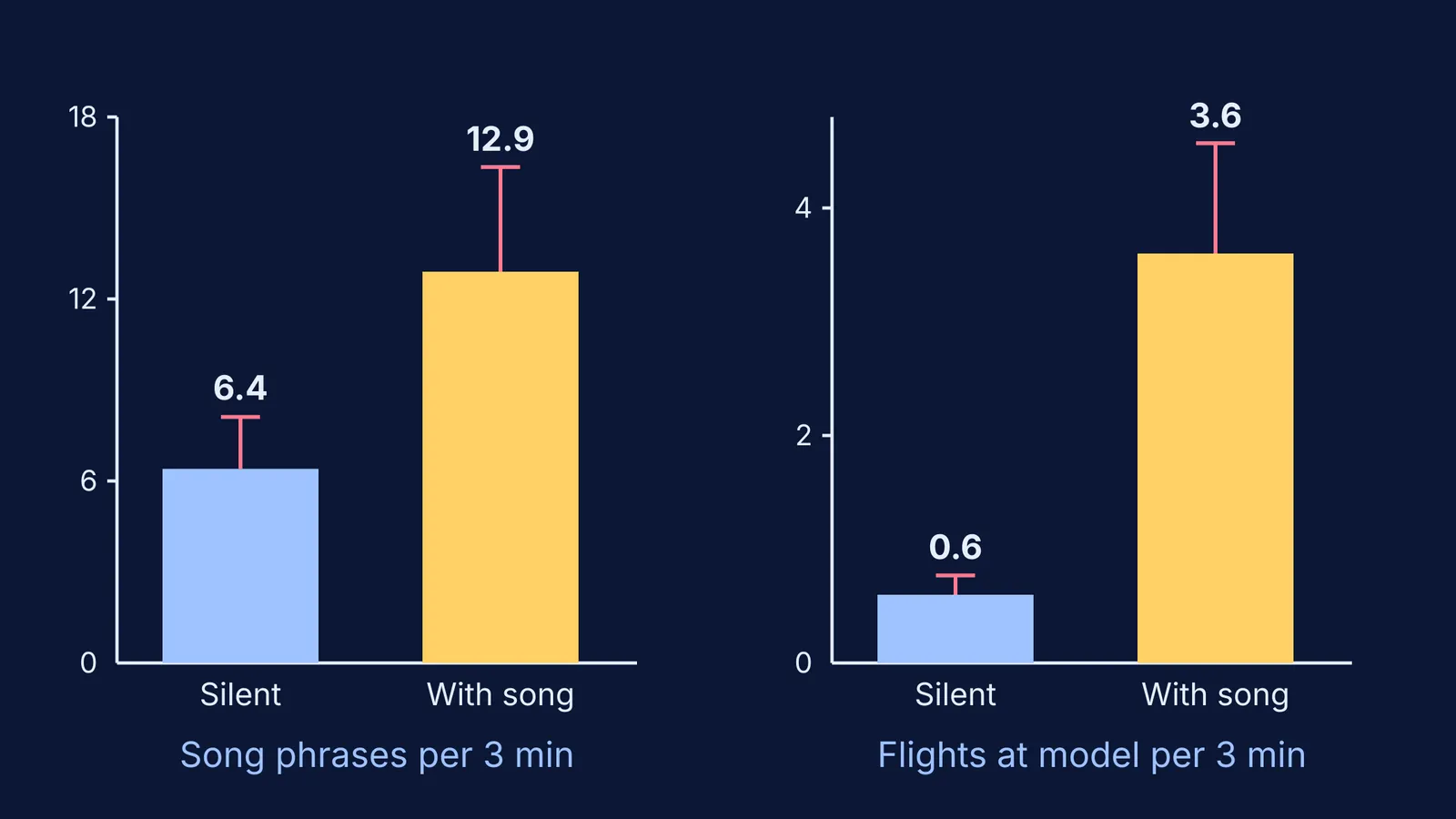
Song. Navjeevan Dadwal and Dinesh Bhatt tested 14 male pied bush chats near Haridwar in the 2015 breeding season (Animal Behavior and Cognition, 2017). They placed a painted wooden model of a pied bush chat near each nest. It stayed silent for three minutes, then a speaker under it played unfamiliar song for three more. Song rate went from 6.4 to 12.9 song phrases per three minutes. Flights at the model went from 0.6 to 3.6. The authors concluded that song was the major cue these birds used against rival intrusions.
Scent. In a 2015 PLoS One study, researchers presented 351 anal gland secretions to 187 European badgers. Sniffing and over-marking were strongest for strangers' scent, weaker for neighbours' and weakest for the badger's own group. The authors argue that the traditional picture of scent marks as a "scent fence" is too simple: badgers seem to weigh up who left a mark. Chemical signals can do other jobs too, as in ant pheromone trails.
Why do territorial animals fight less with their neighbours?
The dear-enemy effect is when a territory holder responds more strongly to intruding strangers than to intruding neighbours, as defined in the Christensen and Radford review. A neighbour is known to turn up at a regular border, while strangers arrive less predictably. And in the breeding season a neighbour already has a territory, while a stranger may be looking to take over the whole thing. Fights are costly: injury or even death, stress, and lost time and energy. Holding back against a low-threat neighbour saves some of those costs.
If food levels on feeding territories go up and down and tempt neighbours to take over, neighbours can become the bigger threat and get the stronger response, which is called the "nasty-neighbour" effect. The review also notes that if neighbours start intruding more, residents may respond more strongly in future.
Ownership can also settle contests with little fighting. In a 1978 paper subtitled "the resident always wins", Nick Davies reported that male speckled wood butterflies defending sunspots kept them against intruders (an interview with Davies about the study and later work). Later studies found that where territories were scarcer, the brief spiral flights could escalate into longer contests. Davies now suspects that ownership is usually linked to a real difference in fighting ability.
How can you spot territorial behaviour yourself?
Pick one bird you see daily, such as a magpie robin or bulbul, and watch it on three mornings. Keep your distance: the Haridwar researchers watched from 20 to 25 metres. Note your answers to five questions:
Place: does it come back to the same perch or patch each day?
Signal: does it sing, call or display from exposed spots at the edges?
Target: does it chase birds of its own species more than other species?
Identity: does it react more to a newcomer than to a regular neighbour?
Prize: what is inside the space: food, a nest site or a mate?
The more "yes" answers to the first four, the likelier it is a territory. Use the same order in a written answer. For example: "Male pied bush chats defend breeding territories (place, prize). They use song as the main signal. In a field test, song rate roughly doubled when a model rival played song (evidence). Signals let owners avoid costly fights (payoff)."
If cost-benefit ideas like these feel loose, the Fermi Concept Library gives every biology concept its own lesson and shows its place in the map, so you can see how territoriality connects to related ideas.


