

On this page
When students prepare for ecology in Class 12 or competitive exams like NEET, competition is often introduced as an interaction strictly between closely related species struggling over scarce food. Yet nature routinely breaks this rule. Interspecific competition—where the fitness of one species is lowered in the presence of another—operates through diverse pathways. Two classic ecological case studies show that competitors need not be related, and resources do not need to be limiting for competition to reshape an ecosystem.
Why did the Abingdon tortoise become extinct?
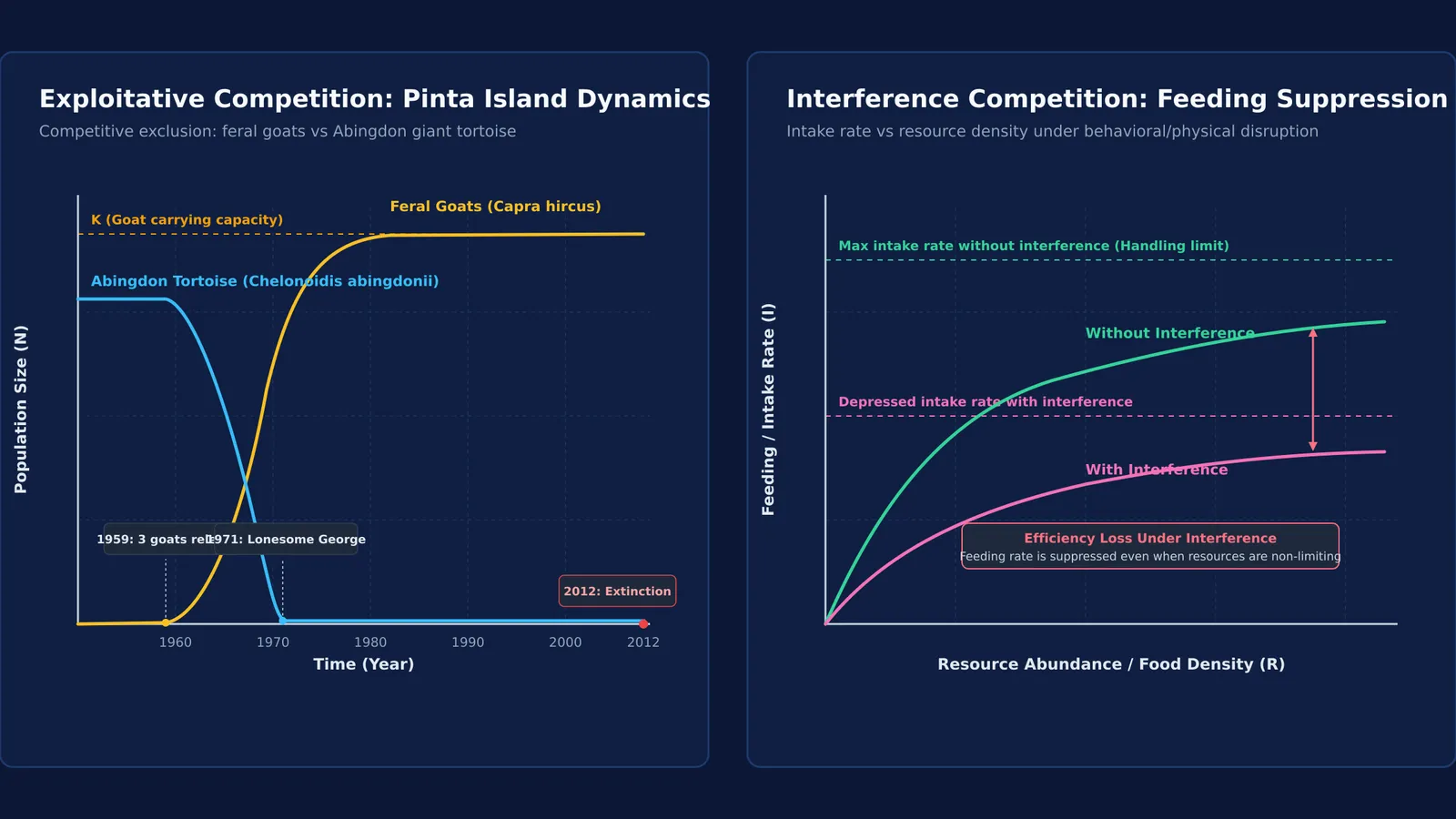
In 1959, local fishermen released just 3 feral goats (*Capra hircus*) on Pinta Island, also known as Abingdon Island, a small volcanic island in the Galapagos archipelago (Weber, 197190045-0)). Within little more than a decade, the feral goat herd expanded into tens of thousands of individuals, eventually prompting an eradication programme where conservationists culled over 41,000 goats (Campbell et al., 2004).
The island's native giant herbivore, the Abingdon tortoise (*Chelonoidis abingdonii*), had evolved without mammalian rivals. The goats possessed far greater browsing efficiency, stripping shrubs, chewing tree bark, and consuming seedlings down to their roots before vegetation could regenerate. Unable to match this consumption rate, the slow-moving tortoises faced severe starvation. By 1971, only one surviving individual—named Lonesome George—remained. When George died in 2012 at the Charles Darwin Research Station, the species became officially extinct. This case illustrates exploitative competition: the goats never attacked the tortoises directly, but their rapid consumption eliminated the shared food supply until the inferior competitor died out.
Can birds and fish compete for the same food?
Another common misconception is that competition only occurs between closely related species with nearly identical morphology. In shallow, high-altitude Andean lakes, however, an entirely different dynamic plays out. Surveying 20 high-elevation lakes between 3,700 and 4,700 metres elevation in southern Peru, ecologist Stuart Hurlbert and his colleagues documented intense competition between visiting Chilean flamingos (*Phoenicopterus chilensis*) and resident cyprinodont killifish of the genus *Orestias* (Hurlbert et al., 1986).
Both species feed on the same prey: large pelagic zooplankton, including calanoid copepods and daphnids. Hurlbert found that Chilean flamingos were abundant on fishless lakes but virtually absent on lakes with *Orestias* fish. The resident fish kept zooplankton densities too sparse for filter-feeding flamingos to harvest profitably. Birds and fish belong to separate vertebrate classes that diverged over 400 million years ago, yet they compete directly for the same food. When reading NCERT biology line by line or answering ecology population questions, this case proves that competitors need not be congeneric or physically similar.
How does competition happen when resources are not limiting?
Perhaps the most counterintuitive ecological principle is that competition can occur even when food and space are abundant. The classic definition formulated by G. F. Gause assumed that competition requires limiting resources. But ecologists recognize a distinct mechanism known as interference competition (Schoener, 1983).
In interference competition, one species directly harms, harasses, or physically obstructs another from utilizing a resource. Even when nourishment is abundant, the feeding efficiency of the subordinate species drops because it spends time and energy avoiding aggressive encounters. In field experiments on Scotland's rocky intertidal coast, ecologist Joseph Connell showed that the larger barnacle *Balanus balanoides* mechanically undercuts and crushes the smaller barnacle *Chthamalus stellatus* (Connell, 1961). When Connell removed *Balanus*, *Chthamalus* quickly colonized the lower zone—a clear demonstration of competitive release showing that direct physical interference, rather than food shortage, caused the exclusion.
The four-step competition diagnostic checklist
To analyze ecological interactions systematically without falling into textbook traps, apply this four-step diagnostic framework:
Identify taxonomic distance: Do not assume competitors must be related. Check whether dissimilar organisms (like flamingos and fish, or insects and rodents) share a common trophic resource.
Distinguish the interaction mechanism: Ask whether the interaction is indirect through resource depletion (exploitative competition) or direct through behavioral harassment, spatial crowding, or allelopathic chemicals (interference competition).
Evaluate resource abundance: Check whether resource limitation is necessary. In exploitative interactions, scarce resources drive exclusion; in interference interactions, feeding efficiency drops regardless of resource abundance.
Predict the evolutionary outcome: Look for whether the interaction leads to competitive exclusion (as seen with the Abingdon tortoise), competitive release (as demonstrated in Connell's barnacles), or resource partitioning (such as MacArthur's warblers dividing foraging heights to coexist).
When revising community ecology or building mental models of species interactions, reviewing an organisms and populations review helps connect these field studies to population equations. The Fermi Concept Library arranges each ecological concept—from logistic growth and carrying capacity to interspecific interactions—into an interconnected knowledge map. If you are practicing numerical or analytical problems on population curves and interaction models, the Fermi Problem Library provides worked problems with a step-by-step solver that explains the ecological reasoning behind each step.


