

On this page
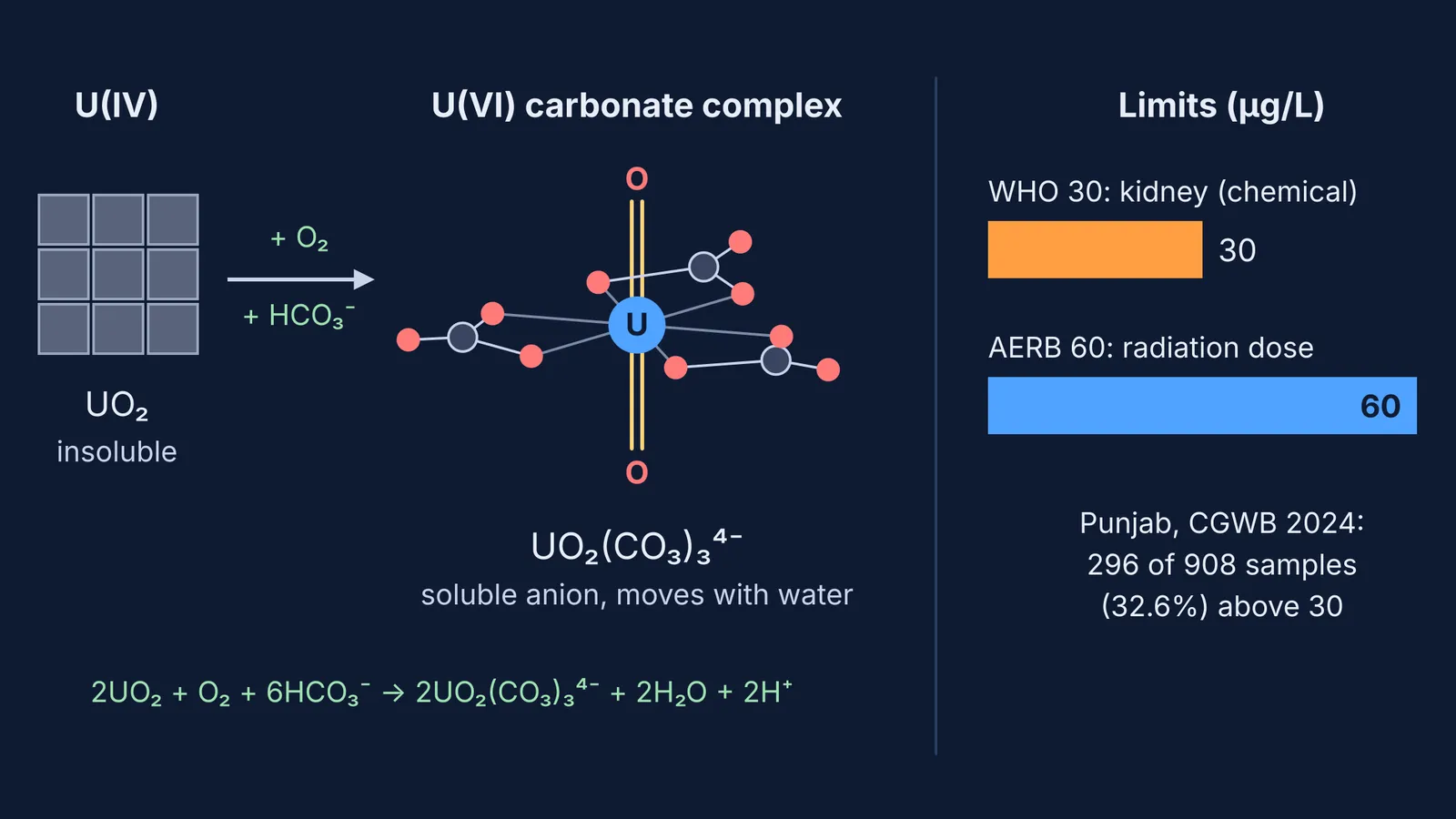
News reports about uranium in Punjab's well water often get the chemistry wrong, blaming radiation or power-plant ash. The Central Ground Water Board's 2024 groundwater quality summary for Punjab found uranium above 30 ppb (30 µg/L) in 296 of 908 samples, 32.6%, with such samples in 20 districts, including the Malwa districts of Bathinda, Mansa, Faridkot, Moga and Muktsar. The reason uranium dissolves in this water is a piece of Class 12 chemistry: an oxidation state change and a very stable complex ion. This post explains it. It is not health advice: if your area is flagged, get your water tested and follow your state water department or local health authority.
Where does the uranium in Punjab's groundwater come from?
Most studies point to the sediments themselves, washed down from the Himalaya and Siwalik hills and carrying small amounts of uranium. A 2018 Panjab University study, reported by Down To Earth, concluded that the most plausible origin in the Malwa region is geogenic (natural). It found nothing alarming in water bodies near coal power stations, which argues against the fly-ash idea, and noted that the phosphate-fertiliser idea had been contested.
A larger study of northwestern India, Coyte and colleagues in Environmental Science & Technology Letters (2018), also concluded that the primary source is geogenic, and found that uranium tended to rise with bicarbonate. Its authors suggested that falling water tables and nitrate pollution may add to the problem. The details are still debated, but "natural uranium, made mobile by the water's chemistry" is the main explanation.
What decides whether uranium dissolves?
Uranium is an actinoid with oxidation states from +3 to +6 (see how lanthanoids and actinoids compare). In nature two matter:
U(IV): found as uranium dioxide, UO₂ (the mineral uraninite). It is almost insoluble in water.
U(VI): found as the uranyl ion, UO₂²⁺. This linear O=U=O unit stays intact through most reactions, like a polyatomic ion.
Oxygen converts U(IV) to U(VI). In oxygen-poor aquifers uranium tends to stay locked up as U(IV); in shallow, oxygenated water it becomes uranyl. But free UO₂²⁺ would stick to mineral surfaces or precipitate. Something has to hold it in solution.
How does bicarbonate keep uranium in solution?
A 2023 review of uranium mobilisation in the Malwa region by Vajinder Kumar and colleagues puts the carbonate complexes at the centre of the story. Much of the groundwater there carries plenty of bicarbonate, HCO₃⁻, from the weathering of carbonate and silicate minerals. In oxygenated, slightly alkaline water, uranyl binds carbonate ions to form very stable complexes: UO₂(CO₃)₂²⁻ and, with plenty of carbonate, UO₂(CO₃)₃⁴⁻. In the tricarbonato complex, the three carbonate ions each bind through two oxygen atoms around the uranyl "waist", giving six oxygens in a ring plus the two uranyl oxygens on the axis, a hexagonal bipyramid with coordination number 8. Where calcium is high, calcium–uranyl–carbonate complexes such as CaUO₂(CO₃)₃²⁻ also form, the review notes.
These complexes are negative or neutral. Most clay and silica surfaces are negatively charged at this pH, so a negative complex is repelled rather than held, and the uranium travels with the water up the tube well.
Worked example: balancing, moles and radioactivity
Problem. (a) Balance the oxidation of UO₂ by dissolved oxygen in bicarbonate water to give the tricarbonato complex. (b) Water has 30 µg/L of uranium and 4.0 mmol/L of HCO₃⁻ (an assumed, typical value for hard groundwater). Compare the moles. (c) What is the activity of 1 L of this water?
Step 1. Electrons. Each U goes from +4 to +6 and loses 2 electrons. One O₂ gains 4 electrons (0 → −2 for two atoms), so two UO₂ need one O₂.
Step 2. Balance. 2UO₂ + O₂ + 6HCO₃⁻ → 2UO₂(CO₃)₃⁴⁻ + 2H₂O + 2H⁺
Check: U 2 = 2. C 6 = 6. O 4 + 2 + 18 = 24 on the left; 2 × 11 + 2 = 24 on the right. H 6 = 4 + 2. Charge −6 on the left; 2(−4) + 2(+1) = −6 on the right.
Step 3. Moles. Uranium: 30 × 10⁻⁶ g ÷ 238 g/mol = 1.26 × 10⁻⁷ mol/L. Bicarbonate: 4.0 × 10⁻³ mol/L (about 244 mg/L). The ratio is about 3 × 10⁴, so even after three carbonates go to each uranium, the bicarbonate is barely touched. That huge excess is why the tricarbonato complex dominates.
Step 4. Decay constant. U-238 has a half-life of 4.468 × 10⁹ years. In seconds that is 4.468 × 10⁹ × 3.156 × 10⁷ = 1.41 × 10¹⁷ s, so λ = 0.693 ÷ 1.41 × 10¹⁷ = 4.92 × 10⁻¹⁸ s⁻¹.
Step 5. Atoms and activity. N = 1.26 × 10⁻⁷ mol × 6.022 × 10²³ = 7.6 × 10¹⁶ atoms. A = λN = 4.92 × 10⁻¹⁸ × 7.6 × 10¹⁶ = 0.37 Bq. Natural uranium also contains U-234, which in equilibrium has the same activity, so the total is roughly 0.75 Bq per litre. Treat that as approximate, since groundwater is often not exactly in equilibrium. The A = λN method is the same one used in activity units, becquerel and curie.
Answer. A litre of water at 30 µg/L has well under one decay per second. For scale, the Health Physics Society estimates about 4,200 Bq of potassium-40 in a 70 kg adult's body. That comparison is why the drinking-water concern at these levels is mainly chemical, not radiation.
Is the risk chemical or radiological?
Mainly chemical. The World Health Organization's Guidelines for drinking-water quality set a provisional guideline of 30 µg/L for uranium, based on its chemical toxicity to the kidney rather than on radiation. India's Atomic Energy Regulatory Board uses 60 µg/L, a figure derived from radiation dose limits, as discussed in a 2024 review in Environmental Science and Pollution Research. The two numbers answer different questions, and news reports often mix them up. The CGWB figures above use 30 ppb.
WHO treats long-term intake above the guideline as a concern for kidney health, and calls the value provisional because the evidence is limited. A guideline is a long-term safety margin, not a line between safe and harmful on any given day.
How is uranium removed from drinking water?
Because the uranium is in an anionic complex, anion-exchange resins that swap chloride for anions take it out well, and reverse osmosis membranes hold it back with other dissolved ions. Boiling does nothing, since uranium does not evaporate, and boiling away water concentrates it slightly, as explained in what boiling cannot remove from water. Which method suits a household or village depends on testing, so follow your local water authority.
If you want to see how half-life and activity link up, the Fermi Simulation Lab has interactive simulations for ideas that are easier to see than read.
Quick checklist
U(IV) as UO₂ is insoluble; U(VI) as the uranyl ion UO₂²⁺ is the mobile form.
Oxygen does the oxidation: 2UO₂ + O₂ + 6HCO₃⁻ → 2UO₂(CO₃)₃⁴⁻ + 2H₂O + 2H⁺.
Bicarbonate forms stable anionic carbonate complexes that slip past negatively charged sediment.
The source is mainly geogenic; the details are still debated.
30 µg/L is about 0.37 Bq/L from U-238, roughly 0.75 Bq/L with U-234: tiny next to the body's own potassium-40.
WHO 30 µg/L is chemical (kidney) and provisional; AERB 60 µg/L is radiological.
Boiling does not help. Test the water and follow local guidance.


