

On this page
Private cord blood banks in India hand out leaflets at antenatal clinics, according to ICMR's 2023 Guidelines for Umbilical Cord Blood Banking. This is a science explainer, not medical advice; decisions about a pregnancy belong with your obstetrician.
What are haematopoietic stem cells in cord blood?
Umbilical cord blood is the blood that remains in the placenta and umbilical cord after a baby is born, according to ICMR's 2023 cord blood guidelines. It is collected from the placenta after delivery, and ICMR says the procedure poses no risk to mother or baby when done properly. (Here is how the placenta and umbilical cord exchange materials.)
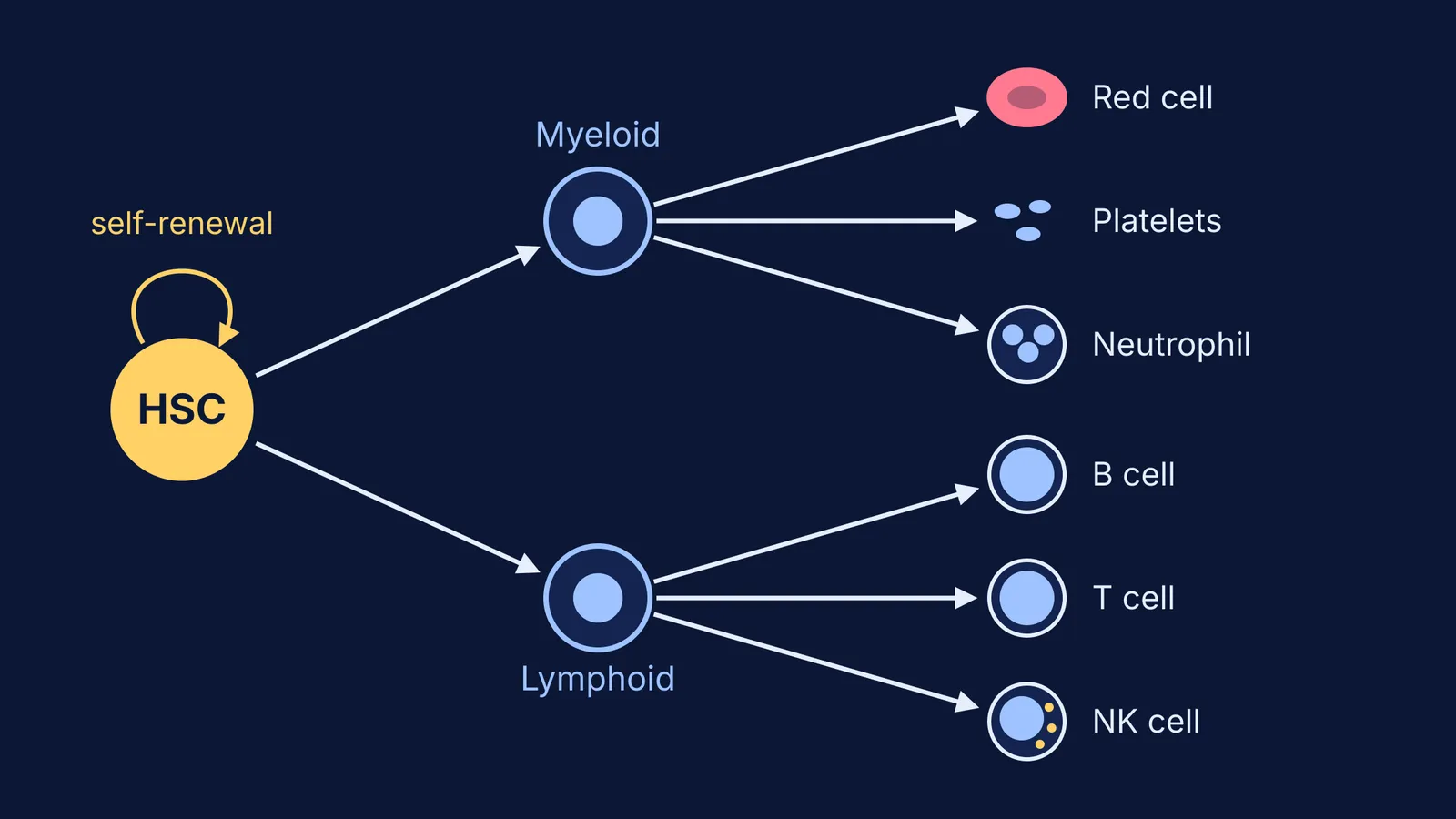
Haematopoietic ("blood-forming") stem cells, or HSCs, are cells that can renew themselves and also mature into the myeloid and lymphoid cell lines, as the same ICMR document puts it. The myeloid line gives red blood cells, platelets and several kinds of white cell; the lymphoid line gives B, T and NK cells. After birth, HSCs live mainly in the red bone marrow inside our bones.
Why is umbilical cord blood stored for stem cells?
Because HSCs can rebuild a patient's whole blood and immune system. In a transplant, healthy stem cells replace a patient's own blood-forming cells after high-dose chemotherapy or radiation has destroyed them, as defined in the ICMR 2023 glossary. The idea grew out of bone marrow transplants, which E. Donnall Thomas made work.
ICMR's 2023 guidelines date the first successful cord blood transplant to Paris in 1988, and say more than 35,000 have since been done worldwide. A child with Fanconi's anaemia received cord blood from an HLA-matched sibling, as reported by Gluckman and colleagues in the New England Journal of Medicine in 1989.
Matching is why cord blood matters. By Mendelian inheritance only 25% of children have an HLA-identical sibling (around 30% in practice), and cord blood needs less strict HLA matching than bone marrow, ICMR notes. The trade-offs, per the same document: a small unit, a cell dose that mostly suits children, and slower engraftment.
What are the proven uses, according to ICMR?
ICMR's National Guidelines for Stem Cell Research 2017 say that any use of stem cells in patients, other than rebuilding the blood system with HSCs for approved indications, is investigational. Its Annexure III lists the approved indications for blood stem cell transplants, among them:
leukaemias such as acute myeloid leukaemia (AML) and acute lymphoblastic leukaemia (ALL)
lymphomas, including Hodgkin lymphoma
sickle cell disease, and thalassaemia major in children
severe aplastic anaemia and Fanconi's anaemia
severe combined immunodeficiency (SCID) and some inherited metabolic diseases
The 2023 guidelines say cord blood is permitted only for transplants in approved indications; every other use is experimental and belongs in approved clinical trials. Banking cord tissue, dental pulp or Wharton's jelly is not permitted.
Is storing your own baby's cord blood useful?
"So far there is no scientific basis for preservation of cord blood for future self-use," the 2017 ICMR guidelines state. The 2023 document adds that the chance a stored unit is used for a transplant may be as low as 0.005 to 0.04% in the first 20 years of life, and that a child's own cord blood should not be used to treat their own genetic condition, because the cells can carry the same defect.
ICMR suggests private storage mainly when a sibling or relative has a malignant or genetic condition that a transplant can treat. Otherwise it encourages donation to public banks, which hold units for any matched patient. The American Academy of Pediatrics' 2017 policy statement calls public banking "the preferred method" and notes that private banks are underused and cost families more.
In India, public options are thin. In January 2023, ICMR's guidelines recorded 22 licensed cord blood banks and no public ones. Use is also falling: the Indian Society of Blood and Marrow Transplantation registry counted only 60 unrelated cord blood transplants in India from 2012 to 2020, and ICMR links the decline to transplants from half-matched family donors.
Questions to take to your obstetrician
These questions come from the points ICMR raises in its 2023 guidelines:
Does anyone in our family have a condition that an HSC transplant treats?
Is the bank licensed by CDSCO, as every cord blood bank in India must be?
How is cell viability checked before release, and what happens to the unit if the bank closes?
Does the doctor or hospital have a financial link to the bank? ICMR asks professionals to disclose this.
Will collection change the timing of cord clamping?
ICMR says complaints about bank practices can go to CDSCO's zonal offices, and misleading adverts to the Advertising Standards Council of India.
Studying this for biology?
HSCs are a clean example of self-renewal and differentiation. Draw the lineage from one HSC to six mature cell types from memory, then check it against the diagram at the top. If a step is fuzzy, the Fermi Concept Library has a lesson for every concept in biology, each with its place in the map.


