On this page
E. Donnall Thomas, an American doctor, spent more than twenty years showing that a patient's diseased bone marrow could be destroyed and replaced with healthy marrow from a well-chosen donor. The result, in the words of the Nobel Prize press release, is a treatment that "can cure" leukaemia, aplastic anaemia and inherited blood disorders such as thalassaemia.
Who was E. Donnall Thomas?
Thomas was born on 15 March 1920 in a small Texas village, where his father was a solo general practitioner, according to his Nobel autobiography. "My high school class consisted of about 15 people. I was not an outstanding student even in this small group," he wrote. At the University of Texas he came to enjoy chemistry and chemical engineering. He earned his medical degree at Harvard in 1946 and became interested in bone marrow and leukaemia in medical school.
In 1990 he shared the Nobel Prize in Physiology or Medicine with Joseph E. Murray "for their discoveries concerning organ and cell transplantation in the treatment of human disease" (Nobel press release).
Why was a bone marrow transplant so hard?
Bone marrow is the soft tissue inside bones that makes blood cells. A transplant has two steps, the Nobel press release explains. First, radiation or drugs destroy the patient's own marrow. Then donor marrow is infused like a blood transfusion, and its stem cells settle in and make new blood.
Cells carry surface proteins called HLA antigens (human leukocyte antigens), and the immune system attacks cells whose HLA looks foreign. In a marrow transplant, the donor's immune cells can also attack the patient's body. This is graft-versus-host disease (GVHD), and it can kill.
From 1955, in Cooperstown, New York, Thomas and Joseph Ferrebee worked on marrow transplants in patients and dogs (autobiography). Early results from infusing marrow into patients appeared in the New England Journal of Medicine in 1957. But, he wrote, "Except for an occasional patient with an identical twin, we quickly learned that allogeneic marrow transplants in man were going to be very difficult."
How did matched donors make it work?
In 1963 Thomas moved to Seattle. His team kept studying dogs and borrowed knowledge of human tissue matching from Amos, Payne and Dausset (autobiography). Thomas also used the drug methotrexate to reduce the graft-versus-host reaction (Nobel press release).
A landmark was a 1977 paper in Blood. It described 100 patients with end-stage acute leukaemia, each given marrow from an HLA-identical brother or sister after total body irradiation. In 94 the donor marrow took hold. Thirteen were alive without leukaemia, on no further treatment for it, 1 to 4.5 years after the transplant. The paper listed failures too: 31 relapses, and interstitial pneumonia as the main cause of death in 34 patients. The authors concluded that transplants should be tried earlier for patients with a matched sibling.
In 1979 the team carried out the first successful leukaemia transplant using marrow from an unrelated donor, Fred Hutch reports, and this success sparked the founding of the National Marrow Donor Program. By the time of his 1990 Nobel autobiography, his team had carried out more than 4,000 human marrow transplants (autobiography).
For the MHC story, read about Zinkernagel and Doherty's MHC restriction and Baruj Benacerraf's immune response genes, and revise humoral vs cell-mediated immunity.
What are the chances a brother or sister is a match?
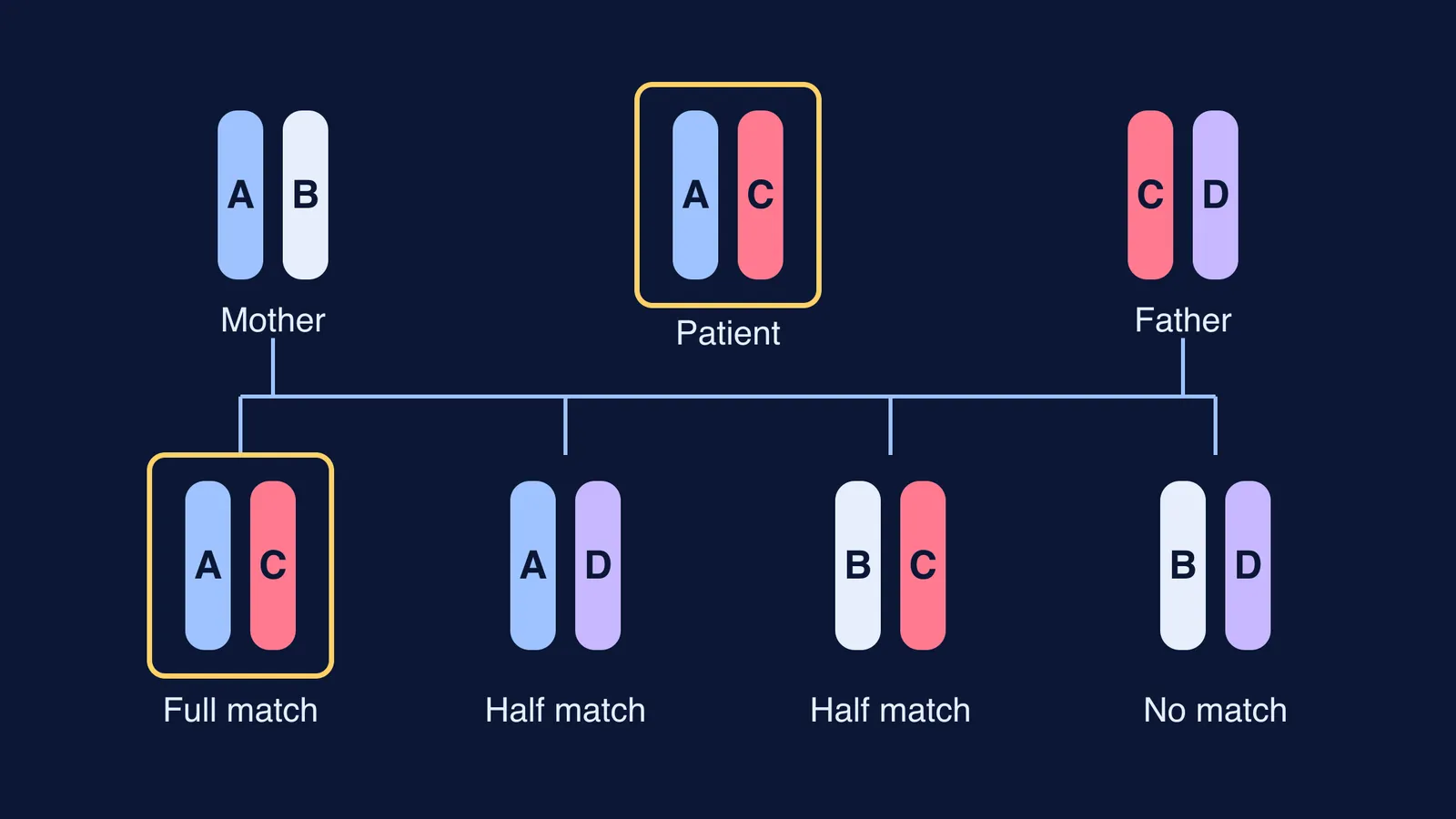
You inherit half of your HLA from your mother and half from your father. Each brother or sister with the same parents has a 25% chance (1 in 4) of being a full HLA match, according to the NMDP. The diagram above shows why. If your mother carries sets A and B, your father carries C and D, and you got A and C, a sibling can get AC, AD, BC or BD. Each is equally likely; only AC matches you completely.
Worked example: each sibling is an independent draw with a 3/4 chance of not matching.
One sibling: chance of a match = 1/4 = 25%.
Two siblings: 1 − (3/4)² = 7/16, about 44%.
Three siblings: 1 − (3/4)³ = 37/64, about 58%.
This is why unrelated donor registries matter. The NMDP says about 70% of patients who need a transplant won't have a fully matched donor in their immediate family.
What can students learn from Thomas?
Name the real obstacle. The hard part was stopping graft and host attacking each other.
Practise on a model first. Years of dog studies came before reliable human results.
Borrow from other fields. Tissue typing came from other labs, and his team used it.
Record your failures. The 1977 paper reported deaths and relapses alongside the 13 survivors.
If HLA immunology is where you are stuck, the Fermi Concept Library gives every biology concept its own lesson and its place in the map. To practise probability problems like this one, the Fermi Problem Library has worked problems with a step-by-step solver that explains the reasoning.