

On this page
An engineer presses a small probe on one face of a concrete column and a second probe on the opposite face, 300 mm away. A box between them beeps and shows 70 µs. That number says the concrete is sound. If the same test on another column reads 95 µs, the engineer marks it for a closer look. Nothing was drilled or broken. This is the ultrasonic pulse velocity test, which looks inside concrete with sound.
How does the ultrasonic pulse velocity test work?
One probe, the transmitter, turns an electrical pulse into a short burst of ultrasound. The other probe, the receiver, picks it up on the far side. The instrument measures the transit time t, and you know the path length L, so
v = L / t
The old Indian Standard for this test, IS 13311 (Part 1): 1992, describes the method. It says:
The transducers should work between 20 kHz and 150 kHz, and 50 to 60 kHz ones suit most structural work.
A couplant such as petroleum jelly, grease or liquid soap fills the gap between the probe and the concrete, because even a thin layer of air would block the pulse.
The receiver times the first arrival, which is the longitudinal (compression) wave, because it is the fastest of the waves that the pulse sets up.
Probes on opposite faces is called direct or cross probing, the arrangement the grading table below is written for.
Why does sound travel faster in better concrete?
A longitudinal wave in a solid travels faster when the material is stiffer and slower when it is denser, roughly as √(E/ρ). Why stiffness and density enter this way is explained in why sound travels fastest in solids, so we take that as known.
For concrete, stiffness wins. Well-compacted, well-cured concrete has few air pockets and a stiff, continuous skeleton of cement paste and stone, so its pulse velocity is high. Poorly compacted or honeycombed concrete has voids that lower its stiffness much more than its density, so the pulse slows down.
A crack or void does something else as well. The pulse cannot cross the air gap, so the first signal to arrive is the one that went round it. The path is longer, the time is longer, and the instrument, which divides the straight-line distance by that time, reports a lower velocity. IS 13311 states both effects.
What pulse velocity counts as good concrete?
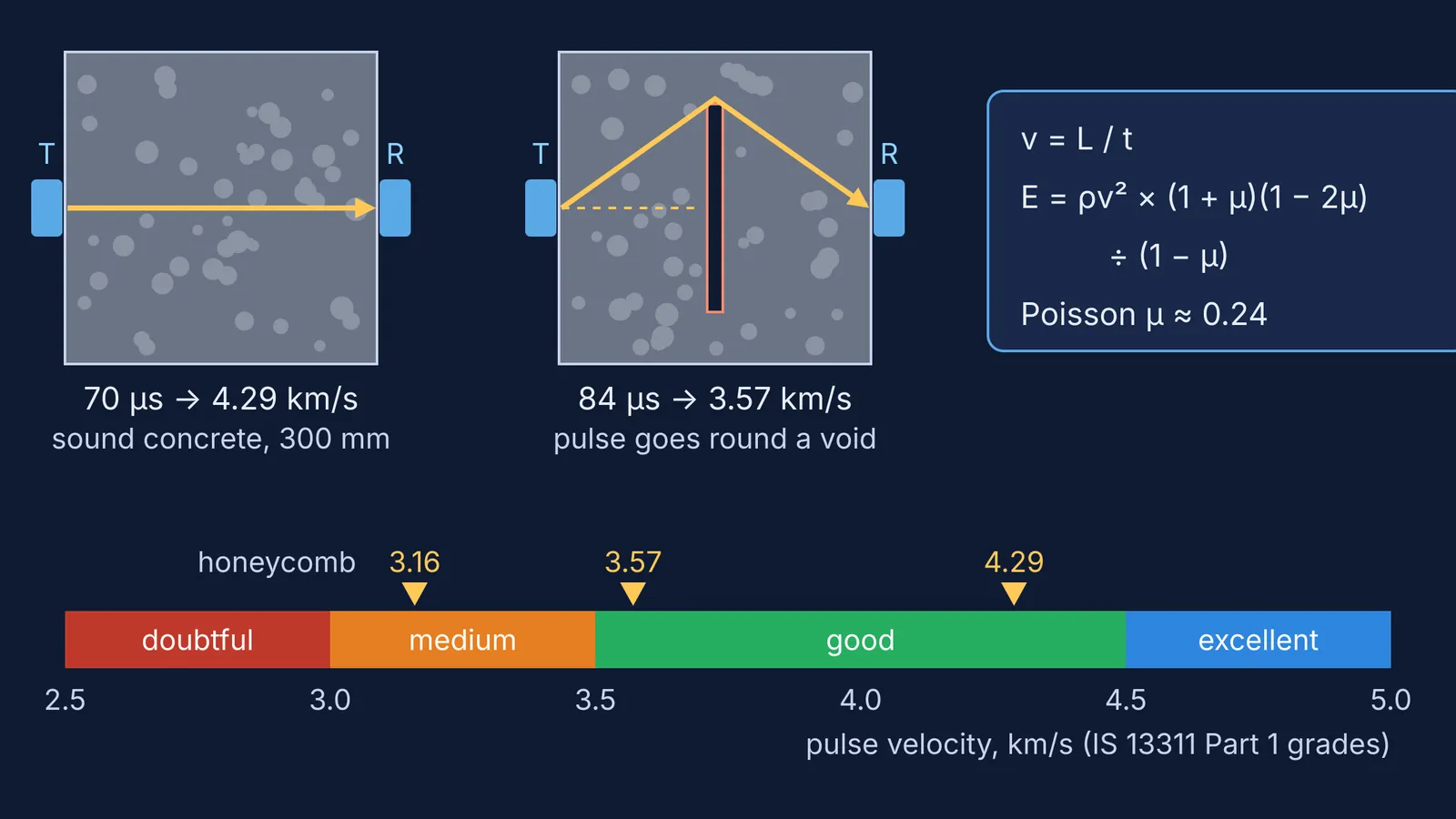
IS 13311 (Part 1) gives this grading for cross probing:
Above 4.5 km/s: excellent
3.5 to 4.5 km/s: good
3.0 to 3.5 km/s: medium
Below 3.0 km/s: doubtful, and further tests are needed
This 1992 standard has been withdrawn. The Bureau of Indian Standards lists it as superseded by IS 516 (Part 5/Sec 1): 2018, so an engineer today should take the grading from that standard's current text. The older table is still widely quoted and is fine for the physics. Even the 1992 standard warns that such a table is a general guide only. Comparing readings from different parts of the same structure, built with the same materials at the same time, is more meaningful than a single number.
Worked example: a sound column, a hidden void and a weak patch
Take a column 300 mm thick and ρ = 2,400 kg/m³ (a typical round value for normal concrete). All three readings are illustrative.
Sound column, 70 µs. v = 0.300 m / (70 × 10⁻⁶ s) = 4,286 m/s = 4.29 km/s. That is in the "good" band.
Modulus from the speed. ρv² = 2,400 × 4,286² = 4.41 × 10¹⁰ Pa = 44 GPa. This is not yet Young's modulus (see the next section).
A hidden flat void, 200 mm wide, across the middle of the path. The fastest route goes round its edge: two straight legs from each probe to the edge, each √(150² + 100²) = 180.3 mm, so 360.6 mm in total. At 4,286 m/s that takes 84.1 µs. The instrument still divides 300 mm by the time and shows 3.57 km/s.
Read it the right way. 3.57 km/s is still "good" on the table. But the neighbouring readings on the same column are 4.29 km/s, and this one is 17% lower. That drop, not the band, is what tells the engineer something is inside.
Honeycombed patch, 95 µs. v = 0.300 / (95 × 10⁻⁶) = 3,158 m/s = 3.16 km/s: "medium". The concrete itself is poorer here, not just the path longer.
The wavelength at 54 kHz in the sound concrete is 4,286 / 54,000 = 0.079 m, about 8 cm. A flaw much smaller than that barely changes the first arrival, so this test finds voids and cracks, not pinholes. For the opposite approach, timing echoes that bounce back to the same probe, see how an ultrasound scan makes a picture from echoes.
Why is v = √(E/ρ) not quite right for a concrete block?
The rod formula v = √(E/ρ) is for a thin bar, which is free to bulge sideways as it is squeezed. A wide block cannot bulge freely, so it acts stiffer and the pulse goes faster. IS 13311 gives the correction through the dynamic Poisson's ratio μ:
E = ρv² × (1 + μ)(1 − 2μ) / (1 − μ)
The standard says μ for concrete lies between 0.20 and 0.35, with 0.24 as an average.
With μ = 0.24 the factor is 1.24 × 0.52 / 0.76 = 0.848. So E = 0.848 × 44.1 GPa = 37 GPa. With μ = 0.20 the factor is 0.900 and E = 40 GPa. The pulse in a wide block is faster than in a thin rod of the same concrete by 1/√0.848 = 1.086, about 9%. Keep the rod formula for the idea and this as the correction.
Can pulse velocity tell you the strength of concrete?
Not directly. Strength depends on the mix, the stone and the curing, and two concretes with the same pulse velocity can have different strengths. IS 13311 says a strength estimate needs a correlation built from test specimens of the same materials and mix, and even then it may differ from the true strength by about ±20%.
Two more things change readings. Steel bars along the path carry the pulse 1.2 to 1.9 times faster than concrete, according to the standard, so a reading taken along a bar can look falsely good. Wet concrete also reads slightly higher than dry. How steel came to sit inside concrete at all is the story of Joseph Monier and reinforced concrete.
If you want to see how a wave's speed depends on the medium, the Simulation Lab has interactive simulations for ideas easier to see than read.
Quick checklist
v = L/t with L the straight path between probes and t the first-arrival time.
Stiffer, denser, well-compacted concrete gives a higher pulse velocity.
A void lengthens the real path, so the reported velocity drops.
IS 13311 (1992) bands: above 4.5 excellent, 3.5–4.5 good, 3.0–3.5 medium, below 3.0 doubtful (km/s); now superseded by IS 516 (Part 5/Sec 1): 2018.
Block correction: E = ρv²(1 + μ)(1 − 2μ)/(1 − μ), with μ about 0.24.
Pulse velocity gives quality, not strength, unless calibrated for that mix.


