

On this page
In 1846 Joseph Monier, a gardener born in 1823, took a post at the Tuileries Gardens beside the Louvre in Paris, where he ran the orangery and began looking for a more durable container for the orange trees (Wikipedia: Joseph Monier). Clay pots broke easily, and wooden tubs were damaged by weather and plant roots (EBSCO Research Starters). His answer was a concrete tub with iron mesh inside.
What did Joseph Monier patent in 1867?
On 16 July 1867 Monier received his first patent, for iron-reinforced concrete troughs used in horticulture, and he showed the invention at the Paris Exposition that same year (EBSCO Research Starters). The trick was not thicker walls: Monier used iron mesh to strengthen the material without the weight of extra concrete, according to the same source.
His later patents covered iron-reinforced concrete pipes and basins (1868), panels for building façades (1869), bridges (1873) and beams (1878) (Wikipedia: Joseph Monier). In 1875 the first reinforced concrete bridge on his system was built at the Castle of Chazelet (Grace's Guide).
He was not the first to try: Joseph-Louis Lambot had made iron-and-concrete water tanks in 1841 and a boat in 1848 (Grace's Guide).
Why does concrete need iron or steel inside it?
Concrete is good at being squeezed and poor at being stretched. The tensile strength of concrete is about 10% of its compressive strength, according to the American Concrete Institute. Typical plain concrete resists a compressive stress of about 28 MPa (4,000 psi), but any appreciable tension breaks it (Wikipedia: Reinforced concrete).
Iron and steel are the opposite: a thin bar can take a large pull. Two more facts keep the partnership together. Hardened cement paste grips the surface of the steel, so stress passes from one material to the other, and concrete and steel expand by similar amounts when heated, so temperature changes do not set up large internal stresses (Wikipedia: Reinforced concrete).
For background, see why stress is an internal restoring force and how cement hardens.
Where does a concrete beam crack first?
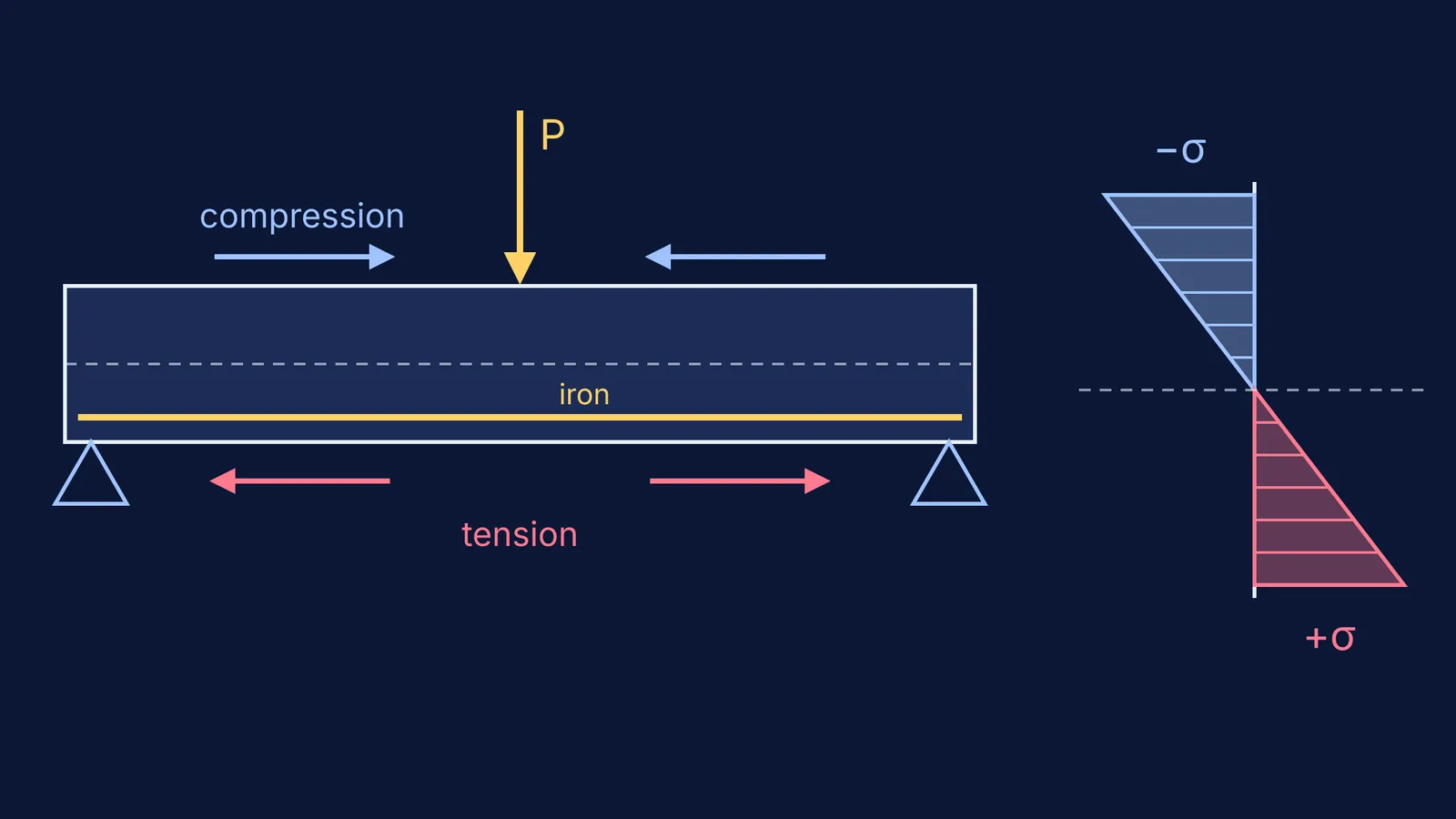
Take a plain concrete beam 3 m long, resting on supports at its ends (reactions on a beam with two supports), 0.2 m wide and 0.3 m deep, with a load P at the middle; ignore the beam's own weight. The beam sags: its top face shortens (compression) and its bottom face lengthens (tension).
Largest bending moment, at mid-span: M = PL/4 = 0.75P, in N·m with P in newtons.
Section modulus of the rectangle: Z = bh²/6 = (0.2 × 0.3²)/6 = 0.003 m³.
Bending stress on the top and bottom faces: σ = M/Z, equal in size and opposite in sign.
Tensile strength, using the ACI rule of thumb and the 28 MPa figure above: roughly 0.10 × 28 = 2.8 MPa.
The bottom cracks when M/Z = 2.8 × 10⁶ Pa, so M = 8,400 N·m and P = 8,400/0.75 = 11,200 N.
That is roughly the weight of 1,140 kg. The top face is then at 2.8 MPa too, a tenth of what concrete can take in compression, so the beam fails from the bottom with most of the top's strength unused. Put iron near the bottom and, once the concrete there cracks, the metal carries the tension; engineers call this "tension steel" (Wikipedia: Reinforced concrete). Monier's tubs are the same story bent into a circle: soil and roots push outward and stretch the wall around its circumference.
What happened to Monier's idea after the flower pots?
The German engineer Gustav Adolf Wayss had obtained all of Monier's patent rights by 1887, and between 1887 and 1899 his company built 320 bridges across Europe (EBSCO Research Starters). The French engineer François Hennebique saw Monier's troughs and basins at the 1867 exposition and patented his own reinforced concrete method in 1892, according to the same source. Monier himself died in poverty on 13 March 1906, aged 82, the same source records.
How can you use Monier's idea in physics problems?
When a question involves something bending, run this checklist:
Sketch the bent shape, exaggerated, and mark the face that gets longer: that face is in tension.
Ask how strong the material is in tension, not just compression.
Find the largest bending moment: mid-span for a central load, the fixed end for a cantilever such as a balcony, where the top face is stretched and the steel belongs on top.
Compare σ = M/Z on each face with the material's strength in that direction.
If bending is hard to picture, the Fermi Simulation Lab has interactive simulations for ideas that are easier to see than to read, and the Fermi Concept Library gives stress, strain and elasticity each their own lesson.
Next time you pass a building site, look at which face of each slab the steel bars sit nearest: a gardener's idea from 1867, still at work.


