

On this page
If you have ever watched a construction crew pour a driveway or lay a foundation, you might have noticed them doing something that seems backwards: after pouring the wet concrete, they deliberately spray it with more water for days, or cover it with wet blankets.
Why soak something you want to dry out?
The answer lies in the chemistry of cement. Concrete does not harden by "drying out" like mud baking in the sun. Instead, it cures through a complex chemical reaction called hydration. If the water evaporates before that reaction finishes, the concrete stops gaining strength and remains permanently weak.
Why does cement need water to harden?
Portland cement, the fine grey powder that binds concrete together, is packed with calcium and silica compounds. When you mix this dry powder with water, it triggers an exothermic (heat-releasing) chemical reaction.
Water is not just a lubricant to make the concrete pourable; it is an active chemical reactant. The compounds in the cement break down and react with the water molecules to form entirely new structures.
Calcium Silicate Hydrate (C-S-H) gel makes up the vast majority of the volume of the fully hydrated paste.
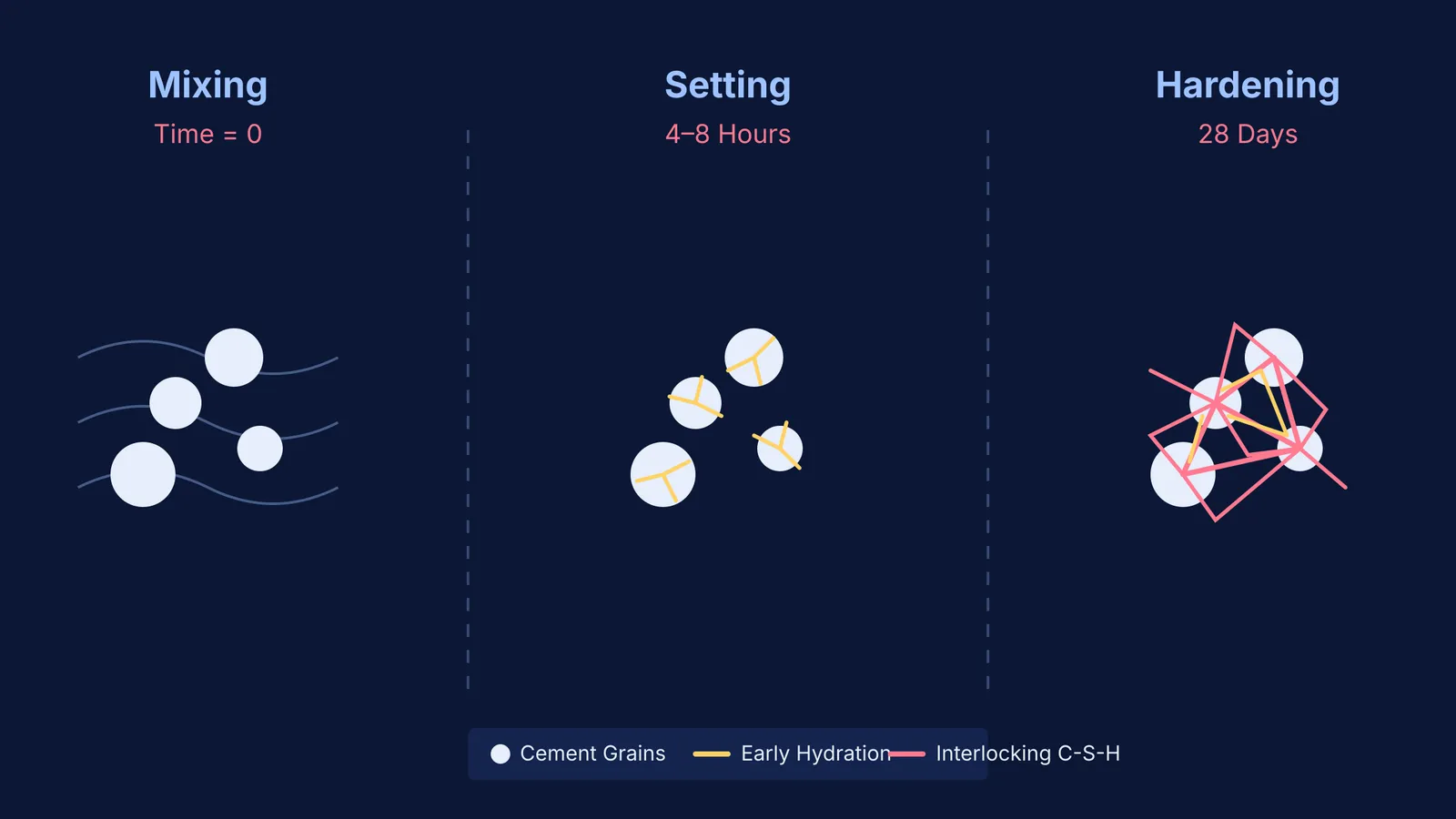
If you were to look at C-S-H under an electron microscope, it does not look like a solid block. It looks like millions of tiny, spiky fibres. As the chemical reaction continues, these fibres grow outward from each grain of cement, branching and interlocking with the fibres from neighbouring grains. This dense, fibrous network acts as the "glue" that locks the sand and gravel together, giving concrete its immense compressive strength.
How does cement harden and why is it watered for days?
Because water is the fuel for this crystal-growing process, keeping the concrete wet is essential. This practice is known as curing.
The chemical reactions of hydration are not instantaneous. While the concrete might feel solid to the touch within a few hours (the "initial set"), the C-S-H crystals are still very small. Over the next days and weeks, they continue to grow and interlock, provided they have enough moisture.
If the internal moisture of the concrete drops too low, the hydration process effectively stops. When hydration stops, the crystal growth halts, and the concrete never reaches its potential strength.
This is why crews spray concrete with water, cover it with wet burlap, or apply chemical curing compounds to seal the moisture inside.
Concrete that is continuously moist-cured for seven days is significantly stronger than concrete allowed to air-dry (source).
The compounds that build strength
The compounds in cement react at different speeds, which is why concrete has both an early set and a long-term hardening phase:
Tricalcium Silicate (C₃S): This compound reacts quickly with water, producing C-S-H gel rapidly. It is primarily responsible for the concrete's initial set and its strength gain over the first seven days (source).
Dicalcium Silicate (C₂S): This compound reacts much more slowly. It provides the concrete with its long-term strength, continuing to hydrate and strengthen the material for weeks, months, or even years after the pour.
If you are struggling to picture how these microscopic fibres branch out and connect across a gap, the Fermi Simulation Lab has interactive 3D models where you can watch crystal networks grow and see how temperature and moisture change the final structure.
Why 28 days?
In the construction industry, concrete is typically tested for its "design strength" at 28 days. This does not mean the concrete stops hardening on day 29.
Because solids are reacting to form new structures—similar to heterogeneous equilibria where solids dictate the active mass—the reaction continues as long as unreacted cement and water remain in contact.
However, by day 28, a properly cured slab will have achieved nearly all of its engineered strength (source). The vast majority of the C-S-H interlocking has already happened. The remaining hydration will continue for years at a microscopic crawl, making the concrete slightly harder as time goes on, but the critical window is those first few days when the water must be protected at all costs.
A quick checklist for pouring concrete at home
If you are laying concrete for a patio or setting a fence post, you can apply this chemistry to get a professional result:
Finish first, water second: Wait until the surface has lost its wet sheen and is hard enough not to be marked by a light touch.
Apply water gently: Use a fine mist or a sprinkler setting; a hard jet will wash the cement cream off the surface.
Trap the moisture: Once wet, cover the concrete with plastic sheeting or wet burlap to stop the sun and wind from stealing the water.
Wait a full week: Keep the covering in place and re-wet it if it dries out. Do not put heavy loads on the slab until this week is up.


