

On this page
It is easy to confuse the two because they share the same mathematical formula (F/A) and the same SI unit, the pascal (Pa or N/m²). However, they describe fundamentally different physical concepts.
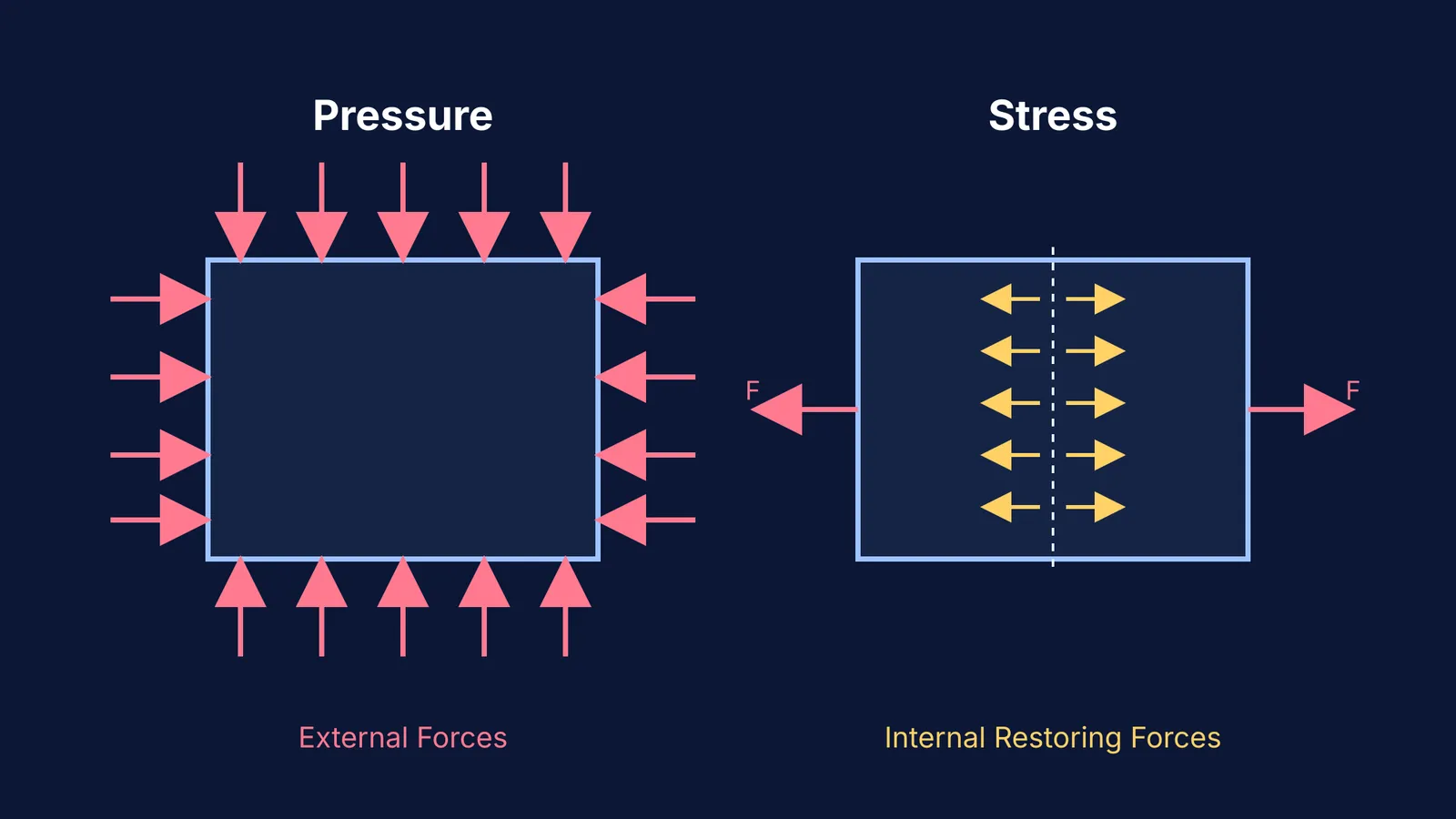
Pressure is an external force that acts perpendicularly on the surface of an object or fluid. Stress, by contrast, is the internal restoring force generated within a solid material when it is deformed. As defined by the open-source textbook *University Physics*, "[s]tress is a quantity that describes the magnitude of forces that cause deformation" (OpenStax).
When you push down on a block of steel, you are applying pressure to its surface. The atoms inside the steel push back against each other to resist being crushed. That internal resistance—the force neighbouring particles exert on one another—is the stress (Wikipedia)).
What is the difference between stress and pressure?
Beyond the distinction of external versus internal forces, stress and pressure behave differently in physics equations and real-world applications.
Directionality. Pressure is a scalar quantity. In a fluid at rest, it pushes equally in all directions, and on a solid surface, it always acts perfectly perpendicularly (normal to the surface). Stress is a more complex tensor quantity. Because the internal forces inside a solid do not have to be perpendicular to the surface, the state of stress depends entirely on the orientation of the cross-section you are measuring.
State of matter. We most commonly use pressure to describe fluids (liquids and gases) at rest, where molecules are free to move. Stress is the standard term in continuum mechanics for solids, where atomic bonds hold the structure together.
Types of forces. Pressure is essentially always a compressive force (it pushes inward on a boundary). Stress can pull, push or slide.
Understanding the difference between an external push and an internal reaction is a core mechanics skill. It is similar to calculating the contact force between blocks pushed together on a smooth floor: you have to look at the boundaries where the masses interact to find the internal forces.
If you find yourself guessing the signs or directions of forces in free-body diagrams, it might be a sign of a concept gap. The Fermi Concept Library maps out the relationship between applied forces and internal resistance, letting you trace how Newton's laws apply inside a solid object.
What are the three types of stress?
Because stress is a reaction to external forces, it takes different forms depending on how the material is being deformed. *University Physics* classifies stress into three main types based on the direction of the deforming force (OpenStax):
Tensile stress: Occurs when equal and opposite forces pull on an object, causing it to elongate. Stretching a rubber band or hanging a heavy weight from a steel cable creates tensile stress.
Compressive stress: Occurs when forces push inward on an object, causing it to contract or shorten. The concrete pillars supporting a heavy bridge are under constant compressive stress.
Shear stress: Occurs when forces act parallel (tangentially) to an object's cross-section, causing layers of the material to slide past one another. A pair of scissors cutting through paper or a heavy book sliding across a table applies shear stress.
How do you solve stress and strain problems?
In exams like the JEE and NEET, stress is rarely calculated in isolation. It is usually paired with strain (the fractional change in size or shape) to find the elastic modulus of a material using Hooke's Law.
For example, calculating the elastic potential energy in a stretched wire requires integrating the tensile stress over its extension. Similarly, finding the elongation of a rod stretching under its own weight requires you to account for how the internal restoring force changes at different cross-sections.
Use this checklist when setting up a mechanics problem involving elastic materials:
Identify the force. Is the external force pulling (tension), pushing (compression) or sliding (shear)? This tells you which elastic modulus to use (Young's, Bulk or Shear modulus).
Find the correct area. For tensile and compressive stress, use the cross-sectional area perpendicular to the force. For shear stress, use the surface area parallel to the force.
Equate the forces. In equilibrium, the magnitude of the internal restoring force equals the magnitude of the applied external force. You can safely calculate the stress by plugging the external force into σ = F/A.
If you keep getting the wrong area or modulus in your homework, try working through the Fermi Problem Library. Instead of just printing the final answer, its step-by-step solver explains the reasoning behind each step, so you learn to spot whether a force is acting normal or parallel to a surface.


