

On this page
Olive ridley turtles come ashore on Odisha's beaches to bury their eggs in the sand (here is the science of olive ridley arribada nesting). Whether those hatchlings turn out male or female is decided by the warmth of the sand, not by chromosomes. That surprises students who learnt sex determination types XO, XY and ZW first.
What is temperature-dependent sex determination?
In many egg-laying reptiles, the first steps in turning the gonad into a testis or an ovary depend on the temperature at which the egg is incubated, as Pieau and Dorizzi summarise in a 2004 review in the Journal of Endocrinology.
The pivotal temperature is the constant temperature that produces both sexes in equal numbers, and the transitional range of temperatures (TRT) is the range that produces both sexes in variable proportions, as defined in a 2020 PeerJ study of olive ridley turtles.
In sea turtles, warmer nests produce females, which is why NOAA Fisheries reports warming beaches turning a turtle population female. In the red-eared slider, a freshwater turtle, 31 °C is a female-producing temperature and 26 °C a male-producing one, according to Matsumoto and colleagues in PLoS One.
How does aromatase turn a warm egg female?
Aromatase is the enzyme that converts androgens, the hormones of male development, into oestrogens, as MedlinePlus Genetics explains. One route to the oestrogen oestradiol is the direct aromatisation of testosterone, as a 2016 Journal of Molecular Endocrinology review puts it.
Temperature turns this enzyme up or down in the developing gonad. In red-eared slider embryos, the aromatase gene is strongly expressed at 31 °C and weakly at 26 °C, and its promoter carries less DNA methylation at the warm temperature (Matsumoto et al., 2013). So warm gonads make more aromatase, turn more testosterone into oestradiol, and develop as ovaries.
Experiments that override the thermometer back this up:
Oestradiol added to an egg at a male-producing temperature redirects it to female (Ramsey and Crews, 2008).
An aromatase inhibitor added at a female-producing temperature redirects it to male (same review).
Fadrozole, an aromatase inhibitor, induced male development in red-eared slider embryos (Wibbels and Crews, 1994).
Switches sit higher up too. In the red-eared slider, the gene KDM6B activates the male pathway (Ge et al., Science, 2018), and at warm temperatures calcium entering gonad cells leads a protein called pSTAT3 to silence it (Weber et al., Science, 2020).
If hormone pathways are where you lose the thread, the Fermi Concept Library gives every biology and chemistry concept its own lesson and its place in the map, so you can see how enzymes, hormones and genes connect. For hormones steering sex in adults, see how clownfish change sex from male to female.
How do you read a pivotal-temperature graph?
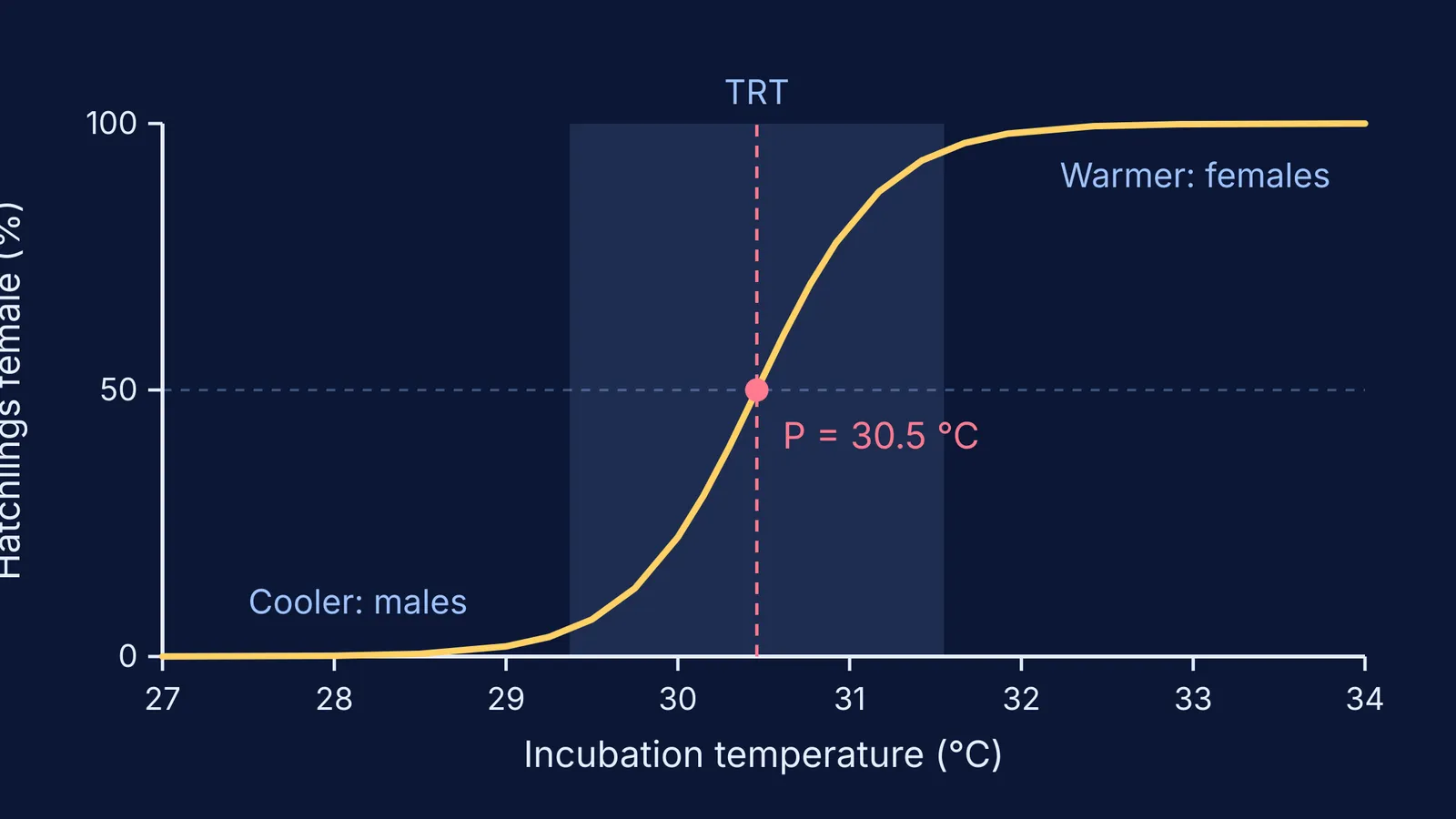
The graph above plots the share of female hatchlings against incubation temperature for East Pacific olive ridleys. It uses the logistic model in the 2020 PeerJ study, with a pivotal temperature of 30.46 °C and a slope parameter of −0.37. The same paper gives a median TRT of 2.19 °C for this population.
Read it in four steps:
Find where the curve crosses 50% and drop to the x-axis: that is the pivotal temperature, about 30.5 °C.
Find where the curve leaves 5% and reaches 95%: that span is the TRT, here roughly 29.4 °C to 31.5 °C.
Judge the slope. A steep curve means a narrow TRT, so a small temperature change swings the sex ratio a long way.
Check which sex is plotted. Many papers plot the male fraction, so their curve falls instead of rising.
Worked example: put 30 °C and 31 °C into the model. At 30 °C about 22% of hatchlings come out female; at 31 °C about 81% do. One degree moves the population from mostly male to mostly female.
Populations differ: the same study estimated 29.49 °C for olive ridleys in Northeast India, though with a very uncertain slope (Abreu-Grobois et al., 2020). And these curves use constant lab temperatures, while real nests warm and cool through the day.
Why does a warming beach matter for turtles?
If warm sand makes females, a hotter climate can tilt whole populations. In a study of green turtles on Australia's Great Barrier Reef (Jensen et al., Current Biology, 2018), turtles from the northern nesting beaches were 99.1% female among juveniles, 99.8% among sub-adults and 86.8% among adults. Turtles from southern beaches were about 65 to 69% female (NOAA Fisheries).
Read those percentages from oldest turtles to youngest and the pattern fits the curve: as the sand warmed, fewer males appear to have hatched.
Try sketching the curve again with the pivotal temperature one degree higher, and see how the 30 °C answer changes. Ideas like this are easier to see than to read, which is what the Fermi Simulation Lab is for.


